


Why One Sleep Aid Does Not Fit Every Insomnia Pattern: A Guide to Better Questions
SleepScript MD Insights Team · November 2, 2026 · 15 min read

📌 Key Takeaways
Sleep patterns help frame prescription discussions, but choosing an appropriate sleep aid requires a physician’s review of symptoms, health history, current medications, and safety factors.
- Insomnia Patterns Describe Different Problems: Sleep-onset insomnia involves difficulty falling asleep, sleep-maintenance insomnia involves difficulty staying asleep, and mixed insomnia combines both complaints.
- Repeated Symptoms Provide Useful Context: Recurring sleep difficulties, their frequency, and next-day effects give physicians more useful information than a single rough night.
- Medication Education Does Not Prescribe: SleepScriptMD’s Medication Education Center explains options, but reading about a medicine does not establish eligibility or determine an appropriate prescription.
- Breathing Symptoms Require Testing: SleepScriptMD requires an at-home sleep test and physician review of results before prescribing medication when snoring, gasping, or breathing pauses are reported.
- Prescription Approval Remains Conditional: SleepScriptMD’s text-based process includes physician review, may require a virtual visit in some states, and does not guarantee a prescription.
For adults considering prescription help for insomnia, a sleep diary can organize observations and questions for a physician while keeping daytime effects and other symptoms visible.
A clearer description of the night gives a physician more useful information than a preferred drug name alone.
~ ~ ~ ~ ~ ~ ~ ~ ~ ~ ~ ~ ~ ~ ~ ~ ~ ~
Start With Where Your Night Breaks Down
The house has gone completely quiet.
At 3:10 a.m., the bedside clock glows in the dark, and you count the hours to your alarm again. Three hours and twenty minutes, if sleep comes back right now. You flip the pillow to the cool side. It doesn't help.
You've had enough nights like this to recognize the routine. Some nights, sleep never quite starts. Other nights, it starts easily and then falls apart in the small hours. Eventually you reach for your phone and type in the name of a sleep medication, hoping one pill will fix whatever kind of night this is.
There is a more useful place to begin.
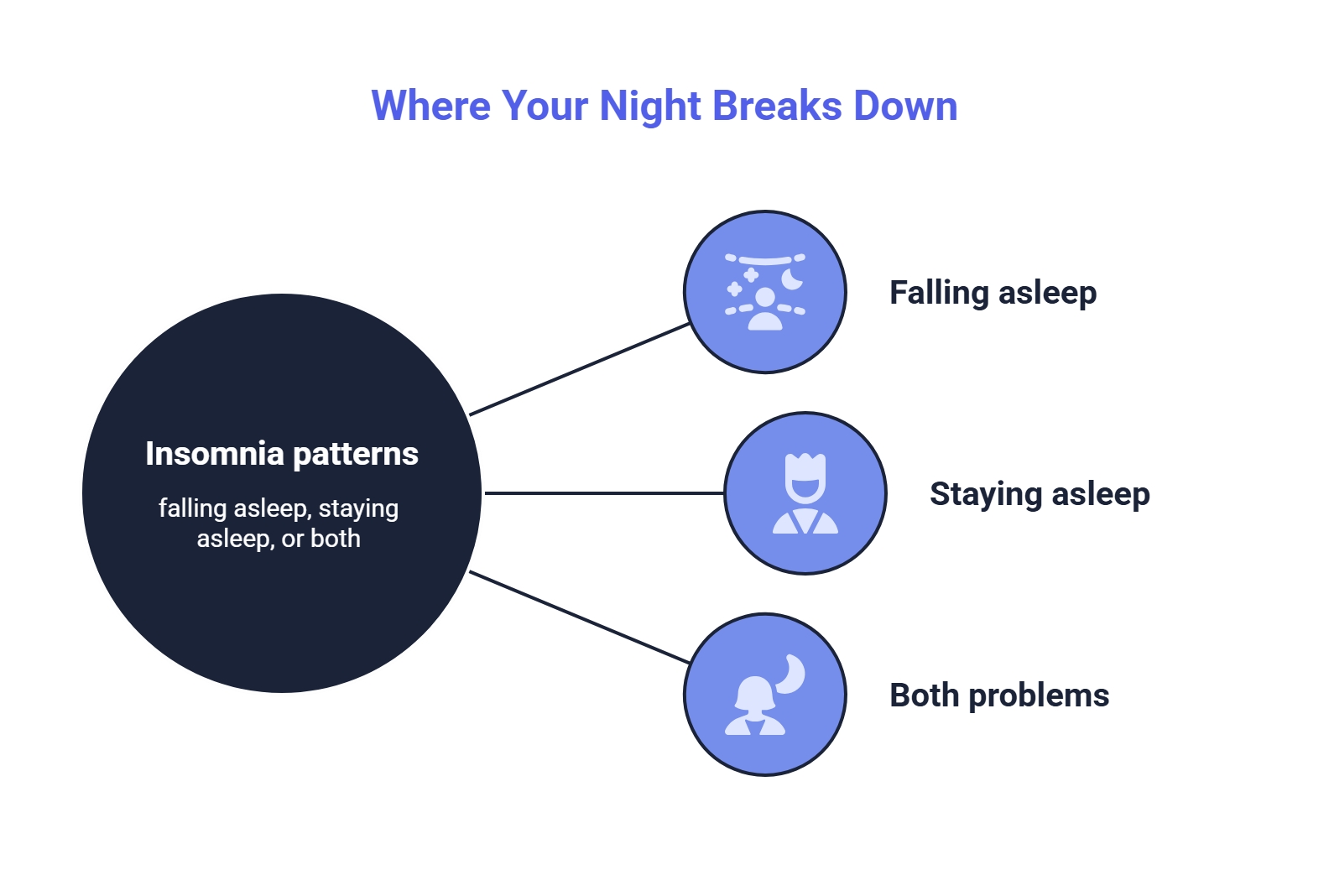
Trouble falling asleep, waking during the night, and dealing with both problems are different ways insomnia can show up. Naming the pattern can make a medication conversation more useful, but it does not tell you which prescription is right for you. Medication choice still depends on a physician reviewing your history, current medications, symptoms, and safety factors.
That idea is the foundation of sleep-pattern matching for prescription sleep aids. You describe whether your main complaint is falling asleep, staying asleep, or both. A physician then uses that description, along with your health information, to decide whether a non-controlled prescription is appropriate. The pattern informs the decision. It does not make it.
Think of it as a route map. Before anyone can plan a way forward, you have to mark where the trip keeps going wrong: at the start of the night, somewhere in the middle, or in both places. That 3:10 a.m. clock check is one of those marks. It tells you that falling asleep wasn't the problem that night, and that staying asleep was.
So before you read about any medication, change the question you are asking. Most people start with "Which sleep aid should I take?" A more useful first question is "Where does my night consistently break down?" Answer that, and every conversation that follows becomes clearer.
Sleep-Onset, Sleep-Maintenance, and Mixed Insomnia Are Different Questions
Insomnia is not one uniform experience. Federal health guidance describes it as symptoms that can vary from person to person, with some people lying awake for a long time before falling asleep, and the National Heart, Lung, and Blood Institute recognizes trouble falling asleep, staying asleep, or both as its core forms. Those three forms map onto three plain-English descriptions.
Sleep-onset insomnia describes difficulty getting to sleep. You may feel tired when you get into bed, yet the lamp is off and sleep still has not arrived. You may replay a conversation from work or shift positions every few minutes. The main struggle is the move from awake to asleep.
Sleep-maintenance insomnia describes difficulty staying asleep after sleep has begun. Falling asleep may come easily, but you wake in the night and struggle to settle back down. For some people that means several wakings; for others, it means one long stretch awake or waking earlier than intended and never getting back to sleep. Waking at one particular time does not point to a specific disorder. The repetition is what matters.
Mixed insomnia combines both complaints. Bedtime is a struggle, and so is staying asleep. In some weeks one problem dominates, and in other weeks the balance shifts. A mixed pattern does not automatically mean a more serious problem, but it does show most clearly why "one symptom, one pill" thinking falls short.
A common pitfall is treating one rough night as a pattern. Brief wakings are a normal part of sleep; they matter when they keep happening, disrupt your night, or affect your day. Clinicians generally look at how often sleep trouble occurs and how long it has lasted. For example, the NHLBI defines chronic insomnia as sleep trouble occurring three or more nights a week for more than three months, when another health problem cannot fully explain it. You don't need to diagnose yourself against that definition. Just remember that a pattern takes several weeks to show itself.
How you feel the next day belongs in your description as well. Morning grogginess, a slow afternoon, or rereading the same email twice are all useful details for a physician. On their own, though, they do not point to a particular medication.
Your One-Page Sleep-Pattern Description Chart
Pattern | Plain-English description | What to notice | Better question to ask |
Sleep-onset insomnia | Trouble getting to sleep | What happens after you turn off the light and intend to sleep, and whether long stretches of bedtime wakefulness keep returning | "What details about my trouble falling asleep matter when a physician considers medication?" |
Sleep-maintenance insomnia | Sleep begins, but waking becomes the main problem | When you wake, how often the pattern repeats, and how the following day feels | "How should I describe repeated nighttime waking when discussing prescription options?" |
Mixed insomnia | Both falling asleep and staying asleep are real problems | Which issue disrupts you more, whether the balance changes from week to week, and daytime effects | "How does having both problems change the questions a physician needs to ask?" |
This chart is educational. An insomnia pattern does not establish a diagnosis or determine which medication is appropriate. Medication decisions depend on physician review of your individual situation.
Why Asking for a Drug Name First Can Skip the Most Useful Information
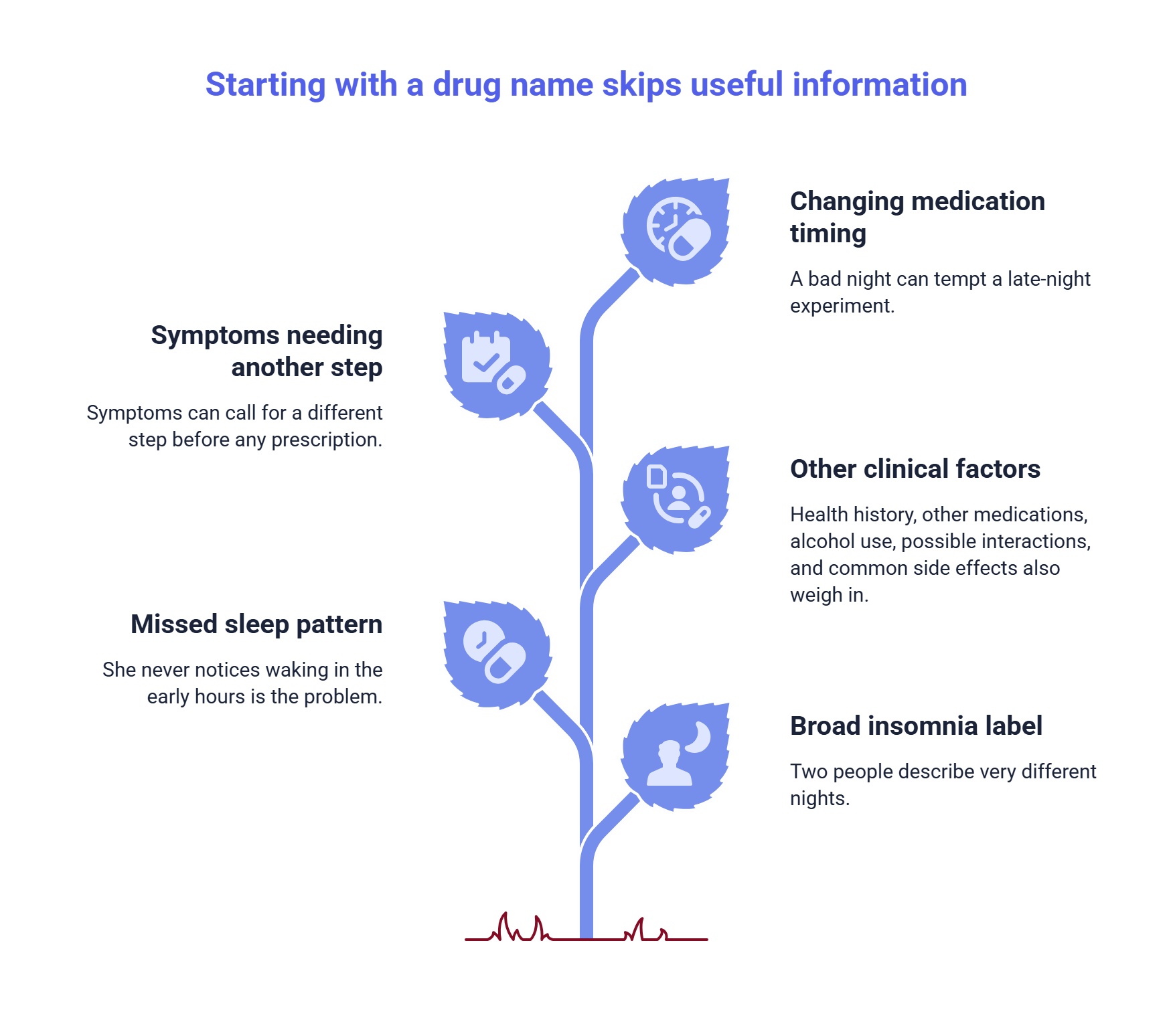
A sleep-pattern label does not establish which medication suits you. That is exactly why starting with a drug name can leave out the information that matters most.
The impulse makes sense. When you're exhausted, a medication name feels like an answer. You can search it, read about it, and ask for it by name. The trouble is that "insomnia" is a broad word. Two people can use it while describing very different nights. One lies awake until after midnight. The other falls asleep at 10:30 and is wide awake by 2:45.
Here is an illustrative example. Picture an account manager with an important 9 a.m. presentation and a week of broken sleep behind her. At midnight, she reads about three different sleep medicines, trying to decide which one sounds right. She never notices that falling asleep isn't her problem, and that waking in the early hours is. By morning, she has a head full of drug names and still no clear way to describe what is actually going wrong.
Sometimes the missing piece isn't a different medication. It's a clearer description of the night.
Your pattern is also only one part of what a prescriber weighs. Physicians generally consider health history, other medications, alcohol use, possible interactions, and common side effects alongside the sleep complaint itself. They also watch for symptoms that call for a different step before any prescription. Alongside clinical evaluation, evidence-based practices like Cognitive Behavioral Therapy for Insomnia (CBT-I)—which addresses stimulus control and behavioral cycles—offer supportive tools that can work in tandem with medical care to reset disruptive sleep routines. That is why two people with the same pattern can end up discussing different options, or no prescription at all.
One more temptation deserves attention. If you already take a sleep medication, it can be tempting to shift when you take it after a bad night. Medication timing is a question for your prescriber, not a late-night experiment.
Better Questions to Ask About Your Insomnia Pattern
Good questions turn a frustrating night into usable information. The questions below are for gathering details, not for diagnosing yourself. The NHLBI suggests keeping a sleep diary of your symptoms and sharing those notes with a healthcare professional. A few lines per night are enough: when you went to bed, whether falling asleep was hard, whether you woke, and how alert you felt the next day. Write your notes in the morning rather than at 3 a.m., when watching the clock can make wakeful stretches feel longer.
Is the hardest part getting to sleep, staying asleep, or both?
Think back over the last two weeks. Which part of the night caused the most trouble? If the answer changes from week to week, write that down too, because shifting answers can point toward a mixed pattern.
When you wake during the night, what does it look like?
Note roughly when you wake, how many times it happens, and about how long it takes to settle again. It also helps to say whether you drift back off quickly or become fully alert. Describe what you notice in your own words. Racing thoughts, lying alert in the dark, or getting up for the bathroom are all worth recording. A physician can work with plain language. You don't need clinical terms.
What happens the next day?
Pay attention to the morning and afternoon. Grogginess when the alarm sounds, trouble concentrating, or dozing at your desk after lunch are all relevant. If you already take a sleep medication, mention any morning grogginess so your prescriber can tell whether it comes from poor sleep or the medicine. One caution applies here. Daytime tiredness helps describe your situation, but it does not by itself confirm insomnia, establish eligibility for treatment, or point to any particular diagnosis.
What else is part of the picture?
List your prescription medicines, over-the-counter sleep products, supplements, and typical alcohol use. Include any mental health concerns, and items that seem unrelated. If your sleep changed after you started another medicine, report that too, but don't stop it without your prescriber's guidance. A prescriber needs this complete list to make a safe decision. Leaving something out because it "probably doesn't matter" is one of the easiest mistakes to avoid.
Has anyone noticed snoring, gasping, or pauses in your breathing during sleep?
If you share a bedroom, ask. These signs matter because they can point to a breathing issue rather than a typical insomnia pattern. A "yes" here changes the route forward, as the eligibility discussion below explains.
Do any symptoms seem unusual for ordinary sleeplessness?
Some experiences fall outside a routine insomnia prescription pathway. These include sudden sleep attacks during the day, acting out dreams, and a strong urge to move your legs at night. If any of these sound familiar, note them. They call for a different next step.
Medication Education Can Inform the Conversation Without Choosing for You
Medication information helps you understand your options. It does not select one for you. Once you can describe your pattern, reading about medications becomes far more productive, because you know which questions you are trying to answer.
The SleepScriptMD Medication Education Center offers general background on the non-controlled medicines physicians may consider alongside supportive sleep habits. According to that library, standard options evaluated include:
- Clonidine was developed as a blood pressure medicine and is often evaluated off-label to help calm physical hyperarousal and racing thoughts before sleep.
- Trazodone is widely used off-label at lower doses for its gentle sedating properties.
- Hydroxyzine is an antihistamine commonly considered off-label to help quiet nighttime worry and situational sleep anxiety.
- Doxepin is specifically FDA-approved at low doses (3 mg and 6 mg) for trouble staying asleep (sleep-maintenance insomnia), while other options like trazodone, clonidine, and hydroxyzine are routinely evaluated off-label for sleep symptoms.
None of these is ranked above the others in this guide, and none automatically guarantees a match, as final selection depends on your complete health profile and physician review.
The library also lists medicines that follow different clinical review pathways. Mirtazapine is reserved for selected cases. Daridorexant, which is a Schedule IV controlled substance (dual orexin receptor antagonist), requires a live appointment and additional clinical review, making it separate from our standard text-based process. Unlike traditional sedatives that broadly quiet central nervous system activity, dual orexin receptor antagonists work by selectively blocking orexin neuropeptides—the brain's chemical signals that promote wakefulness—which is why they are regulated differently and require dedicated clinical oversight. SleepScriptMD does not prescribe controlled substances such as benzodiazepines or Z-drugs under any circumstances.
Reading about a medication and qualifying for it are different things. If you want an overview of the non-addictive sleep medication options SleepScriptMD works with, that page is a good place to start.
Practical Safety Basics
A worry many people share is waking up foggy, almost zombie-like, the next morning. That concern is reasonable, and it belongs in your conversation with a physician. The common effects listed in SleepScriptMD's medication library include drowsiness, dry mouth, dizziness, and next-day grogginess. Because some of these medicines influence blood pressure or heart rate, a few practical safety habits apply broadly:
- Tell your prescriber about alcohol use, other sedating medicines, and any history of low blood pressure, heart conditions, or urinary retention.
- Take any prescription exactly as directed on the label, and never stop medications like clonidine abruptly, as blood pressure needs to return to baseline gradually under clinician guidance.
- Avoid alcohol and other sedating products unless your prescriber explicitly confirms they are fine with your medication.
- Don't drive or handle safety-sensitive tasks while you feel drowsy.
- Check with your prescriber before changing your dose, adjusting your timing, or discontinuing treatment.
These points are general guidance. Your prescriber and pharmacist are the right people to answer questions about your specific medication.
Some Sleep Symptoms Change the Next Step
Not every sleep problem belongs on a routine insomnia prescription path. That boundary exists to protect you, and knowing it in advance saves time.
SleepScriptMD's published eligibility criteria cover low-risk adults ages 18 to 65 who are new patients. Candidates should have no major medical, mental health, or substance use conditions that would make sleep medication unsafe. Pregnancy, or planning a pregnancy, falls outside these criteria.
Breathing symptoms add a required step. If you report snoring, gasping, or pauses in breathing during sleep, SleepScriptMD requires an at-home sleep test before any medication is prescribed, and a physician reviews the results first. This is a safety step, not a diagnosis. Think of it as a checkpoint on the route rather than a dead end.
Three other symptom groups point toward in-person care with a local clinician or sleep specialist:
- Possible narcolepsy. Signs include falling asleep unexpectedly during the day, sudden muscle weakness during strong emotions, or brief paralysis when falling asleep or waking.
- REM sleep behavior disorder. This involves physically acting out dreams by yelling, kicking, or punching. Some common sleep medications can make these symptoms worse, which is one reason it needs a separate workup.
- Restless legs syndrome. An uncomfortable urge to move your legs at rest can be linked to iron levels, kidney function, or nerve issues, so basic lab work usually comes first.
None of these detours is a failure. It's simply the right route for that situation.
How the SleepScriptMD Text-Based Prescription Process Fits In
Physician review determines whether a non-controlled prescription is appropriate. SleepScriptMD delivers that review through text-based care, a focused prescription pathway for insomnia rather than a general medical practice.
The process has three parts:
- Answer a short quiz about your sleep. You complete it online, on your own schedule.
- A physician reviews your responses. A board-certified physician considers your answers, medical history, and current medications.
- If appropriate, a non-habit-forming prescription is sent to your pharmacy. You pick it up at the local pharmacy you choose.
Some details vary. In most states, no real-time appointment is needed, but some states require a brief virtual visit before prescribing. Because state rules can change, the requirements in your state may differ from what is typical. Completing the quiz also does not mean a prescription will follow. The physician decides, and sometimes the answer is no. If you report breathing symptoms, the at-home sleep test described above comes before any prescribing decision.
For many people, the appeal is practical: no waiting room and no phone calls to schedule. Convenience matters, but this focused process is not a substitute for general medical care, and the clinical boundaries still apply.
Use the Pattern Chart Before Your Next Medication Question
Go back to that 3:10 a.m. clock. A few weeks ago, it meant nothing more than another lost night and another hurried search for a drug name. Now it's a mark on your route map. It shows you where the night breaks down, and that is information a physician can actually use.
That is the real change. You started with a frustrating question about which sleep aid might work. Now you can describe whether your trouble is falling asleep, staying asleep, or both. You know which details to record and which symptoms call for a different path. You also know that a physician still weighs your health history before any prescribing decision. Sleep-pattern matching for prescription sleep aids doesn't hand you a medicine. It gives you a clearer, safer conversation about one.
Picture yourself a few weeks from now. You can say, "I fall asleep fine, but I wake around three most nights," without hesitating. Your notes are ready. Your questions are specific. Trial and error has given way to clarity, and you're making a responsible decision with a qualified physician.
If you're still working out how to describe your sleep, explore the Medication Education Center to understand the non-controlled options a physician may consider.
Find the breakdown. Describe it clearly. Let a physician decide.
Take the short quiz if you want a physician to review whether a non-controlled prescription may be appropriate. Approval depends on physician review.
Disclaimer: This content is for general educational purposes only and is not a substitute for individualized medical advice, diagnosis, or treatment. A sleep pattern or symptom description does not determine which medication is appropriate. Prescription decisions require review by a qualified clinician. If you report snoring, gasping, or breathing pauses during sleep, SleepScriptMD requires an at-home sleep test and review of the results before medication is prescribed. Some symptoms and conditions require evaluation through a local clinician or sleep specialist instead.
Our Editorial Process
SleepScriptMD content is developed from documented service information, clinician-reviewed medication education, eligibility and safety guidance, and reputable supporting sources. Medical and service claims should be checked for accuracy, current applicability, and consistency with SleepScriptMD's documented scope before publication. Anecdotal patient experiences are treated as individual experiences rather than clinical efficacy evidence.
By: The SleepScriptMD Editorial Team
The SleepScriptMD Insights Team is our dedicated engine for synthesizing complex topics into clear, helpful guides. While our content is thoroughly reviewed for clarity and accuracy, it is for informational purposes and should not replace professional advice.