


Online Prescription Sleep Care Without Auto-Approval: Why Real Physician Review Is the Trust Layer
SleepScript MD Insights Team · August 19, 2026 · 14 min read

📌 Key Takeaways
The author recommends judging online sleep care by who makes prescription decisions, whether approval is conditional, and stated limits.
- Doctors Decide on Prescriptions: In this model, a licensed physician reviews your information and may approve or decline a prescription.
- Flexible Timing Preserves Review: You can submit sleep information on your schedule while a doctor reviews it separately before deciding.
- Some Symptoms Need Testing: The author explains that breathing problems during sleep may require testing before a physician considers medication.
- Focused Care Has Limits: A focused sleep review does not provide a full health checkup or ongoing monitoring of your health.
- Follow-Up Requires Fresh Decisions: Returning patients submit specific requests, and a physician reviews each refill or medication change as a separate decision.
Flexible timing, physician decisions, and clear limits define this model.
Busy adults considering online sleep prescriptions will find questions for assessing physician review and care limits in the guide below.
~ ~ ~ ~ ~ ~ ~ ~ ~ ~ ~ ~ ~ ~ ~ ~ ~ ~
Physician-reviewed text-based care for sleep prescribing is a workflow in which you submit sleep information on your own schedule, and a licensed physician separately reviews it before making the medication decision. Submission is not approval, and that human decision gate is what makes online sleep prescribing legitimate.
It is 11:48 PM.
You are at the kitchen table, and tomorrow's calendar is already packed. The laptop is still open, the phone keeps lighting up with reminders, and another bad night of sleep is already on its way. Somewhere in that crowded schedule, you are supposed to find time for a doctor's appointment. One more appointment. When, exactly?
So you look at online options, because you have no time for doctor appointments that eat half a workday. The convenience is obvious. A second thought arrives right behind it: Is anyone actually reading this, or does a program just approve it? That is a fair question. A medication decision deserves a real decision-maker, and a busy schedule does not change that.
Skipping a real-time interaction does not mean skipping the doctor. The more important question is who actually makes the prescription decision. Once you can see where that decision happens, you can judge an online sleep-prescribing model on your own terms. You will know who decides, what happens after you submit, and when the answer should be a different route entirely.
The clearest mental model is a secure handoff rather than a live meeting. You submit when convenient, but the decision does not become automatic. That directly addresses the common doubt about whether an online sleep-med service is legitimate, and it sets a practical standard: every convenience claim should make the human decision gate visible. The promise also has limits, because physician review should not be inflated into broad diagnostics or ongoing general medical oversight.
Why Online Prescription Sleep Care Can Trigger a Legitimacy Question
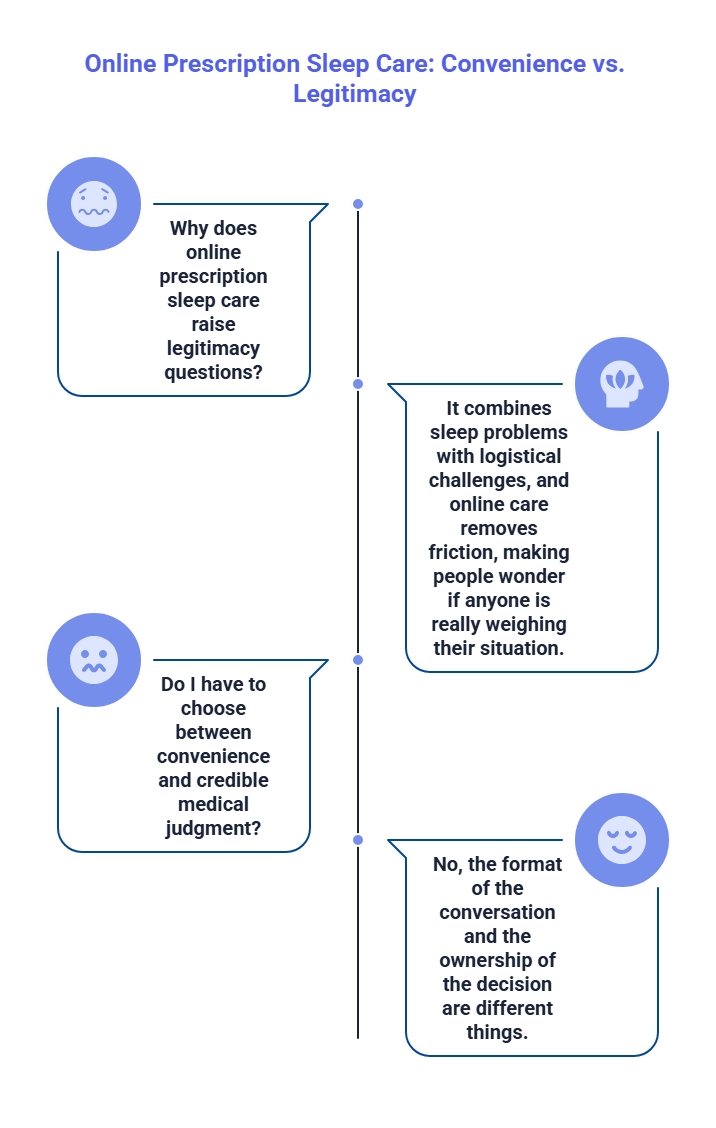
Most people facing this decision are dealing with two problems stacked together. The first is the sleep itself. Insomnia, as described by NIH research resources, involves persistent trouble falling or staying asleep even when there is enough time to sleep, and it can affect memory, concentration, and mood.
The second problem is logistical. Getting prescription help usually means scheduling a visit, taking time off, and explaining a long sleep history all over again. For a manager, founder, clinician on rotating shifts, or parent caring for others, that friction adds up quickly. Many people simply put it off. They tell themselves another bad night is easier to tolerate than another round of phone calls, and they keep cycling through over-the-counter options that leave them feeling like a zombie the next day.
Online care removes much of that friction, and that is exactly why it raises suspicion. If you never sit across from anyone, it is natural to wonder whether anyone is really weighing your situation.
That worry rests on a false trade-off. It assumes you must choose between convenience and credible medical judgment, as if one automatically cancels the other. The format of the conversation and the ownership of the decision are two different things.
What Real Physician Review Means in a Text-Based Sleep-Prescribing Workflow
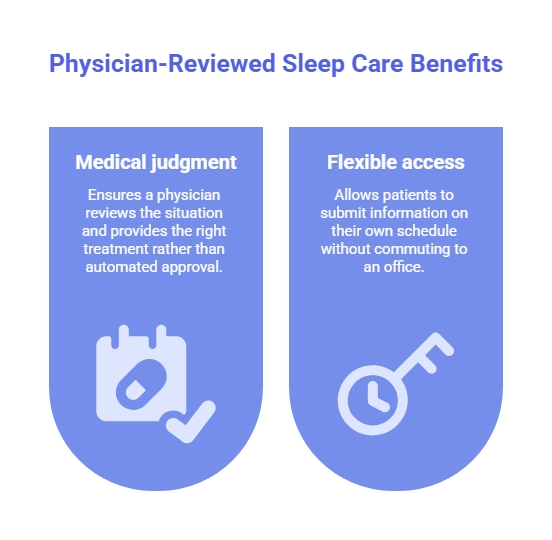
Real physician review means a licensed physician holds decision authority over your prescription, not merely that a doctor's name is attached to a platform. You answer questions about your sleep on your own schedule, and that physician reviews your responses afterward. The physician, not software, decides whether a prescription is appropriate. In most states, this review is typically completed within 2 to 4 hours on weekdays, meaning you get answers quickly without sacrificing medical scrutiny. If it is not appropriate, no prescription is issued.
A few terms are worth translating into plain English:
- Physician-reviewed: A doctor reads your responses after you submit them.
- Auto-approval: A system that grants a prescription automatically once a form is complete, with no human judgment in between.
In a text-based sleep-prescribing program structured this way, the patient completes a digital intake, then a board-certified physician reviews the chart and sends a prescription only if approved. That order matters. The review sits between your submission and any medication decision.
Think of it as a secure handoff to a physician instead of another waiting room. Picture finishing the short quiz after a long shift. You close the browser and go to bed, or try to. Your information has not disappeared into an approval machine. It has been passed to a physician who will review it separately and make the call.
The practical rule follows from that picture: whenever you read a claim about speed or convenience, look for the human decision-maker. If you cannot find one, keep looking.
The Human Decision Gate: From Short Quiz to Prescription-If-Appropriate Decision
Here is the full sequence in a physician-reviewed model built this way:
- Short online quiz: You answer questions about your sleep, health history, and current medications on your own schedule.
- Separate physician review: A licensed physician reviews your submitted responses.
- Fit decision: The physician decides whether your situation fits the focused prescribing pathway.
- Prescription decision: If it fits, the physician decides whether a non-habit-forming prescription is appropriate.
- Pharmacy transmission: When appropriate, the prescription is sent electronically to your chosen pharmacy.
The fourth step is where legitimacy lives, and the third is where honesty lives. The gate below shows both.
Short online quiz
↓
Real physician review
↓
Does the focused pathway fit?
↙ ↘
Yes No, or not yet
↓ ↓
Prescription At-home sleep testing,
decision local care, or a
↓ specialist when indicated
Prescription sent
only if appropriate
Notice what the diagram does not show: a button that turns a completed form into a prescription. Submission is not approval. A human review can end in "yes," but it can also end in "not yet," "not appropriate," or "a different path is needed."
One off-ramp makes this concrete. SleepScriptMD's eligibility materials say that anyone reporting snoring, gasping, or stopped breathing during sleep must complete an at-home sleep test before treatment can begin. No medication is prescribed until those results are reviewed. That caution has a clear clinical basis. The National Heart, Lung, and Blood Institute notes that snoring, gasping for air, and breathing that stops and starts during sleep can be signs of sleep apnea, and that a sleep study may be needed to diagnose it.
That branch is what human judgment looks like in practice.
Why Convenience Does Not Have to Mean Automated Approval
Removing appointment friction and removing medical judgment are separate choices. A service can drop the first without touching the second. The real question is who owns the decision, not whether the conversation happens live.
Medicine already works this way often. A pharmacist checks a prescription without meeting the prescriber. A specialist reads test results after the patient has gone home. In both cases, the professional's judgment is fully present, even though no one is sitting in the same room. Careful review depends on the reviewer, not the meeting format.
A credible provider draws the line explicitly. Technology may organize the data you submit, but physicians, not algorithms, author and approve every treatment decision. That is the entire role automation should play: sorting information, never deciding. There is no need to imagine an elaborate AI scoring system or automated medication selector, because neither belongs in the decision.
A second assumption often travels with the first: that prescription sleep medication must mean strong controlled sedatives. The DEA's drug scheduling overview lists familiar medications such as Xanax, Valium, Ativan, and Ambien among Schedule IV controlled substances. A focused sleep-prescribing pathway does not need to include benzodiazepines or Z-drugs. It can rely instead on non-controlled, non-habit-forming options such as trazodone, hydroxyzine, and clonidine, which physicians routinely prescribe for appropriate patients.
A common pitfall is treating a live video call as proof of scrutiny. A rushed call can involve less thought than a careful written review. What protects you is a clear decision-maker working within clear limits.
What a Physician-Reviewed Process Is and Is Not
Trust also depends on a service describing itself accurately. Overstating what a review covers can be just as misleading as understating it.
A focused physician review is | A focused physician review is not |
|---|---|
A licensed physician reading your quiz responses and medical history | A complete general health checkup |
A decision about whether a non-controlled sleep prescription fits your situation | A broad diagnostic workup for every possible sleep disorder |
A medication and dose decision within a defined scope | A traditional, ongoing primary care relationship |
Discrete follow-up requests when you need them | Continuous monitoring of your health |
Follow-up works the same way. In a program structured this way, existing patients use a patient portal to request a refill, ask for a dose increase or decrease, report side effects, or switch medications. Each request is a new, specific decision point.
When a situation turns out to be more complex, the right response is not to stretch the online model until it fits. The right response is a different care path. This narrowness is a strength, not a disclaimer. A service that says exactly what it does is easier to trust than one that promises everything.
Where Real Physician Review Has Limits, and a Different Care Path Is the Better Fit
Physician review is what makes this model credible. It is not a magic filter that makes every sleep complaint suitable for online prescribing. The strongest trust signal is a service that knows when its own pathway is not enough.
Who the focused pathway is designed for. According to SleepScriptMD's eligibility criteria, the service is intended for new patients ages 18 to 65 who are at low risk of medication complications. They should have no major medical, mental health, or substance use conditions that could make sleep medication unsafe, and they should not be pregnant or planning pregnancy. Symptoms that suggest narcolepsy (sudden daytime sleep attacks or muscle weakness with strong emotions), REM sleep behavior disorder (physically acting out dreams), or restless legs syndrome need in-person evaluation, testing, or specialist care instead. Availability and prescribing requirements can depend on the patient's situation and applicable jurisdictional rules.
These boundaries exist for sound reasons. Restless legs, for example, can be linked to iron deficiency or other conditions that require lab work. Some common sleep medications can also worsen dream-enactment symptoms. A text-based review cannot draw blood or run an overnight study.
Location adds another layer. HHS guidance on licensure and online prescribing explains that telehealth and online prescribing requirements vary under federal and state law. Because those rules change, it is worth verifying current requirements for your location rather than assuming them.
Sometimes the problem is not that you need a stronger sleep aid. Sometimes it is a mix of persistent insomnia, an uncertain medication fit, and a schedule that has pushed careful decisions aside. Reaching for something stronger at midnight does not solve that mix. A physician who looks at the whole submitted picture, and sends you elsewhere when needed, can help.
If any of the symptoms above sound familiar, a local clinician or sleep specialist is the right next step. This article is informational and does not replace that conversation.
How to Recognize a Credible Human-Reviewed Online Sleep-Prescribing Path
You do not need medical training to evaluate an online sleep-prescribing model. You need a few pointed questions:
- Who makes the decision? A licensed medical professional should make every prescription decision, and the service should say so plainly.
- Is approval conditional? Look for language like "if appropriate." A promise of a prescription before anyone reviews your information should give you pause.
- Are eligibility boundaries stated? A credible service tells you who it can and cannot treat.
- Are other care routes made clear? It should explain when you need testing, local care, or a specialist.
- Does it describe itself accurately? It should not imply broad general medical care if it offers focused sleep prescribing.
Speed alone tells you very little. A fast answer from a clearly accountable physician is worth far more than a fast answer from no one in particular. Polished branding and vague promises of "high-quality care" tell you even less. Visible process proof, showing exactly where clinical judgment enters the workflow, is the stronger signal. A provider's frequently asked questions page is often the quickest place to check eligibility, pharmacy options, and what the service does not prescribe before you submit anything.
What Physician-Reviewed Sleep Care Changes for a Time-Pressed Adult
Picture a different moment. It is 6:15 AM after a demanding shift. Daylight is already coming through the blinds, and the window for real sleep is shrinking by the minute. For someone living this schedule, the idea of booking, commuting to, and sitting through an appointment can feel absurd.
This is where the secure handoff matters most. You submit when your life allows it. The decision still belongs to a physician. You get back some control over your schedule without giving up legitimate medical oversight.
Patients describe that shift in their own words. These are individual experiences, not predictions of any particular result:
"I was kinda skeptical about an online thing for sleep meds, but it actually worked out great. They were really thorough, didn't just throw a prescription at me, and made sure I got the right thing for my situation. Sleep has been WAY better since I started this." ~ Christopher V.
"I was dreading having to explain my sleep problems again, but thankfully, I didn't have to. Just filled out the form, they reviewed it, and boom—prescription sent. Honestly, this should be how all medical stuff works. Way easier than going into an office for something like this." ~ Brittany
Look at what each person noticed. One valued that no one simply handed over a prescription. The other valued not having to retell her sleep history or go into an office. Those are the same two needs this whole model is built around: judgment and access.
What to Ask Next After You Understand the Human Decision Gate
Does My Situation Broadly Fit This Pathway?
It may, if you are a low-risk adult with straightforward insomnia and none of the concerns described above. The physician makes the final call based on your responses.
What Do I Submit, and What Happens Afterward?
You answer a short quiz about your sleep, health history, and current medications. A physician reviews it separately. If a non-habit-forming prescription is appropriate, it goes to your pharmacy. If it is not, you will be pointed toward another route.
When Is Another Care Route the Better Choice?
Breathing concerns during sleep, suspected narcolepsy, dream enactment, restless legs, pregnancy, and higher-risk medical or mental health conditions all fall outside the focused pathway. A different route in those cases is responsible care, not a failure of the system.
What Kinds of Medications Does SleepScriptMD Focus On?
The service focuses on non-controlled options such as trazodone, hydroxyzine, and clonidine, and it does not prescribe controlled sedatives.
What Happens If Something Changes Later?
Returning patients submit specific requests through the Returning Patient Portal, such as a refill, a dose change, a side-effect report, or a switch to a different medication. Each request goes back through physician review as its own decision. This is not continuous general health monitoring.
Back at that kitchen table at 11:48 PM, the original question has a clear answer. You were never really choosing between convenience and credibility. You were trying to find out who makes the decision, and now you know where to look: a real physician, a conditional "if appropriate," and honest limits on what an online review can handle. With that, you can judge any service on substance rather than hope.
If you want to see how your own sleep pattern maps to this approach, take the Sleep Clarity Quiz or the 6-Second Sleep Check. When you are ready to learn more about the process, getting started explains what the intake involves.
The format can move to your schedule. The decision stays with a physician.
Disclaimer: This article provides general information about physician-reviewed online prescription sleep care for educational purposes. Individual circumstances vary significantly based on factors like sleep symptoms, medical history and current medications, eligibility risk factors, and applicable jurisdictional requirements. For personalized guidance tailored to whether prescription sleep medication is appropriate for your situation, it is recommended to consult with a qualified healthcare professional.
Our Editorial Process
Our expert team uses AI tools to help organize and structure our initial drafts. Every piece is then extensively rewritten, fact-checked, and enriched with first-hand insights and experiences by expert humans on our Insights Team to ensure accuracy and clarity.
About the SleepScriptMD Insights Team
The SleepScriptMD Insights Team is our dedicated engine for synthesizing complex topics into clear, helpful guides. While our content is thoroughly reviewed for clarity and accuracy, it is for informational purposes and should not replace professional advice.