


What Own-Schedule Prescription Sleep Care Removes From a Busy Workday
SleepScript MD Insights Team · August 5, 2026 · 9 min read

📌 Key Takeaways
Own-schedule sleep care can reduce appointment hassles while keeping a physician responsible for deciding whether prescription medication fits your situation.
- Care Fits Your Schedule: You can complete the sleep quiz when convenient, while a physician reviews your answers separately.
- Prescriptions Are Not Automatic: A real physician reviews your sleep concerns and medical history, prescribing only when medication fits your situation.
- The Service Has Limits: This service focuses on lower-risk adults with trouble sleeping; complex symptoms may need a local, in-person medical review.
- Care Requirements Can Vary: State rules can affect required interactions, and a physician confirms whether this pathway fits your specific health needs.
Fewer scheduling demands still leave medical decisions with physicians.
Busy adults struggling with sleep will understand appointment demands and care limits through the explanation of text-based care below.
~ ~ ~ ~ ~ ~ ~ ~ ~ ~ ~ ~ ~ ~ ~ ~ ~ ~
It's 11:48 PM, and tomorrow's calendar has no open slots. Own-schedule prescription sleep care can remove much of the scheduling friction around getting help: finding an appointment, arranging a call, waiting for a visit, and blocking time out of your workday. What it does not remove is the medical decision, because a physician still reviews your answers before any prescription is issued.
You're at the kitchen table, and your phone glows with a day packed edge to edge: back-to-back meetings, a school pickup, a shift you agreed to cover for a coworker. You scroll through it twice looking for a gap, and you can't see where a doctor's appointment would even go.
That leaves you with two problems at once. The first is sleep that keeps falling apart. The second is the effort it takes to get help, because arranging care becomes one more task competing for rest you already can't get. When nothing gives, another bad night wins by default, but that trade-off isn't the only option.
What you'll learn:
- Which appointment-related tasks can disappear from your day
- Which physician-review steps stay firmly in place
- When a different care pathway makes more sense
What Own-Schedule Prescription Sleep Care Can Remove From a Busy Workday
The real benefit of own-schedule care is calendar control, not telehealth as an abstract idea. You complete a short online sleep quiz whenever it fits your day. A physician then reviews your answers separately, and a non-habit-forming prescription is sent to your pharmacy if appropriate.
Think of it as removing the waiting room from the workflow while keeping the physician decision. That distinction matters because patients, in their own reviews, describe scheduling calls, office visits, and lack of time as a second burden layered on top of insomnia. The goal isn't just to get medication faster, but to ensure medical oversight remains intact without the logistical hurdles of a traditional office visit.
In practical terms, the model takes several appointment logistics off your plate. You no longer have to hunt for an opening that doesn't collide with meetings, shifts, or caregiving. There's no phone tag with a front desk, no drive across town, and no waiting room. You also don't have to guard a fixed hour of your workday for a routine live visit.
This table shows how each piece of friction changes, and where the physician stays in the picture:
Common Appointment-Dependent Friction | Own-Schedule Focused Pathway |
|---|---|
Find a routine appointment opening that fits your work | Complete the short quiz when it fits your schedule |
Coordinate a scheduling call | No routine scheduling call is needed for the quiz itself |
Protect part of your day for a routine live visit | Physician review happens separately |
Wait for the scheduled interaction | Your submitted information enters physician review without you needing to attend at the same time |
Wonder whether convenience means automated approval | A real physician still makes the prescribing decision |
Rearrange your workday before knowing whether medication is appropriate | The quiz gathers the information the physician needs to determine fit |
The left column is logistics, while the right column still has a doctor in it. That split between a lighter workflow and an unchanged prescribing decision is the practical idea behind text-based care.
What Does Not Disappear: Eligibility Questions and Physician Review
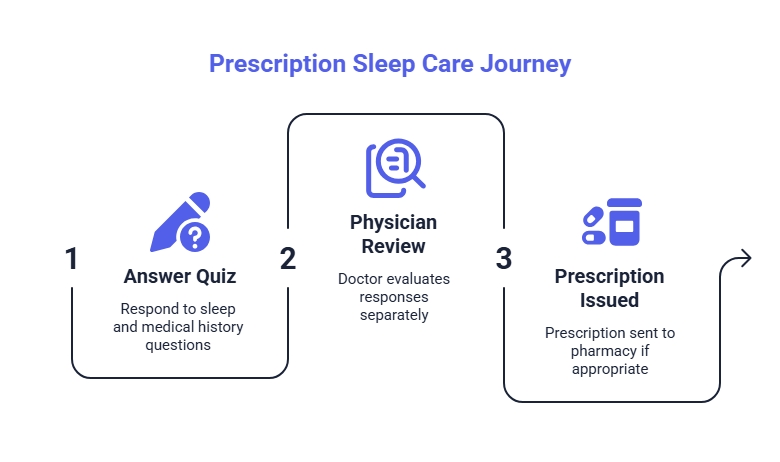
Own-schedule care shortens your calendar, not the clinical decision. The core sequence stays short, and each step does real work:
- Answer a short quiz. You respond to questions about your sleep and relevant medical history whenever it suits your day.
- A physician reviews your responses. A board-certified doctor evaluates your file separately, so you don't need to be available at the same moment. In most states, these reviews are typically completed within 2 to 4 hours on weekdays, meaning a form submitted on your lunch break can often result in a prescription ready by your evening commute.
- A prescription follows only if appropriate. If a non-habit-forming medication fits your situation, the prescription goes to your pharmacy. If it doesn't, no prescription is issued. If the reviewing physician determines that this focused pathway isn't safe or appropriate for your specific health profile, you receive a full refund and are directed toward local, in-person specialist care.
Does Own-Schedule Care Mean Automatic Prescribing?
No. SleepScriptMD states that a real physician, not an algorithm, reviews each file. Submitting information on your own time changes when you share it, but it doesn't change who decides.
It also helps to be clear about what this kind of service is. A focused prescription pathway is not a broad online diagnostic clinic. Its purpose is narrower: physician-reviewed access to prescription sleep medication for situations that fit this focused pathway.
Many people hear "prescription sleep medication" and immediately picture a controlled sedative. The Drug Enforcement Administration classifies Ambien and benzodiazepines such as Xanax as Schedule IV controlled substances. A non-controlled pathway does not prescribe them. Physicians on this pathway work with non-addictive medications commonly prescribed off-label for sleep, such as trazodone, hydroxyzine, and clonidine, when one fits your situation.
Why Appointment Friction Matters When You Are Already Exhausted
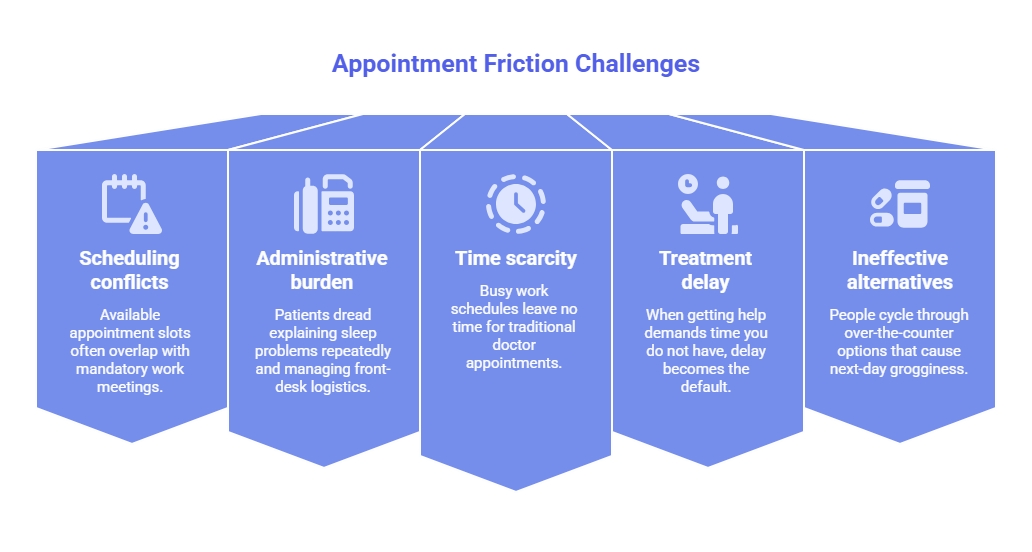
Appointment friction matters because insomnia drains the same daytime energy you'd need to overcome it. The National Heart, Lung, and Blood Institute's overview of insomnia notes that difficulty falling asleep, staying asleep, or getting good-quality sleep can interfere with daytime activities and contribute to daytime sleepiness.
That is why a hurdle that seems minor on a rested day feels much heavier after weeks of broken sleep. The reviews SleepScriptMD patients have shared make this concrete. One patient, Emily R., summed it up: "I have a crazy work schedule and no time for doctor appointments."
Her comment isn't an outlier. Other reviewers describe dreading the need to explain their sleep problems yet again, wasting time scheduling a call, or dealing with front-desk logistics. Several admit they were skeptical of an online option until the process felt physician-led rather than automatic. These accounts are useful as evidence of the access problem, not as promises about treatment results.
Picture a common version of this. A manager decides on Sunday night to finally address her insomnia. By 9:15 on Monday morning, the only available slot sits on top of a standing team meeting, and she can't move either one. The plan quietly dies in her calendar, and another week of poor sleep follows.
That is the real cost of friction: when getting help demands time you don't have, delay becomes the default. Many people end up cycling through over-the-counter options instead, including ones that leave them with what some patients call the "zombie the next day" feeling. Removing the scheduling step doesn't fix sleep on its own, but it does remove the reason to keep postponing the first move.
When Appointment Friction Is Not the Whole Problem
A simpler workflow helps only when your clinical situation fits it. Consider a nurse finishing a demanding overnight shift at 6:15 AM, with daylight already arriving and the sleep window shrinking. Or a caregiver whose nights are interrupted for reasons no prescription can address. Exhaustion also shapes decisions, pushing people to ask for "something stronger" when the real issue may be medication fit.
The pathway is useful precisely because it is narrow. When a situation steps outside its boundaries, the right move is to change pathways, not stretch this one.
Quick Safety and Eligibility Check
The focused pathway is designed for lower-risk adults with straightforward insomnia. A different route may fit better if any of these apply:
- You are pregnant or planning to become pregnant.
- You have a major medical, mental health, or substance use condition that could make sleep medication unsafe.
- You fall asleep suddenly during the day (possible narcolepsy), physically act out your dreams (possible REM sleep behavior disorder), or feel an uncomfortable urge to move your legs at rest (possible restless legs syndrome). These call for local, in-person evaluation.
The breathing question isn't a formality. The National Heart, Lung, and Blood Institute identifies snoring, gasping for air, and breathing that stops and starts during sleep as recognized symptoms of sleep apnea, which may require a sleep study to diagnose.
Availability also differs from state to state. Telehealth.HHS.gov's licensing guidance explains that the ability to deliver healthcare across state lines varies according to state regulation, so the exact interaction required for you can depend on the rules where you receive care. Treat these points as general information. The physician review confirms whether the pathway fits your specific situation.
What to Do Next if the Focused Pathway Sounds Like a Fit
If appointment friction is your main obstacle, the next step is to understand the process and confirm your fit. Back at the kitchen table, tomorrow's calendar hasn't changed. What has changed is whether getting help needs a slot in it.
Before, seeking prescription sleep care meant hunting for openings, trading calls, and giving up part of a workday you couldn't spare. Now the path is a short quiz on your time and a separate physician review, followed by a prescription only if it's appropriate. The useful question was never whether physician review can be removed, because it can't. The better question is whether the scheduling machinery around that review needs to consume part of an already crowded day.
Your next questions are likely practical ones. Is this clinically responsible? Does your situation fit? What information will the quiz ask for, and what happens after you submit it? Learn how text-based care works to see each step in plain terms, and when you're ready, getting started walks you through the intake itself.
Fewer calls. No waiting room. A real physician still decides.
Ready when your schedule is. See what getting started involves.
Disclaimer: This article provides general information about own-schedule prescription sleep care for educational purposes. Individual circumstances vary based on factors including eligibility and service scope, medical history and risk factors, and applicable requirements where care is provided. For personalized guidance about whether a focused prescription sleep pathway fits your situation, consult a qualified healthcare professional.
Our Editorial Process
Our expert team uses AI tools to help organize and structure our initial drafts. Every piece is then extensively rewritten, fact-checked, and enriched with first-hand insights and experiences by expert humans on our Insights Team to ensure accuracy and clarity.
By: The SleepScriptMD Insights Team
The SleepScriptMD Insights Team is our dedicated engine for synthesizing complex topics into clear, helpful guides. While our content is thoroughly reviewed for clarity and accuracy, it is for informational purposes and should not replace professional advice.