


When Appointments Become Part of the Sleep Problem: Prescription Sleep Medication on Your Own Schedule
SleepScript MD Insights Team · October 5, 2026 · 15 min read

📌 Key Takeaways
Text-based sleep care lets eligible adults submit information on their schedule, while a physician decides whether a prescription fits.
- Convenience Keeps Physician Review: A board-certified physician reviews your sleep history and health details, so completing the quiz never guarantees a prescription.
- Eligibility Shapes Your Options: The pathway serves low-risk adults ages 18 to 65 with straightforward insomnia, while more complex concerns may need other care.
- Medication Choices Stay Individual: The service offers non-controlled medications, and physicians consider your sleep pattern, medical history, and current medications before prescribing.
- Some Symptoms Require Testing: SleepScriptMD requires an at-home sleep test before prescribing when patients report snoring, gasping, or breathing pauses.
- State Rules Affect Access: Most states allow review without a live appointment, but some require a brief virtual visit before prescribing.
Your schedule controls submission; physician judgment controls prescribing.
Busy adults with persistent insomnia will understand this pathway’s fit and limits through the eligibility and physician-review details below.
~ ~ ~ ~ ~ ~ ~ ~ ~ ~ ~ ~ ~ ~ ~ ~ ~ ~
Text-based prescription sleep medication lets eligible adults with insomnia answer a short sleep quiz on their own schedule. A board-certified physician reviews the responses and, if appropriate, sends a non-habit-forming prescription to their pharmacy. The process removes the waiting room. It does not remove the physician’s decision.
Too Tired to Sleep, Too Busy to Book
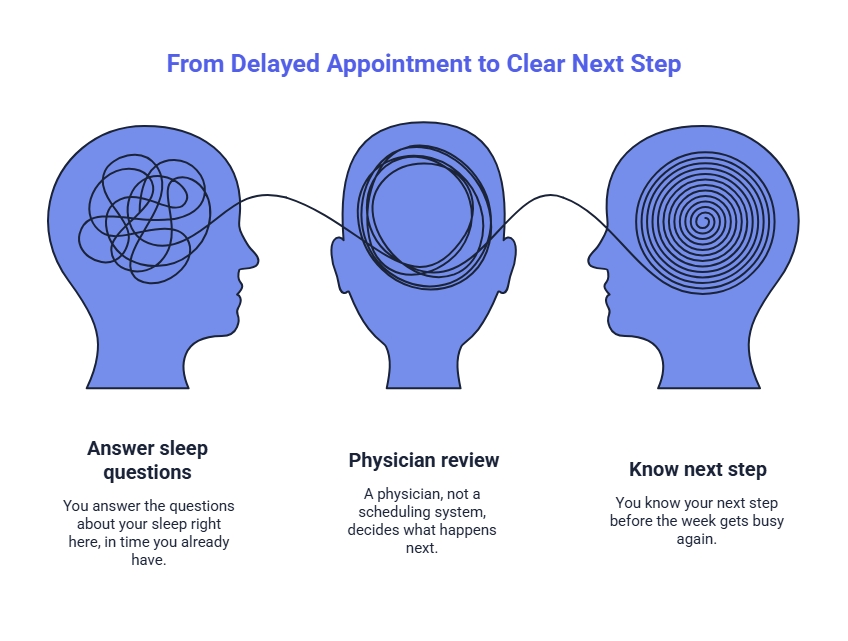
It’s 11:48 PM at the kitchen table.
The laptop glows and the tea has gone cold. Tomorrow’s calendar runs from the first meeting straight through to the school pickup. Bed was supposed to happen an hour ago.
You already know the sleep problem is real. Some nights you lie awake for an hour before sleep finally comes. Other nights you drift off fine, then wake at 3 AM and stare at the ceiling. By mid-afternoon, coffee is doing most of the work. Getting help sounds simple until you look at the week. You can’t move three meetings just to start fixing this. So the appointment gets pushed back again.
Now picture a different version of tonight. You answer the questions about your sleep right here, in time you already have. A physician, not a scheduling system, decides what happens next. Whatever that decision is, you know your next step before the week gets busy again.
That is the idea behind a secure, asynchronous clinical review. The administrative bottleneck is eliminated, but strict medical oversight remains fully intact.
In the next few minutes, you’ll see three things:
- why scheduling itself can keep insomnia going longer than it should
- what physician review protects when there’s no live appointment
- how to tell quickly whether a text-based prescription pathway fits your situation
What Is Text-Based Prescription Sleep Medication?
Text-based prescription sleep medication is a focused, non-real-time pathway for eligible adults with straightforward insomnia. You complete a short online sleep quiz on your own schedule. A board-certified physician reviews your responses and medical history separately. If a non-habit-forming medication is appropriate, a prescription is sent to your pharmacy. Think of it as untethering the consultation from the clock without compromising clinical safety.
Key Terms
- Text-based care: You submit information when it’s convenient, and a physician reviews it separately rather than during a real-time appointment.
- Physician-reviewed: A licensed physician reviews the submitted information and makes the prescription decision.
- Non-controlled sleep medication: Prescription sleep medication outside the benzodiazepine and Z-drug categories.
“On your own schedule” describes timing. It says nothing about approval. You decide when to answer, and the physician decides what your answers mean for treatment.
If you want the step-by-step mechanics, you can read how text-based care works. For someone with a crowded calendar, the more pressing question is why the appointment itself can turn into a barrier.
Why Appointment Friction Can Become Part of the Sleep Problem
Persistent insomnia is the first problem. The effort it takes to get help can become the second.
The first problem is well defined. The National Heart, Lung, and Blood Institute describes the main symptom of insomnia as trouble falling or staying asleep, even when a person has enough time and the right conditions for sleep. Most people living with it recognize that description immediately.
The second problem gets far less attention. It means finding an open slot and moving a meeting or arranging childcare around it. Then come the travel time, a stretch in the waiting room, and the job of describing a long sleep history to someone new. Each step is ordinary on its own. Stacked on top of weeks of poor sleep, the steps add up to enough friction that some people never start.
SleepScriptMD patients have described this barrier in their own words. Emily R. put it plainly: “I have a crazy work schedule and no time for doctor appointments.” Another patient said one of the most welcome parts of the process was not having to schedule a call or explain their sleep struggles one more time. These are individual accounts, not population data. Still, they name the friction precisely.
Maybe next week will be calmer. It rarely is, and the decision usually gets made while exhausted. That is when the quick fix tends to win: another box of over-the-counter pills from the pharmacy aisle. Several patients have described cycling through over-the-counter options that either did not help or left them feeling like a zombie the next day. The deeper issue was that no physician had looked at which medication actually fit them.
None of this means traditional appointments are the wrong choice. For many situations, an in-person visit is exactly right. The point is narrower: when scheduling becomes the reason a person never starts, the route to treatment deserves a closer look.
What Text-Based Access Removes, and What It Keeps
Text-based access removes administrative friction and keeps the medical decision. The model is easiest to understand when you separate those two things.
The Appointment-Friction Map sorts each part of the experience into one of two lanes. It shows how text-based access reduces the scheduling burden while the physician decision stays in place.
The Appointment-Friction Map: What Changes When You Use Text-Based Care?
Administrative Friction Reduced | Safeguards Retained |
|---|---|
Finding a routine appointment slot | A short intake about your sleep and medical history |
Rearranging work or caregiving around that slot | Eligibility boundaries for low-risk adults ages 18 to 65 |
Waiting for a real-time interaction | Board-certified physician review of your responses |
Treating access as another calendar burden | A prescription sent only when appropriate |
Unnecessary scheduling overhead | Redirection to testing or local care when a different path is needed |
The left column describes convenience. The right column describes what makes the process credible. Only the left column shrinks.
The handoff changes. The decision does not.
Why Physician Review Still Matters Without a Live Appointment
A physician, not an algorithm, makes the prescribing decision.
Put plainly, physician-reviewed text-based care means a doctor reviews your responses after you submit them. In most states, you are not on a call while that happens, meaning the review takes place without requiring you to be present. (A few states do mandate a brief virtual visit to finalize the prescription)..
It matters just as much to be clear about what the review is not. It is a focused review built around one question: does a non-controlled sleep medication fit this person’s situation? It is not a general health checkup, a sleep-disorder diagnosis, or ongoing tracking of your progress. If you later need a dosage adjustment or want to switch medications, you can request a change through the Returning Patient Portal. That request is reviewed as well, so a change is never automatic. To learn more about the physicians behind the reviews, visit the Meet the SleepScriptMD Team page.
One patient who started out skeptical of an online process said afterward that it felt thorough rather than automatic. That reaction speaks directly to the most common doubt people have about this model.
Quick Q&A: Can prescription sleep medication be legitimate without a traditional live appointment?
Yes, when the right elements are in place. In this model, legitimacy rests on four things:
- a licensed physician reviewing the submitted information
- a clearly defined prescribing scope
- eligibility screening
- a prescription decision made only after that review
The prescription itself must come from an appropriately licensed professional and meet applicable prescribing requirements, which differ by state. The U.S. Department of Health and Human Services explains telehealth licensing across state lines for readers who want the regulatory background.
Changing the format reduces the scheduling burden. It does not turn prescribing into automatic approval.
What Non-Controlled Sleep Medication Looks Like
Through its text-based pathway, SleepScriptMD prescribes only non-controlled, non-habit-forming sleep medications. Benzodiazepines, Z-drugs, and other controlled sedatives are not part of that pathway.
Several commonly prescribed options fall into the non-controlled category, including trazodone, hydroxyzine, clonidine, and low-dose doxepin. Physicians often match them to the pattern of the sleep problem.
Trouble staying asleep through the night is a different challenge from lying awake with racing thoughts. Feeling physically wired at bedtime is different again. Each of these options works in its own way, which is why the pattern you describe in the quiz matters.
Medication | What It Is | Common Effects to Know About |
|---|---|---|
Trazodone | A prescription antidepressant sometimes used off-label for insomnia because of its sedating effects | Next-day drowsiness or dizziness |
Hydroxyzine | A sedating antihistamine sometimes prescribed for short-term sleep difficulties | Drowsiness and dry mouth |
Clonidine | A medication used mainly for blood pressure and certain other conditions, sometimes prescribed off-label for sleep-related concerns | Dizziness, drowsiness, or lowered blood pressure |
These are general characteristics, not prescribing recommendations. The options are not interchangeable, and no single one is the right choice for every adult with insomnia.
Choosing the medication and the dose remains the physician’s decision. That decision weighs more than the simple fact that you have trouble sleeping: your sleep pattern, medical history, and current medications all shape it. A medication that leaves noticeable morning drowsiness may be a poor fit for someone who drives early in the day. Another may be ruled out by an existing condition or a possible interaction. The goal is not the strongest option. It is the option that fits.
Your role is to describe your sleep honestly. To see the options and how each one is used, see which meds we offer.
Using Your Prescription Safely
Non-controlled does not mean free of side effects. Common effects such as next-day drowsiness or dry mouth come up for some people, and a few practical habits keep them manageable:
- Share your full medical history and medication list, including supplements and over-the-counter products.
- Take the dose and timing printed on your label, and don’t raise the dose on your own.
- Avoid alcohol while taking a sedating sleep medication unless your prescriber advises otherwise.
- Pay attention to drowsiness or dizziness before driving or doing anything that needs full alertness.
- If an effect concerns you, raise it through the Returning Patient Portal or with a healthcare professional.
For broader background, the FDA’s guidance on managing the benefits and risks of medicines is a useful plain-language resource.
A 3-Part Fit Check Before You Start
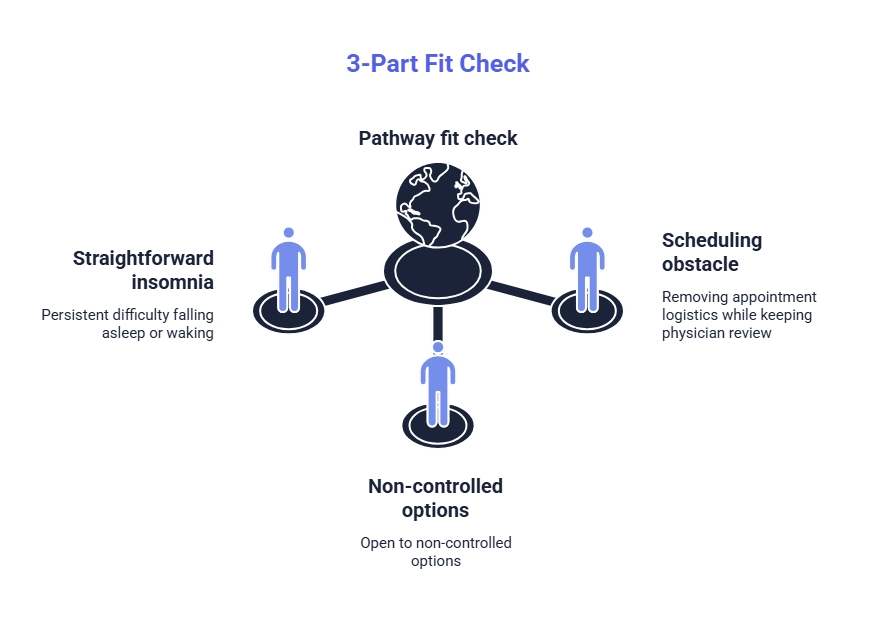
Three questions can show whether this pathway is designed for your situation. They are a general orientation tool, not a diagnosis.
- Does this sound like straightforward insomnia? Difficulty falling asleep or waking in the middle of the night fits the pathway’s focus, as long as the pattern is persistent rather than an occasional restless night. Some symptoms point toward a different path instead: sudden sleep attacks during the day, physically acting out dreams, or a strong urge to move your legs while resting.
- Are you open to non-controlled options? If you want a specific controlled sedative, discuss it at a traditional visit with your own doctor. It also helps to keep expectations realistic. Effects vary from person to person, and no prescription can promise uninterrupted sleep.
- Is scheduling the real obstacle? If removing appointment logistics while keeping physician review would solve your access problem, the model matches it. If you want an extended, real-time conversation with a doctor, an in-person visit may suit you better. The same is true when your symptoms are medically complex, because convenience alone won’t make this pathway the right one.
Three yes answers mean the pathway is worth exploring. The physician still makes the call.
When the Text-Based Pathway Should Redirect You
A focused pathway is only responsible if it knows its limits. Eligibility screening exists to send certain sleep concerns to care better suited to them.
Safety and Eligibility at a Glance
- The pathway is designed for low-risk adults ages 18 to 65 without major medical, mental health, or substance use conditions that could make sleep medication unsafe.
- Pregnancy, or plans to become pregnant, falls outside this pathway.
- Suspected narcolepsy, REM sleep behavior disorder, or restless legs syndrome calls for in-person care with a local specialist or primary care provider.
- Snoring, gasping, or breathing pauses during sleep can signal a sleep-related breathing problem. If you report them, an at-home sleep test is required before any medication is prescribed, and medication is not sent until the results are reviewed. The requirement doesn’t mean everyone who snores has sleep apnea; it adds one step before prescribing.
- No real-time appointment is needed in most states. Some states require a brief virtual visit before prescribing.
The reasoning behind these limits is widely accepted in sleep medicine: some concerns need testing that no questionnaire can replace. Suspected narcolepsy generally calls for a full in-person sleep study, and the Narcolepsy Network offers support for people starting that process. REM sleep behavior disorder is usually confirmed with an overnight video sleep study.
Restless legs syndrome follows similar logic. Clinicians typically look for contributing causes before treating it, and Baylor College of Medicine notes that iron deficiency should be ruled out, usually through blood tests that include ferritin. That kind of workup belongs with a local provider.
To find out how availability works in your state, check the SleepScriptMD FAQs. For advice specific to your own health history, speak with a qualified healthcare professional.
Common Misunderstandings About Online Sleep Prescriptions
Three assumptions keep many busy adults from considering this route. Each one is understandable, and each one leaves something out.
Myth: Online prescription sleep medication is basically automatic approval.
Fact: A physician decides whether a prescription fits. Some people do not receive one, which is exactly why a yes carries weight.
Myth: Prescription sleep medication means Ambien, Xanax, or another controlled sedative.
Fact: Ambien (zolpidem) and Xanax (alprazolam) are both Schedule IV controlled substances under the Drug Enforcement Administration’s scheduling system, and temazepam is another controlled sleep medication. The options described earlier sit outside that category entirely.
Myth: A shorter process means a broad medical review is being squeezed into a few questions.
Fact: Nothing is being squeezed. The process is short because its scope is narrow: prescription sleep medication for straightforward insomnia. It is not general medicine or sleep-disorder diagnostics, and it does not claim to be.
What If the Quiz Shows This Pathway Is Not a Fit?
Then the screening worked as intended.
A focused service earns trust by recognizing where its scope ends. When someone’s answers fall outside that scope, the responsible move is to change pathways rather than stretch the model to cover something it was not built for. Depending on what the answers suggest, the next step might be an at-home sleep test, a visit with a primary care provider, or a local sleep specialist. The same principle applies to individual medications: if one is unsuitable, the decision reflects that rather than forcing a prescription. Clinical fit, not the convenience of the platform, sets the next step.
Learning that a pathway is not the right one can feel like wasted effort. It is not. A clear redirect from a physician who has read your answers is more useful than another month of guessing in the pharmacy aisle. It also arrives without you rearranging a workday.
Think of it as the same handoff running in a different direction. Instead of sending a prescription to a pharmacy, the physician points you toward the kind of care your situation calls for.
Boundaries are not the weak point of this model. They are part of what makes it trustworthy.
Resources
- How text-based care works
- Learn about non-controlled prescription sleep aids
- FDA: Managing the benefits and risks of medicines
- HHS: Telehealth licensing across state lines
Schedule Control Without Giving Up Physician Judgment
Back at the kitchen table at 11:48 PM, the choice looked binary: protect the workday or get help with sleep. It does not have to be.
Text-based treatment models decouple scheduling from clinical evaluation, allowing you to access medical care without the calendar conflict. The logistics change. The safeguards stay: a real review, clear eligibility limits, and a decision about whether a prescription fits.
That shift changes the question worth asking. It is no longer “Can I get sleep meds without an appointment?” A better question is: Can I use a focused prescription pathway that fits my schedule while keeping a real physician decision and clear safety boundaries?
For many people, the real change is less about speed than about weight. Getting help for sleep stops being one more appointment waiting on a crowded calendar. It becomes something you handle on a quiet evening at home, with a physician’s judgment on the other end.
What to Do Next
If the fit check points toward yes, the next step takes a few minutes. Start Your Sleep Treatment with the short sleep quiz. If a prescription is appropriate, it is often sent to your pharmacy the same day. Same-day isn’t guaranteed: timing depends on physician review, eligibility, your state’s requirements, and whether an at-home sleep test has to be completed and reviewed first. You pay a flat $69 fee for the physician review, with no hidden costs or insurance required. The cost of any prescribed medication is paid separately at your local pharmacy.
Want to know more first? See which meds we offer, or review pricing before you begin.
Your schedule. A physician’s judgment. A clear next step.
Disclaimer: This article provides general information about text-based prescription sleep medication for educational purposes. Individual circumstances vary significantly based on factors like eligibility, red-flag sleep symptoms, current medications and medical history, and applicable state requirements. This focused prescription pathway does not replace comprehensive medical care when additional assessment or testing is necessary. For personalized guidance about whether it fits your insomnia and safety profile, consult a qualified healthcare professional.
Our Editorial Process
Our expert team uses AI tools to help organize and structure our initial drafts. Every piece is then extensively rewritten, fact-checked, and enriched with first-hand insights and experiences by expert humans on our Insights Team to ensure accuracy and clarity.
By: The SleepScriptMD Insights Team
The SleepScriptMD Insights Team is our dedicated engine for synthesizing complex topics into clear, helpful guides. While our content is thoroughly reviewed for clarity and accuracy, it is for informational purposes and should not replace professional advice.