


Why Appointment-First Prescription Sleep Care Can Delay Help for Busy Adults With Insomnia
SleepScript MD Insights Team · August 12, 2026 · 8 min read

📌 Key Takeaways
The author recommends choosing sleep care that reduces scheduling delays while keeping physician review and clear safety checks.
- Scheduling Can Delay Care: Calls, waiting, and fixed appointment times can keep busy adults from seeking help for ongoing insomnia.
- Flexible Intake Removes Barriers: Eligible adults can complete an online sleep quiz on their own schedule, without booking a routine appointment.
- Doctors Still Decide: A real physician reviews each request and prescribes medication only when it fits the person’s situation.
- Different Symptoms Need Different Care: Some adults need testing or specialist care because their symptoms or health risks fall outside the service’s limits.
- Check Fit Before Choosing: The author recommends confirming whether the service suits your symptoms, with professional guidance for your individual circumstances.
Fewer scheduling barriers, with physician judgment still in place.
Busy professionals and caregivers will understand scheduling barriers and physician review through the sleep-care checklist and pathway explanation below.
~ ~ ~ ~ ~ ~ ~ ~ ~ ~ ~ ~ ~ ~ ~ ~ ~ ~
When the Calendar Becomes Your Second Sleep Problem
11:48 PM, the kitchen table. Your laptop fan is still humming, tomorrow's calendar barely has a gap in it, and 'I'll call the doctor's office next week' sounds exactly like it did last week.
Appointment-first prescription sleep care can delay help because a person with persistent insomnia must also find time for scheduling calls, fixed visit windows, waiting, and repeated intake conversations. That burden is appointment friction. For many busy adults, it becomes a secondary obstacle. The fix starts with separating the steps that can go from the decisions that should stay.
Text-based care access to prescription sleep aids for insomnia for busy professionals is a focused pathway with three parts:
- A busy adult completes a short online sleep quiz on their own schedule.
- A physician reviews the information separately.
- If appropriate, a non-habit-forming prescription is sent to a pharmacy.
Think of it as removing the waiting room from the workflow while keeping the physician decision. That distinction matters. Patient feedback on this kind of service shows that scheduling calls, office visits, and lack of time can become a logistical hurdle that rivals the exhaustion itself.
The practical next step is not simply "get medication faster." First, confirm your symptoms fit the service. Then, understand the pathway—quiz, physician review, prescription—so convenience doesn't turn into unsafe prescribing.
What you'll learn: how to spot when appointment logistics become a second barrier, which administrative steps can go without losing physician judgment, and what an own-schedule pathway changes.
What Appointment Friction Means in Prescription Sleep Care
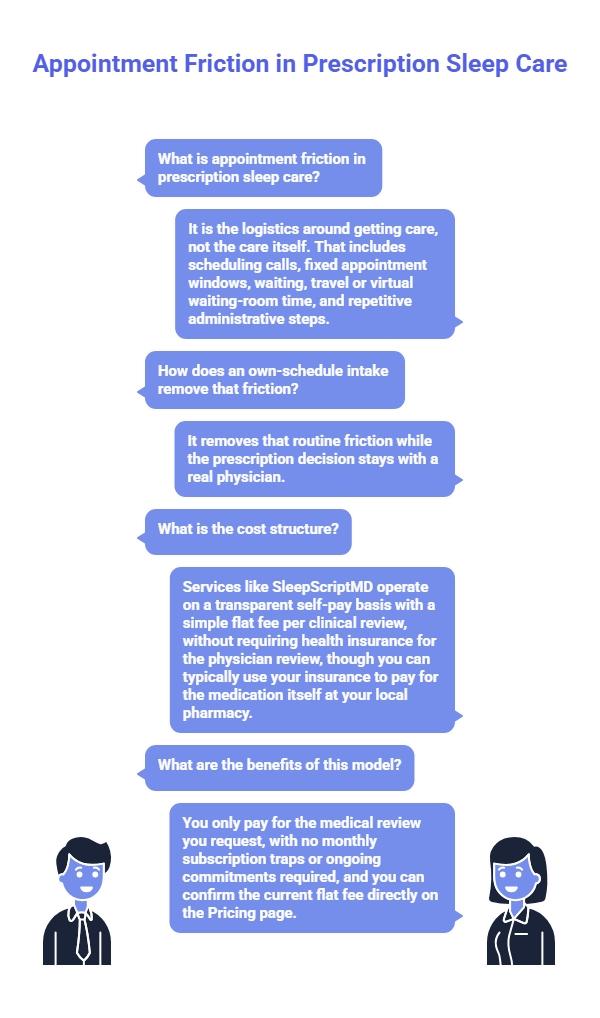
What is appointment friction in prescription sleep care? It is the logistics around getting care, not the care itself. That includes scheduling calls, fixed appointment windows, waiting, travel or virtual waiting-room time, and repetitive administrative steps. None of these steps involve a clinical decision.
For some eligible adults, an own-schedule intake removes that routine friction while the prescription decision stays with a real physician. Because the model is streamlined, services like SleepScriptMD operate on a transparent self-pay basis with a simple flat fee per clinical review, without requiring health insurance for the physician review, though you can typically use your insurance to pay for the medication itself at your local pharmacy. This structure means you only pay for the medical review you request, with no monthly subscription traps or ongoing commitments required, and you can confirm the current flat fee directly on the Pricing page.
When "I Should Get Help" Keeps Losing to the Calendar
Exhaustion makes ordinary admin feel heavier, so the call gets postponed again. The National Heart, Lung, and Blood Institute notes that insomnia can get in the way of daily activities and affect memory and concentration. Those are the same resources you would need to organize an appointment.
None of this makes appointments bad. An appointment-first pathway can simply be a poor match for someone whose days are already full, whether that is a manager moving between back-to-back meetings or a caregiver with little control over free time. If that sounds familiar, it helps to know how text-based care works and what physician review still includes.
Why Appointment Friction Matters When Insomnia Is Already Draining Your Day
Logistics can quietly become part of the delay. Patients of one online sleep service have described this barrier directly. One, Emily R., put it plainly: "I have a crazy work schedule and no time for doctor appointments." Another valued not having to book yet another call and re-explain long-standing sleep struggles. While these are individual experiences rather than a measure of prevalence, they illustrate how the delay builds.
Consider a nurse finishing a night shift at 6:15 AM, daylight already pushing through the blinds. Calling a clinic when it opens would cost sleep she cannot spare. So the call slides another week, for reasons unrelated to her symptoms.
The Second Barrier Is Administrative, Not Another Sleep Symptom
A common trap is reaching for a stronger over-the-counter sleep aid. The real obstacle is often persistent insomnia plus a care pathway that clashes with your schedule. Name the pathway as part of the problem, and it becomes fixable.
The Sleep-Care Friction Audit
These five questions separate what slows you down from what protects you.
Appointment window: Is finding a slot the main reason you keep postponing action?
Logistics conflict: Are waiting rooms, phone calls, or visit windows competing with work, caregiving, or your sleep window?
Repeated history: Are you re-explaining your sleep history mainly because the process requires another scheduled interaction?
Removable steps: Could an own-schedule intake remove those steps while leaving the prescription decision to a real physician?
Pathway fit: Is your situation straightforward enough for a focused prescribing pathway, or do symptoms, risk factors, or testing needs call for a different route?
The goal is not to remove every step. Remove avoidable administrative friction, and keep the steps that protect clinical judgment and pathway fit.
How Own-Schedule Prescription Sleep Care Removes Logistics Without Removing Physician Judgment
An own-schedule, physician-reviewed pathway removes routine appointment friction while preserving physician review for eligible adults with straightforward insomnia. What changes is when you share information, not who decides.
In a pathway structured this way, you complete a short online quiz whenever it suits you. A licensed doctor reviews your intake details on their own time. If a medication is a safe fit, they send an order for a non-controlled sleep aid directly to your local pharmacy. SleepScriptMD, for example, states that a practitioner, not an algorithm, reviews each file and determines whether a medication fits. It is a secure physician handoff instead of another waiting room. In most states, this physician review typically happens within 2 to 4 hours on weekdays, meaning you aren't waiting weeks just to find out if a medication is appropriate.
Real physician review builds confidence in legitimate online prescription sleep care. Prescription sleep medication also does not have to mean a controlled sedative. Because drugs such as Ambien and Xanax are DEA Schedule IV controlled substances, SleepScriptMD does not prescribe these benzodiazepines or Z-drugs.. Its focus is non-controlled options, outlined under prescription sleep aid online. These non-controlled options include evidence-based medications like trazodone, hydroxyzine, and clonidine, depending on what the reviewing physician determines is medically appropriate for your specific sleep pattern. For broader clinical context on where medication fits, the American Academy of Sleep Medicine maintains practice guidelines covering pharmacologic treatment of insomnia alongside behavioral approaches.
Safety & Fit: What Still Has to Stay in the Process
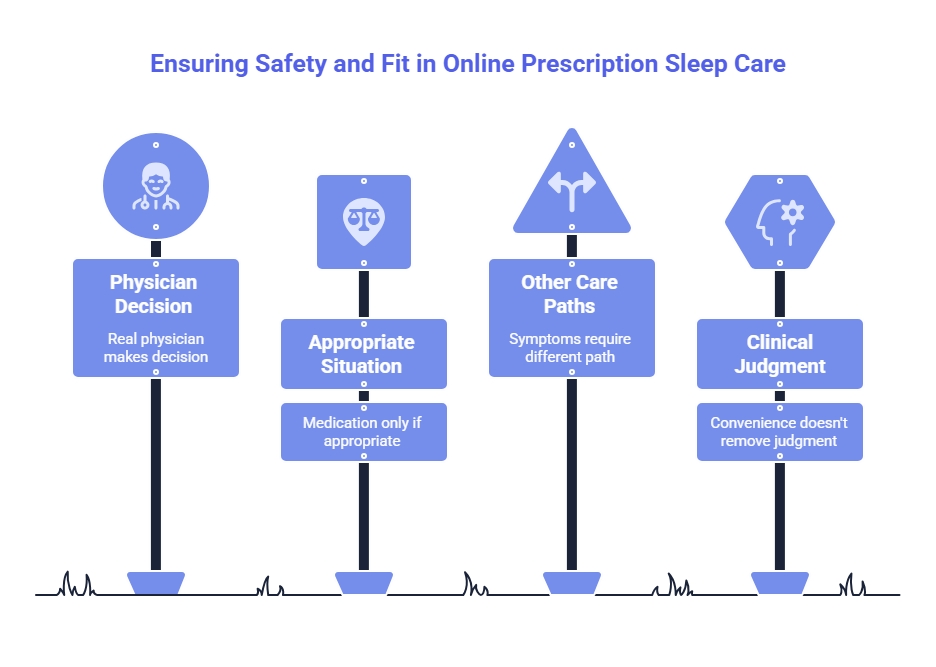
- A real physician still makes the prescription decision.
- Medication is provided only if your situation is appropriate for the focused service.
- Some symptoms, risk factors, testing needs, or jurisdictional requirements call for another care path.
- Convenience removes logistics. It does not remove clinical judgment.
When a Streamlined Pathway Should Stop and a Different Pathway Should Start
A responsible streamlined pathway does not accept every request. It has a clear point where it stops.
Eligibility and scope screening limit the model to situations it is designed to handle. SleepScriptMD's criteria describe the service as intended for low-risk adults. That means adults without major medical, mental health, or substance use conditions that could make sleep medication unsafe, and not people who are pregnant or planning a pregnancy. If you have been told you snore, gasp, or stop breathing during sleep, an at-home sleep test comes before any medication decision.
Some concerns need local testing or specialist care, and requirements can vary by jurisdiction, so confirm fit rather than assume it. Past that boundary, change pathways rather than stretch the model.
What to Ask Next Before Choosing an Online Prescription Pathway
Will a Real Physician Review My Information?
Yes, in a physician-reviewed pathway. Nothing is approved automatically.
Is Own-Schedule Prescription Sleep Care Appropriate for Every Type of Insomnia?
No. Fit depends on your symptoms, your safety profile, and whether a focused service suits your situation.
What Happens After I Submit the Sleep Quiz?
Your answers undergo clinical evaluation. Should a non-habit-forming treatment align with your symptoms, the provider transmits the order to your preferred pharmacy. If medication is not appropriate, a different form of care is the better next step. Depending on your sleep quiz responses, this may involve a recommendation for an at-home sleep test or a referral for an in-person evaluation with a local specialist, accompanied by a full refund.
Getting Sleep Help Should Not Require Inventing Another Hour in Your Day
Back at the kitchen table, the calendar looks the same, but how you read it has changed. The appointment you could not fit was never the only route. The steps that protect you, physician judgment and clear limits, are the ones worth keeping.
That is control over your sleep care without giving up credible oversight. To see how a focused pathway might fit, review the Getting Started process.
Fewer hoops. The same physician decision. Sleep care that fits the life you actually have.
Disclaimer: This article provides general information about appointment-first prescription sleep care and own-schedule prescription pathways for educational purposes. Individual circumstances vary significantly based on factors like medical eligibility, sleep symptoms, current medications, and applicable requirements. For personalized guidance tailored to whether a prescription sleep pathway is appropriate for your situation, it is recommended to consult with a qualified professional.
Our Editorial Process
Our expert team uses AI tools to help organize and structure our initial drafts. Every piece is then extensively rewritten, fact-checked, and enriched with first-hand insights and experiences by expert humans on our Insights Team to ensure accuracy and clarity.
About the SleepScriptMD Insights Team
The SleepScriptMD Insights Team is our dedicated engine for synthesizing complex topics into clear, helpful guides. While our content is thoroughly reviewed for clarity and accuracy, it is for informational purposes and should not replace professional advice.