


What a Real Physician Reviews Before an Online Sleep Prescription Can Move Forward
SleepScript MD Insights Team · October 19, 2026 · 9 min read

📌 Key Takeaways
An online sleep prescription depends on a physician’s review of your symptoms, health history, and eligibility, with no guaranteed approval.
- Physicians Make the Decision: A board-certified physician reviews your answers and may approve medication, request testing, or direct you toward other care.
- Complete Details Support Review: The author recommends sharing your sleep patterns, past treatments, and complete medication list to help the physician assess fit.
- Breathing Symptoms Trigger Testing: SleepScriptMD requires an at-home sleep test for reported snoring, gasping, or breathing pauses before a prescription can proceed.
- State Rules Affect Visits: Some states require a brief virtual visit before prescribing, while others allow the consultation to remain entirely text-based.
- Focused Reviews Have Limits: This service assesses whether a sleep prescription fits your situation; it does not replace a full sleep evaluation.
Online convenience still depends on a physician’s judgment.
Adults considering SleepScriptMD will better understand what may affect prescription approval through the review steps and safety checks below.
~ ~ ~ ~ ~ ~ ~ ~ ~ ~ ~ ~ ~ ~ ~ ~ ~ ~
The Question Behind the Start Button
It’s late, and you’re still awake.
At 11:48 PM, you sit at the kitchen table with tomorrow’s calendar open on your phone. Every block is taken. Fitting in one more appointment would mean moving a meeting, a school pickup, or both.
You want real help with your sleep, and an online prescription sounds easier. Then a quiet doubt stops your thumb above the button. Is anyone actually going to read this, or does the website just approve everybody?
It’s a fair question, and it has a clear answer.
With SleepScriptMD’s text-based care, you complete a short sleep quiz on your own schedule, and a board-certified physician reviews your responses and medical history. If a non-habit-forming medication fits your situation, the prescription is sent to your pharmacy. If it doesn’t, the physician may ask for another step first or point you toward a different kind of care.
Below, you’ll see exactly what the physician looks at, what can pause the process, and how to take the next step with confidence.
What the Physician Is Actually Deciding
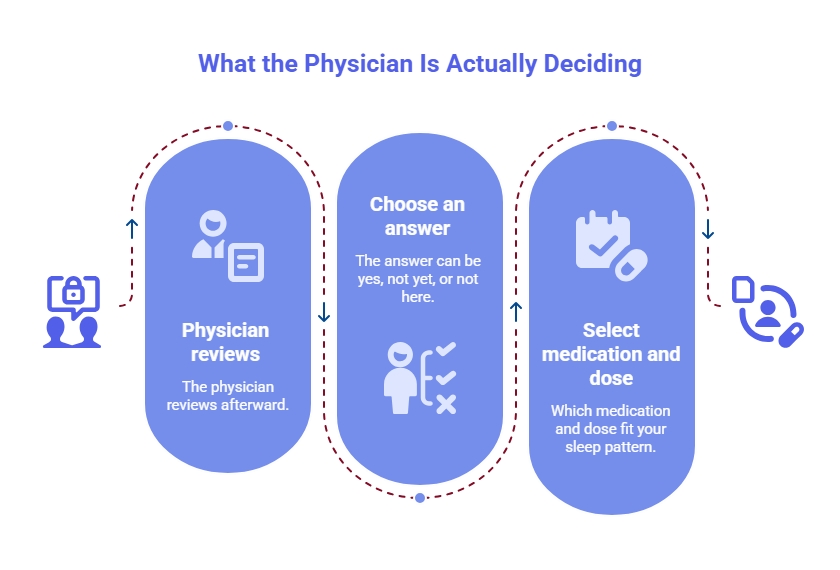
Text-based care changes when you share your information. It does not change who makes the call.
Think of it as a secure handoff rather than a live meeting. You submit when it suits you, and the physician reviews afterward. No algorithm signs off on a prescription. The answer can be yes, not yet, or not here, and those last two options are what make the review real.
The medications on the table are routine, well-established options. SleepScriptMD’s standard first-line choices include trazodone, hydroxyzine, and clonidine. All three are non-controlled, non-habit-forming, and commonly prescribed to help with sleep.
All three are prescribed off-label for insomnia, which means their use for sleep differs from the condition they were originally FDA-approved to treat. No single medication fits everyone. Each can bring common, manageable effects such as drowsiness, dizziness, or dry mouth.
SleepScriptMD does not prescribe benzodiazepines or Z-drugs such as Ambien. That is a deliberate choice, and it keeps the decision focused on which medication and dose fit your sleep pattern. You can read about each option in the medication education center.
One patient, Christopher V., described how the review felt from his side:
“I was kinda skeptical about an online thing for sleep meds, but it actually worked out great. They were really thorough, didn’t just throw a prescription at me, and made sure I got the right thing for my situation. Sleep has been WAY better since I started this.”
His account reflects one person’s experience, not a typical result. Still, it makes the point: someone was choosing, not rubber-stamping.
What Information the Physician Reviews
The quiz is short because it asks only what a prescribing decision needs. It centers on four areas:
- Your sleep pattern. Sleep-onset insomnia means trouble falling asleep: you lie awake long after bedtime, even when you’re exhausted. Sleep-maintenance insomnia means trouble staying asleep: you drift off without much difficulty but wake in the middle of the night and struggle to get back to sleep. Many people deal with both.
- Your medications and health history. This covers the prescriptions, supplements, and conditions you report that could affect whether a sleep medication is a good fit. Combining medications that cause drowsiness can increase sedation, so list everything, including over-the-counter sleep aids.
- Eligibility. SleepScriptMD treats low-risk adults aged 18 to 65. Pregnancy, plans to become pregnant, and major medical, mental health, or substance use conditions fall outside this pathway.
- Breathing during sleep. The quiz asks whether anyone has told you that you snore, gasp, or stop breathing while asleep.
Your sleep pattern shapes the review, but it doesn’t settle the medication choice on its own. The physician weighs it alongside everything else you share, including what you have already tried.
Many people arrive after months of over-the-counter sleep aids, most of which rely on sedating antihistamines that can leave some people foggy the next morning. That history helps the physician choose a better-fitting option rather than more of the same.
What the physician reviews | What can change the pathway | What the review is not |
|---|---|---|
Trouble falling asleep or staying asleep | Reported snoring, gasping, or breathing pauses | An automatic approval |
Medications, supplements, and past sleep aids | Symptoms that need local, in-person care | A guaranteed prescription |
Relevant health history you share | A state rule requiring a brief virtual visit | A diagnostic workup |
Age, pregnancy, and major risk factors | Higher-risk health factors | Ongoing monitoring of your health |
Before You Start the Quiz
A few minutes of preparation helps the physician understand your situation without guesswork. You don’t need to know which medication you want, because that decision belongs to the physician. Your job is simply to describe your sleep accurately.
Before you begin, it helps to have three things in mind:
- How often your sleep trouble happens, and how it affects your days.
- What you’ve already tried for sleep, prescription or over-the-counter, and anything notable about how it went.
- Every prescription and supplement you currently take, so the list you report is complete.
Keep taking your existing medications as directed while you explore this option. Considering a new sleep prescription is not a reason to stop or change what you already take on your own.
Safety Check: What Can Pause or Redirect the Pathway
A pause is not a failure. It is the review doing its job.
Breathing symptoms. Snoring, gasping, and pauses in breathing are recognized signs of sleep apnea, and many people learn about them only when a partner mentions it. If you report any of these, an at-home sleep test is required before any medication is prescribed. Medications are not sent until the results are reviewed, though you can continue the intake while you arrange the test.
Symptoms that need local care. Suspected narcolepsy, REM sleep behavior disorder, and restless legs syndrome are not treated online, and each has recognizable signs:
- Narcolepsy: sudden daytime sleep attacks, especially alongside muscle weakness triggered by strong emotions.
- REM sleep behavior disorder: shouting, kicking, or punching while acting out dreams.
- Restless legs syndrome: a persistent, uncomfortable urge to move your legs at rest.
Each of these calls for a visit with a local specialist or your primary care provider. These boundaries don’t mean ordinary insomnia routinely requires specialized testing before medication can be considered. They mark the specific situations where a different kind of care is the better fit.
Your state. Telehealth licensing rules vary from state to state. No real-time appointment is needed in most states, but some require a brief virtual visit before prescribing. For example, some jurisdictions require a brief video check-in, while others allow the consultation to remain entirely text-based.
Everyday medication sense. If you are prescribed a medication, follow these basics:
- Take it at the dose and time on your label, and avoid alcohol while taking it.
- Check with your prescriber or pharmacist before combining it with other sleep aids or anything else that causes drowsiness.
- Don’t drive or take on tasks that need full concentration while you still feel its effects.
- Don’t raise your dose on your own if sleep stays difficult.
- Tell your provider about any new prescriptions or supplements.
Your prescription label and your pharmacist’s guidance always come first.
Physician Review Is Focused, Not a Full Sleep Workup
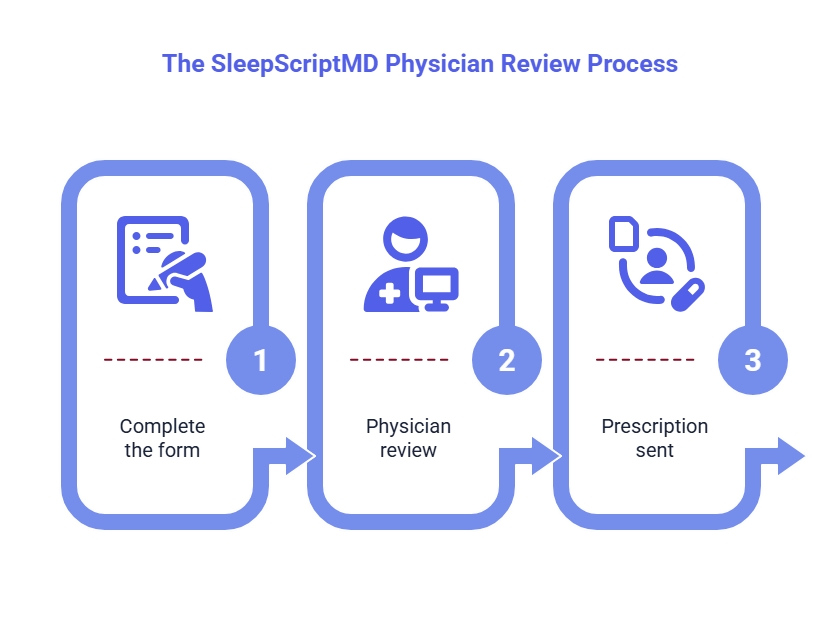
The review does not replace a complete physical or diagnose every sleep disorder. SleepScriptMD is a text-based prescription medication service for insomnia. The physician answers one specific question: is a non-habit-forming sleep prescription appropriate for you right now?
A narrow scope can sound like a limitation. In practice, it is what keeps a convenient process credible. Your primary care provider remains the right place for wider health concerns.
What to Do Next
For many people, the biggest relief is not having to retell the same story in another waiting room. Brittany put it this way:
“I was dreading having to explain my sleep problems again, but thankfully, I didn’t have to. Just filled out the form, they reviewed it, and boom—prescription sent. Honestly, this should be how all medical stuff works. Way easier than going into an office for something like this.”
If you want a closer look first, read how text-based care works, browse our prescription sleep aids, or check current pricing. You can also meet the physician review team. Already a patient? You can request a dose adjustment or a medication change through the Returning Patient Portal.
Common Questions About Physician Review
Does finishing the quiz guarantee a prescription?
No. The quiz supplies information, and the physician makes the decision. That decision can be a prescription, a required test, or a different care path.
Do I need a video appointment?
In most states, no. Some states require a brief virtual visit before prescribing. Our frequently asked questions cover availability in more detail.
Is an at-home sleep test required for everyone?
No. The test is required only when you report snoring, gasping, or pauses in breathing during sleep. The physician reviews the results before any medication is prescribed.
Can an online physician prescribe a non-habit-forming sleep medication?
Yes, when the applicable prescribing requirements are met. The medication, your circumstances, and your state’s rules together determine whether an online prescription can move forward.
How much does physician-reviewed sleep medication cost?
Cost depends on the service you choose, and pricing can change. The pricing page linked above always shows the current options.
From Late-Night Doubt to a Decision You Can Trust
Back at the kitchen table, that doubt now has an answer. A real physician reviews what you share and decides what happens next.
The format may be streamlined, but the medical judgment remains entirely in human hands.
Your schedule. A physician’s judgment. A decision made for you, not by a machine. When you’re ready, Start Your Sleep Treatment.
Disclaimer: This article provides general information about physician review before an online sleep prescription for educational purposes. It is not a guarantee of eligibility or prescription approval. Individual circumstances vary significantly based on factors such as your sleep symptoms, relevant medical and medication history, breathing-related screening responses, eligibility factors, and applicable state requirements. For personalized guidance about whether a focused text-based prescription pathway is appropriate for your situation, consult a qualified healthcare professional.
Our Editorial Process
Our expert team uses AI tools to help organize and structure our initial drafts. Every piece is then extensively rewritten, fact-checked, and enriched with first-hand insights and experiences by expert humans on our Insights Team to ensure accuracy and clarity.
By: The SleepScriptMD Insights Team
The SleepScriptMD Insights Team is our dedicated engine for synthesizing complex topics into clear, helpful guides. While our content is thoroughly reviewed for clarity and accuracy, it is for informational purposes and should not replace professional advice.