

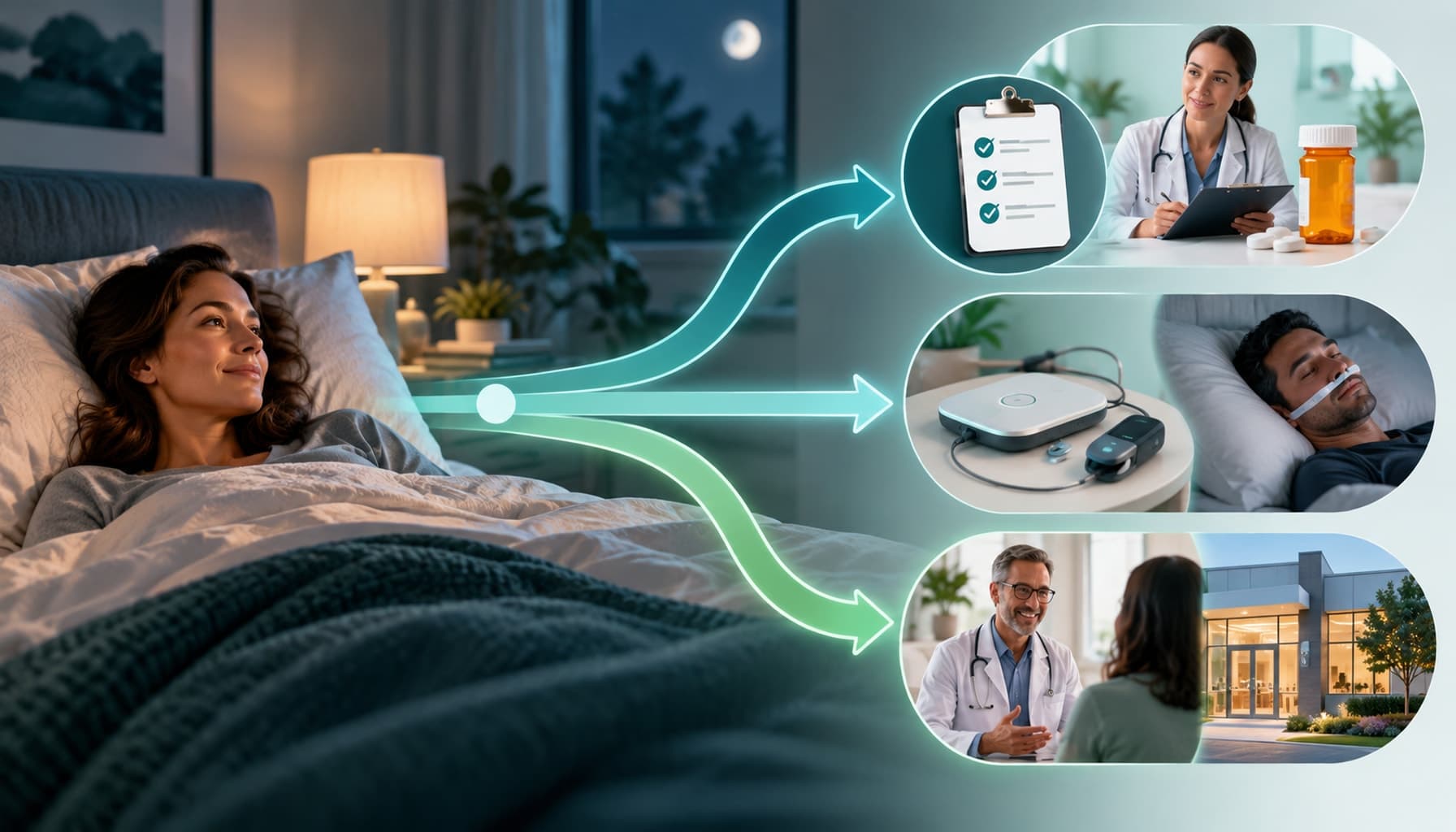
When Real Physician Review Is Not Enough: Sleep Symptoms That Need a Different Care Path
SleepScript MD Insights Team · October 12, 2026 · 9 min read
📌 Key Takeaways
SleepScriptMD recommends matching your sleep symptoms to the right care path before seeking medication through its text-based service.
- Physician Review Has Limits: A physician’s review cannot replace sleep testing or local evaluation when symptoms extend beyond straightforward insomnia.
- Breathing Symptoms Require Testing: SleepScriptMD requires an at-home sleep test for reported snoring, gasping, or breathing pauses before prescribing any medication.
- Some Symptoms Need Specialists: SleepScriptMD directs people with sudden sleep attacks, physical dream enactment, or persistent restless legs toward local evaluation.
- Testing Does Not Guarantee Approval: Sleep test results help physicians assess prescribing suitability, but completing the test does not guarantee a prescription.
- Straightforward Insomnia May Qualify: Eligible, lower-risk adults with trouble falling or staying asleep may fit the pathway, subject to physician review.
The right sleep care starts with recognising the symptoms.
Adults considering SleepScriptMD will understand which symptoms may change their care path, using the symptom guide and eligibility details below.
~ ~ ~ ~ ~ ~ ~ ~ ~ ~ ~ ~ ~ ~ ~ ~ ~ ~
From “Is This Just Insomnia?” to a Clear Next Step
Good physician review sometimes says “not yet.”
Your partner mentioned it over coffee: you gasp in your sleep, then go quiet. Now it is 2:47 a.m., the house is silent, and you are awake again. Is this my insomnia, or something else?
You want prescription help that fits a crowded week, without a waiting room. The open question is whether your symptoms belong on a text-based path at all.
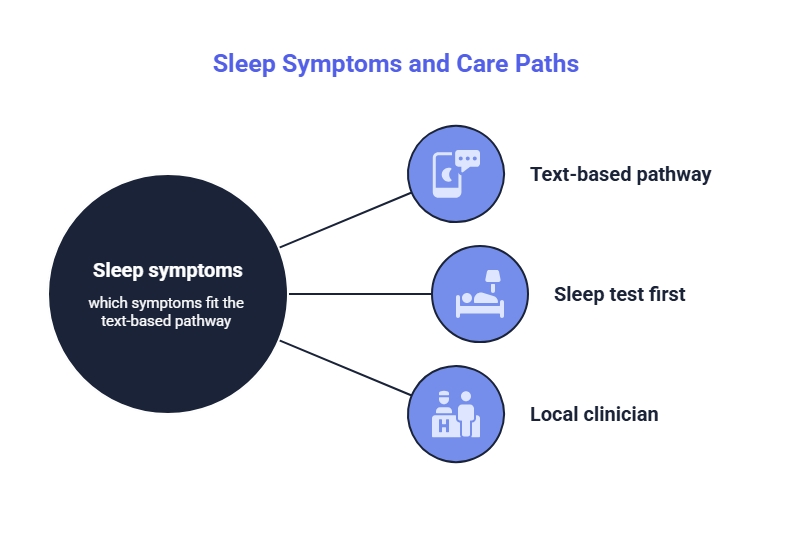
Many people assume physician review means any sleep complaint fits the same path. Yet a questionnaire cannot record breathing overnight or observe movement during dreams. Below, you will learn which symptoms fit the text-based pathway, which require a sleep test first, and which belong with a local clinician.
Real Physician Review Has a Boundary
While physician review is crucial for a trustworthy text-based prescription pathway, it doesn't make that pathway appropriate for every symptom. Some patterns need information that a short online quiz cannot provide. When symptoms point toward a condition that requires testing or local evaluation, the responsible next step is to change the care path rather than stretch a focused insomnia-prescribing service beyond its scope.
Four symptom patterns most often change the route:
- Unexpected daytime sleep attacks or sudden weakness with strong emotion: local sleep evaluation for possible narcolepsy.
- Shouting, kicking, or physically acting out dreams: a neurologist or local sleep center.
- An uncomfortable urge to move the legs at rest: a primary care provider or local specialist.
- Snoring, gasping, or breathing pauses: an at-home sleep test before any medication.
These routes reflect SleepScriptMD’s documented service scope. Its text-based care is designed for straightforward insomnia, meaning trouble falling asleep or staying asleep, in eligible, lower-risk adults. It prescribes non-controlled medication only and does not prescribe benzodiazepines or Z-drugs such as Ambien.
A fast lane is only trustworthy when its exits are clearly marked. These four patterns are the exits.
Sleep Symptoms That Need Another Care Path
The first three patterns lead away from the online pathway entirely.
Unexpected Daytime Sleep Attacks or Sudden Weakness
Feeling drained after a poor night is normal with insomnia. Falling asleep without warning, mid-conversation or even while driving, is different. Some people also notice their knees buckle during a laugh or a flash of anger, or they briefly cannot move while falling asleep or waking.
Together, these features can be a reason to evaluate for narcolepsy, a neurological sleep disorder involving excessive daytime sleepiness, but they do not confirm it. According to MedlinePlus guidance on narcolepsy, diagnosis may involve an overnight sleep study and a daytime nap test that measures how quickly a person falls asleep. SleepScriptMD does not treat suspected narcolepsy through its text-based pathway, so a local sleep specialist is the right place to start.
Acting Out Dreams
During normal REM sleep, muscle activity is substantially reduced while the mind dreams. In REM Sleep Behavior Disorder (RBD), that protective reduction breaks down, and people may shout, kick, or punch as they act out dream content. Occasional sleep talking is different; the concern is repeated physical dream enactment.
Confirming RBD takes more than a description. Diagnostic criteria from the American Academy of Sleep Medicine call for an overnight sleep study with video recording. Because certain sleep and mood medications can bring out or intensify RBD symptoms, SleepScriptMD does not prescribe when RBD is suspected and refers the pattern to a specialist first. Until you have professional guidance, keeping the area around your bed clear of objects that could cause injury is a sensible precaution.
An Irresistible Urge to Move the Legs
Restless Legs Syndrome (RLS) typically appears as an uncomfortable urge to move the legs while resting, often worst in the evening. Moving brings brief relief. Then the sensation returns, which makes it easy to mistake for ordinary insomnia.
The distinction matters because RLS can be linked to underlying factors. The National Institute of Neurological Disorders and Stroke lists iron deficiency, kidney disease, nerve damage, and certain medications among them. A local clinician may check blood work, such as iron levels or kidney function, to look for a contributing cause. SleepScriptMD does not treat RLS through its prescription pathway, because the underlying concern may need investigation that an online insomnia questionnaire cannot provide.
When Breathing Symptoms Trigger an At-Home Sleep Test
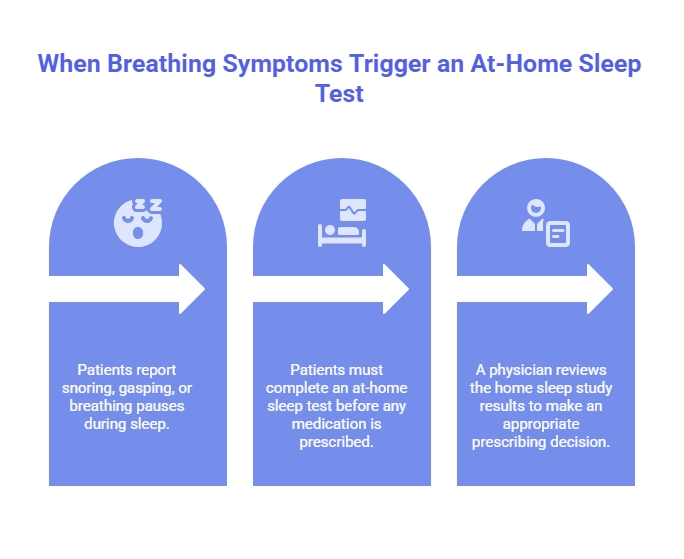
This pattern works differently. Under SleepScriptMD’s current policy, patients who report snoring, gasping, or breathing pauses during sleep must complete an at-home sleep test before any medication is prescribed. The intake can still begin, but no prescription is sent until a physician has reviewed the results.
The reasoning reflects standard practice: breathing problems during sleep should be identified before a sleep-promoting medication is considered. Snoring and breathing pauses can be associated with obstructive sleep apnea, in which breathing is repeatedly interrupted during sleep. A person may notice only nighttime awakenings or daytime tiredness without ever recognizing the breathing problem behind them, which is exactly why it can pass for insomnia.
A home sleep study records breathing, heart rate, oxygen levels, and snoring to diagnose obstructive sleep apnea. Because it cannot diagnose other sleep disorders, it is only suited for breathing symptoms. Completing the test does not guarantee approval; it supplies the information a physician needs to make an appropriate prescribing decision.
Focused Review Off-Ramp Chart
Here is how each pattern changes the route.
What you notice | Why it changes the pathway | Better next step |
|---|---|---|
Unexpected daytime sleep attacks, or sudden muscle weakness with strong emotion | May point beyond insomnia | Local sleep evaluation for possible narcolepsy |
Shouting, kicking, punching, or physically acting out dreams | Dream enactment needs video sleep testing to confirm | Neurologist or local sleep center |
Persistent, uncomfortable urge to move the legs while resting | RLS can have underlying medical contributors | Primary care provider or local specialist |
Snoring, gasping, or breathing pauses | Breathing must be checked before medication | Complete the required at-home sleep test first |
Trouble falling or staying asleep without the patterns above | May fit the focused pathway if otherwise eligible | Complete the SleepScriptMD quiz for physician review |
The chart supports recognition, not diagnosis, and it is not exhaustive: other medical conditions or risk factors can also make the focused pathway unsuitable. Even in the last row, physician review decides whether a prescription is appropriate.
What a Different Care Path Actually Means
Being redirected does not mean your sleep problem is being dismissed. Physician review can lead to several outcomes: a prescription when the case fits, testing first, a brief virtual visit where state rules require one, or referral to local care. Stretching a focused service to cover everything would not make it safer.
The value of review does not come from approving everyone. It comes from recognizing when the information in a short quiz is not enough. For people with straightforward insomnia, those same limits offer reassurance: the service addresses a clearly defined need without presenting itself as a substitute for broader medical care.
What to Do If None of These Patterns Apply
If your difficulty is simply falling asleep or staying asleep, the focused pathway may fit. This generally means you experience persistent trouble falling asleep or waking up in the middle of the night. Complete a short online quiz about your sleep on your own schedule. A physician reviews your responses and, if appropriate, sends a non-habit-forming prescription to your pharmacy. No real-time appointment is needed in most states, although some states require a brief virtual visit before prescribing, and neither approval nor timing is guaranteed.
Common non-controlled prescription sleep aids include trazodone, hydroxyzine, and clonidine. These are routine, non-addictive options, though some of their uses for insomnia are off-label, and the physician matches the choice to your sleep pattern. The medication education pages explain each one in plain language.
Before you start: a quick safety check. The text-based pathway is for new patients ages 18 to 65 who are at low risk of medication side effects. Pregnancy, or plans to become pregnant, falls outside its scope. Major medical, mental health, or substance use conditions can make online prescribing unsuitable. If you report snoring, gasping, or breathing pauses, an at-home sleep test is required before any medication is prescribed. Describe your symptoms accurately in the quiz, including unusual daytime sleepiness, nighttime movements, or breathing concerns, and list every medication and supplement you take so the physician can check for interactions. Once you start, follow your prescription instructions closely and avoid alcohol or other sedating substances when your prescriber advises against combining them.
If insomnia persists on your medication, resist the urge to raise the dose or switch medications on your own. Already a patient? If you need a dosage adjustment or want to switch medications, request a change through the Returning Patient Portal.
Resources
- MedlinePlus: Narcolepsy
- MedlinePlus: Sleep Study
- NINDS: Restless Legs Syndrome
- American Academy of Sleep Medicine: Parasomnias, including REM Sleep Behavior Disorder
From 2:47 a.m. Uncertainty to a Clear Route
That late-night question now has an answer. Gasping points to a sleep test first. Sleep attacks, dream enactment, or restless legs point to a local clinician. Straightforward insomnia may fit the focused path.
Real physician review earns its credibility from these limits. If you still have questions, the SleepScriptMD frequently asked questions cover eligibility in more detail, and current fees are listed on the pricing page. When your symptoms look like straightforward insomnia, Start Your Sleep Treatment with the short quiz.
Know the route. Then take the right first step.
Disclaimer: This content is for general educational purposes and is not a diagnosis or a substitute for care from your own healthcare professional. It does not determine eligibility for prescription medication. Sleep symptoms such as unexpected daytime sleep episodes, dream-enactment behaviors, persistent restless-leg symptoms, or breathing pauses during sleep may require testing or evaluation outside SleepScriptMD’s focused prescription pathway. If you are concerned about your symptoms, seek appropriate medical care.
Our Editorial Process
SleepScriptMD content should be developed from documented clinical and service information, supported by authoritative sources where medical claims require substantiation, and reviewed for accuracy, appropriate scope, and compliance with the current SleepScriptMD content guidelines before publication.
By: The SleepScriptMD Insights Team
The SleepScriptMD Insights Team is our dedicated engine for synthesizing complex topics into clear, helpful guides. While our content is thoroughly reviewed for clarity and accuracy, it is for informational purposes and should not replace professional advice.