
📌 Key Takeaways
Treating your daytime sleep block like biological midnight—and getting your household on board—is the key to surviving a rotating shift.
- Your Daytime Is Your Midnight: Household noise at noon hits a night-shift worker’s nervous system the same way a car alarm at 3 AM would hit everyone else.
- Have the Talk Before the Rotation: One calm conversation covering your shift dates, protected hours, and what counts as a real interruption prevents most conflicts before they start.
- Visual Cues Replace Guesswork: A door sign and a one-page schedule on the fridge tell your family exactly when you’re sleeping—so nobody has to wonder or knock.
- Medication Can Bridge the Gap: When a quiet house still isn’t enough, non-habit-forming prescriptions like trazodone, hydroxyzine, or clonidine may help your body settle into daytime sleep.
- Know When to Escalate: Heavy snoring, gasping, leg urges, or acting out dreams are red flags that need an in-person sleep specialist—not just a better routine.
A shared system beats a perfect house every time.
Rotating-shift workers balancing family life with daytime sleep will find a ready-made communication plan and practical household rules here, preparing them for the detailed guide that follows.
~ ~ ~ ~ ~ ~ ~ ~ ~ ~ ~ ~ ~ ~ ~ ~ ~ ~
The best way to balance family life with a rotating shift is to treat your daytime sleep block like your biological midnight. Tell your household exactly when that block starts and ends, agree on quiet rules, use visible cues like a door sign, and build a shared routine that protects your sleep without creating resentment. When sleep remains unreliable despite these steps, a clinician can help decide whether schedule-adjusted, non-habit-forming support makes sense.
The door slams.
It’s 11:14 AM on a Tuesday. Your sleep medication kicked in 43 minutes ago, and you were finally drifting off after a 12-hour overnight. Now you’re wide awake, heart pounding, staring at the ceiling while the kids argue over cartoons downstairs.
If you work a rotating shift, you know this feeling. You need deep, uninterrupted daytime rest to stay safe at work—but your household runs on a completely different clock. The frustration builds fast. And right behind it comes the guilt, because you don’t want to be the person who snaps at your family for living their normal day.
Your household runs on a normal daytime clock. Your body does not. Once that becomes the starting point, everything else gets easier to talk about.
Why Your Family’s Normal Day Can Wreck Your Recovery
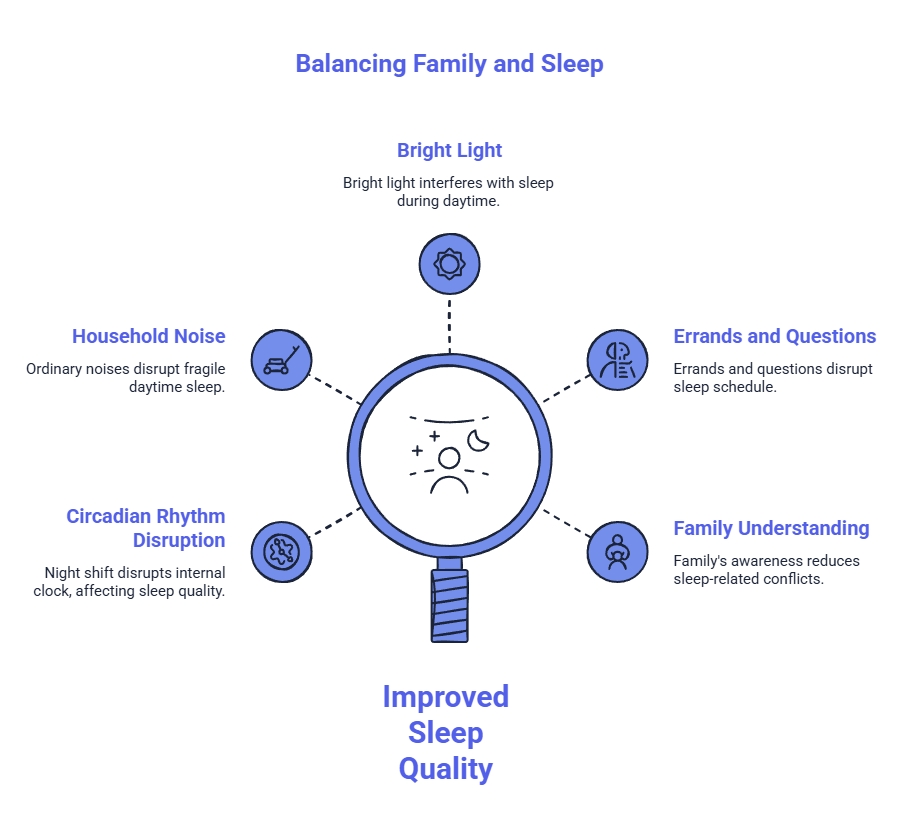
Your family isn’t doing anything wrong. They’re making lunch, letting the dog out, running the vacuum. The problem is biological timing.
When you come off a night shift, your circadian system—the internal clock that regulates alertness—still thinks it’s daytime. That makes daytime sleep lighter, shorter, and more fragile than nighttime sleep. According to CDC / NIOSH guidance on shiftwork, sleep after night work tends to be less refreshing and is closely linked to fatigue-related errors on the job.
Now layer ordinary household noise on top of that fragile state. A lawnmower at noon hits your nervous system the way a car alarm at 3 AM would hit your partner. If your protected sleep block starts at 9:00 AM, that hour may function more like midnight for your body than morning. Noise, bright light, errands, speaker volume, and “quick questions” all hit differently during that window. The American Academy of Sleep Medicine recommends consistent routines and environment protection for shift workers—a visible household cue extends that protection beyond the bedroom.
Your daytime is your midnight. Once your household understands that—really understands it—the conversation about boundaries stops feeling like a demand.
The One Conversation to Have Before Your Next Rotation Starts
Protecting your sleep works best as a shared decision. You shouldn’t have to issue commands, and your household shouldn’t treat rest as optional. Have this conversation before the rotation starts—not during it, and not after a blow-up.
Sit down together and cover four things:
The upcoming shift pattern. Give exact dates and times. “Starting Monday, I work 7 PM to 7 AM for seven nights.”
Which hours are protected. “My sleep block is 9 AM to 4 PM. During those hours, the house stays quiet.”
What counts as a real interruption. A child’s injury? Wake me. A package delivery? It can wait.
How the family stays connected outside the block. “When I’m up at 5 PM, I’m all yours—dinner, homework, whatever you need.”
A useful script sounds like this: “Here’s what my next rotation looks like. These are the hours when I need protected sleep. If something comes up during that block, let’s decide now what counts as a true interruption and what can wait. I also want to make sure we still have clear family time when I’m awake.”
That script does three jobs at once. It defines the sleep window. It reduces ambiguity. And it reassures the people around you that the goal is not withdrawal from family life—it’s a better plan for staying functional inside it.
Treat it as a living agreement the household revisits as schedules change.
Build a Protected Sleep Block, Not Just a Dark Room
Blackout curtains help. Earplugs help. But protecting daytime sleep requires explicit communication and boundary-setting with household members, not just blackout curtains. A dark room means nothing if someone knocks to ask where the cereal is.
A “Do Not Disturb — Sleeping Shift Worker” sign on the bedroom door removes the guesswork. Without it, family members are left wondering: Are they napping? Actually sleeping? The sign answers before anyone knocks. For kids, keep it simple: “When the sign is up, we whisper and play in the back of the house.”
If you’ve already tossed and turned after overnight work, the missing piece may not be another gadget. It may be a better agreement between you and your household.
Rules of the House That Prevent Accidental Wake-Ups
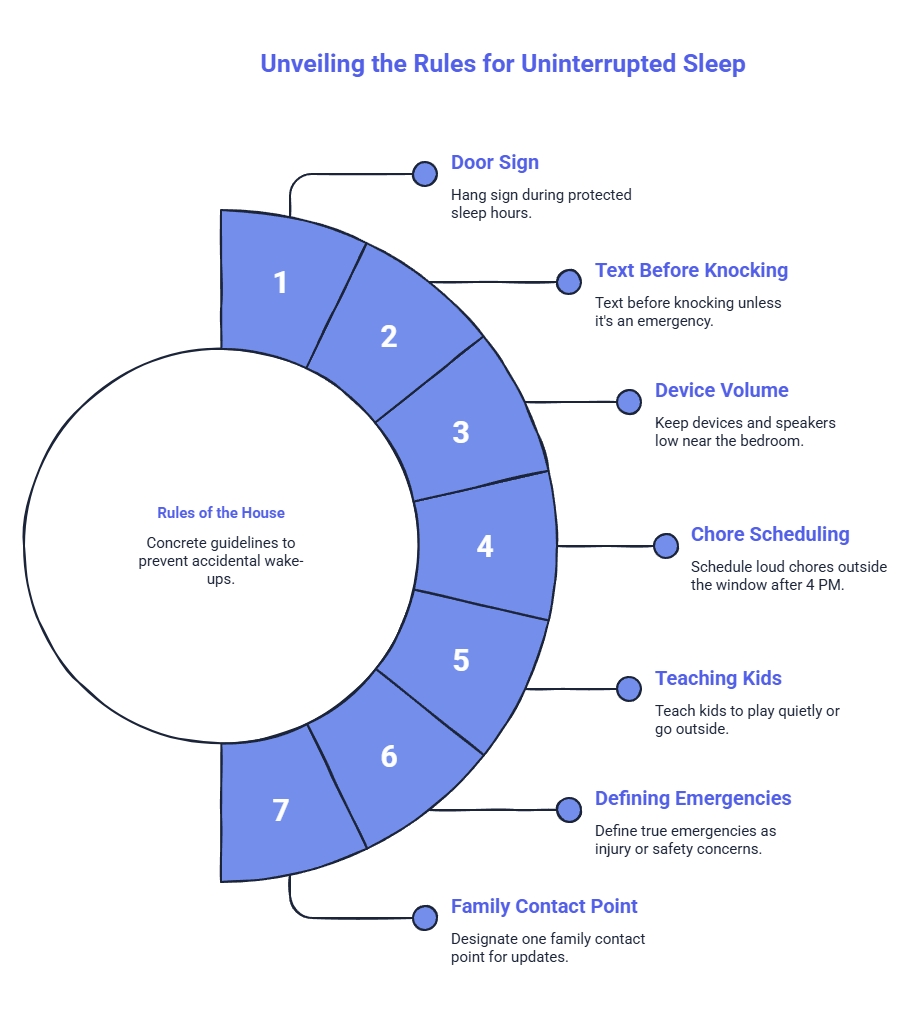
Once the conversation has happened, the household needs a short set of concrete rules. These aren’t punishments—they’re guardrails:
- Hang the door sign during protected sleep hours.
- Text before knocking. If it’s not urgent enough to text, it’s not urgent enough to knock.
- Keep devices and speakers low near the bedroom during the sleep block.
- Schedule loud chores outside the window. Vacuuming, laundry, and yard work can shift to after 4 PM.
- Teach kids what the sign means. “When the sign is up, we play quietly or go outside.”
- Define true emergencies. Injury or safety concern = wake up. A missing remote = wait.
- Pick one family contact point for updates so your door is not the household front desk.
Visible rules reduce guesswork. Guesswork wakes people up.
How Medication-Supported Sleep Fits Into the Plan
Even with quiet rules in place, some shift workers still can’t fall asleep during the day. That’s not a personal failure—it’s a powerful circadian system doing what it was designed to do. And it’s exactly the kind of problem where non-addictive, off-label sleep support can make a difference.
Options like trazodone, hydroxyzine, and clonidine are non-controlled, widely prescribed, and generally effective at helping your body settle into sleep when your circadian clock is working against you. A clinician matches the right medication to your sleep pattern—whether the problem is falling asleep, staying asleep, or calming a mind that won’t stop running after a high-stress shift. The result: you wake up restored enough to actually be present for your family when you’re off the clock.
If OTC options have left you feeling like a zombie the next day, that’s a common pattern with a clear explanation. The key is pairing the right prescription with household coordination—non-controlled sleep medications paired with good sleep habits deliver steadier results than either approach alone.
“I have a crazy work schedule and no time for doctor appointments. This was the easiest thing ever—filled out some questions, got approved, and my prescription was ready pretty fast.” — Emily R.
Create Your Family Guide to the New Sleep Schedule
Conversations fade. A one-page printable on the fridge doesn’t. Build a simple family guide to the new sleep schedule that includes:
- this week’s shift pattern
- protected sleep hours
- quiet-hours reminders
- what to do instead of waking the sleeper
- the next family check-in window
- a short note: “When I’m awake, I’m available for dinner, school pickup, or a 20-minute catch-up”
That last line matters. It reduces guilt and makes connection visible.
Pair it with a door hanger, and the household has two visual tools—the guide says when; the hanger says right now. Together, they replace guesswork with clarity. For medication timing specifics, how to time your sleep medication on a 3-day rotating shift is a useful companion to this guide. And if your schedule changes around the clock shift in spring or fall, Navigating Daylight Saving Time When You Already Work Night Shifts can help you adjust the routine with less friction.
When It’s Time to Escalate to a Medical Review
Some sleep problems go beyond what a quiet house and a door sign can fix. If your bed partner reports heavy snoring, gasping, or pauses in breathing, an at-home sleep test may be needed before any medication is prescribed. Sudden daytime sleep attacks or muscle weakness triggered by emotions may indicate narcolepsy. Uncontrollable urges to move your legs at night could signal restless legs syndrome. And physically acting out dreams—punching, shouting during sleep—may point to REM sleep behavior disorder. All of these require in-person evaluation by a sleep specialist. The NHLBI overview of sleep disorder treatments is a useful general resource on how these conditions are evaluated and treated.
For persistent insomnia without those red flags—where the core problem is simply that you cannot sleep during the day—a clinician-led review can match you with safe, non-habit-forming support. SleepScriptMD was built for workers with schedules like yours. Care is typically asynchronous in [Insert verified number of approved states] states, meaning no video calls or appointments—just a secure intake and physician review. Learn more about how asynchronous care works or meet the team behind the platform.
You Don’t Need a Perfect House. You Need a Shared System.
Remember that slammed door at 11:14 AM? It doesn’t have to end in a fight. With one honest conversation, a printed guide on the fridge, a sign on the door, and—when needed—medication that makes your limited sleep window count, your household can actually support your recovery instead of accidentally sabotaging it.
Start with the conversation. Build the guide. Hang the sign. And if sleep still won’t come, take the next step—because your rest isn’t a luxury. It’s how you stay safe, stay present, and stay healthy for the people who need you awake.
Ready to get started? Complete your secure intake in about 10 minutes—no appointment needed in most states. See pricing for details.
“Your family isn’t trying to ruin your sleep; they just operate on a different biological timeline. Communication is your best defense.”
Disclaimer: While our content is thoroughly reviewed for clarity and accuracy, it is for informational purposes and should not replace professional advice.
SleepScriptMD is an asynchronous medical platform. If you are experiencing a medical emergency or severe mental health crisis, please call 911 or proceed to your nearest emergency room.
Our Editorial Process:
Our expert team uses AI tools to help organize and structure our initial drafts. Every piece is then extensively rewritten, fact-checked, and enriched with first-hand insights and experiences by expert humans on our Insights Team to ensure accuracy and clarity.
About the SleepScriptMD Insights Team:
The SleepScriptMD Insights Team is our dedicated engine for synthesizing complex topics into clear, helpful guides. While our content is thoroughly reviewed for clarity and accuracy, it is for informational purposes and should not replace professional advice.