
📌 Key Takeaways
The author recommends tracking why daytime sleep ends early before discussing any prescription for night-shift sleep.
- Map the Waking Pattern: A clear timeline shows whether body timing, interruptions, anxiety, or limited sleep time drives early waking.
- Stronger Is Not Safer: Longer-lasting sedation may reduce waking but can impair driving, patient care, or machinery use afterward.
- Match Treatment to Cause: Clinicians should separate trouble falling asleep, repeated waking, outside triggers, and anxiety before choosing treatment.
- Consider the Full Picture: Health history, other medications, schedule stability, available sleep time, and required alertness all shape prescription fit.
- Evidence Remains Limited: Research on sleep medications for shift workers is limited and generally low quality, so no option fits everyone.
Track the pattern before chasing stronger sedation.
Night shift workers will prepare for safer medical reviews, using the sleep-tracking questions and prescription factors that follow below.
~ ~ ~ ~ ~ ~ ~ ~ ~ ~ ~ ~ ~ ~ ~ ~ ~ ~
Falling asleep after a night shift is only half the challenge. You may be exhausted enough to drift off quickly, only to wake two, three, or four hours later while daylight, household activity, and your body’s internal clock are pushing you toward alertness.
That example is not a diagnostic cutoff. It describes a pattern in which the main question is no longer only how sleep begins, but why the intended sleep period ends too soon.
For night workers, daytime sleep often conflicts with the body’s circadian wake signals. CDC/NIOSH notes that this mismatch can disturb daytime sleep, although it is rarely the only possible factor. The timing of the awakening, what triggered it, whether sleep resumes, and when full alertness is required again all help clarify the problem.
A medication that feels stronger or lasts longer is not automatically a better fit.
Waking Too Soon Is Different From Trouble Falling Asleep
Sleep onset means making the transition from wakefulness to sleep, while sleep maintenance means staying asleep and returning to sleep after an awakening.
A person may struggle with one pattern, both patterns, or different patterns on different workdays.
Early waking is also not one uniform problem. Possible contributors include:
- Circadian timing
- Rotating or unpredictable shifts
- A sleep period that is too short
- Morning light exposure
- Heat, noise, pets, children, or deliveries
- Caffeine timing
- Stress or racing thoughts
- Medication effects
- Another medical or sleep condition
The event that wakes you may also be different from the factor that keeps you awake.
For example, a nurse may wake when the home becomes warmer and noisier, then remain awake because work concerns start running through the mind. A warehouse worker may wake at nearly the same point in every daytime sleep period and immediately feel fully alert. Those patterns raise different questions, even though neither identifies a diagnosis or a specific medication by itself.
For a broader comparison of symptom patterns, see matching sleep patterns to prescription options.
Why Melatonin or Other OTC Options May Not Solve Early Waking
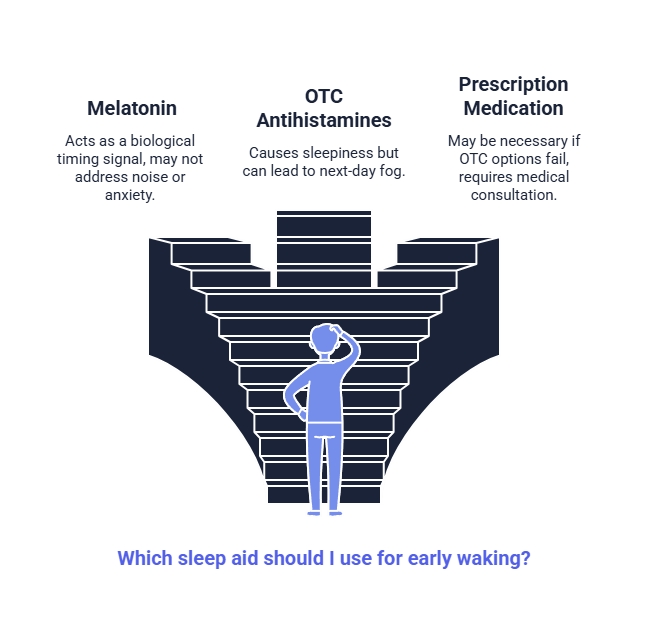
Many night workers begin with melatonin because it is accessible and commonly associated with sleep timing. Melatonin acts primarily as a biological timing signal. It may be relevant when the central problem is a mismatch between the intended sleep period and the body clock, but it does not directly remove household noise, extend a limited sleep opportunity, reverse late caffeine use, or stop anxious thinking after an awakening.
Some people also try sedating over-the-counter antihistamines. These products may cause sleepiness, but they can also leave some users foggy or slowed after waking. That matters when the next responsibility involves driving, patient care, machinery, emergency response, or another safety-sensitive task.
When OTC approaches have not helped—or have produced unacceptable next-day effects—the next step is not automatically to find the strongest prescription. The more useful question is which part of the sleep pattern needs to be addressed.
Use This Daytime Sleep Pattern Audit Before Discussing Medication
Track several sleep periods rather than relying on the most frustrating day. More than one factor may be involved.
What happens | What to track | What it may help assess | What not to assume |
|---|---|---|---|
You wake after a similar number of hours and feel fully alert | Sleep-onset time, wake time, schedule stability, and whether sleep resumes | Whether the pattern is predictable and how it relates to the intended sleep window | That medication is definitely “wearing off” |
Light, heat, noise, pets, children, or deliveries wake you | The first trigger and what happens afterward | Whether an external interruption begins the awakening and another factor sustains it | That every external awakening proves treatment failure |
You wake with racing thoughts | What you think about, how activated you feel, and how long you remain awake | Whether mental activation becomes important after waking | That one particular medication automatically fits |
You wake feeling physically “wired” | Restlessness, physical alertness, stress, heart-rate awareness, and caffeine timing | Whether activation, schedule timing, or another condition needs attention | That more sedation necessarily addresses the cause |
You wake briefly several times but return to sleep | Number and approximate length of awakenings | Whether sleep is fragmented but recoverable | That each brief awakening requires separate treatment |
You wake groggy but cannot remain asleep | Grogginess, dizziness, balance, concentration, and required alertness time | Whether residual effects and sleep continuity are poorly aligned | That a longer-lasting effect would automatically be safer |
An alarm, caregiving duty, or family schedule ends the sleep period | The protected time actually available for sleep | Whether the main limitation is insufficient sleep opportunity | That medication can create time that is not available |
For more detail about racing thoughts or anxiety that appears when trying to sleep during the day, see the guide to daytime sleep anxiety after night shifts.
Prescription Fit Depends on More Than Sedation
Sedation is not the same as appropriate treatment.
A medication discussion may consider:
- Whether the main problem is sleep onset, sleep maintenance, or both
- Whether awakening is caused by an external trigger
- Whether anxiety or physical activation appears after waking
- The intended length of the sleep period
- The time available before driving or returning to work
- Whether the work schedule is fixed or rotating
- Previous responses to sedating products
- Other prescriptions, supplements, alcohol, and caffeine
- Blood pressure, cardiovascular history, and mental health history
Feeling foggy, dizzy, unsteady, or unable to concentrate after waking connects the sleep pattern to real-world safety.
A longer duration of effect may sound useful when sleep ends too soon. However, an effect that continues later into the day may overlap with the next required period of alertness. Current prescribing information for several sedating medications includes warnings involving drowsiness, impaired thinking, driving, or operating machinery.
For example, suppose a worker plans to sleep from 9 a.m. until 4 p.m. but must drive at 4:30 p.m. A medication whose meaningful effects continue near or beyond that wake time may create a different problem, even if it reduces awakenings. How long a medication stays active in your system does not predict an individual’s exact level of impairment, but it helps explain why sleep duration, dose timing, and the next required alert period must be considered together.
With rotating schedules, the same clock time can represent very different sleep opportunities. See questions about medication timing on rotating shifts for a more detailed framework.
One Clinical and Safety Note for All Prescription Options
Medication choice, dose, timing, combination, and discontinuation should be based on a licensed medical review of the full health history, current medications, blood pressure and cardiovascular risks, substance use, pregnancy status, sleep schedule, previous medication responses, and next-day safety responsibilities.
Do not independently change a prescribed dose, combine sedating products, or abruptly stop a medication that requires tapering. Avoid driving or hazardous work while impaired.
The medication descriptions below explain factors that may enter a prescribing discussion. They are not instructions for choosing or using a medication.
What “Off-Label” Means
“Off-label” means a medication is being considered for a use that is not listed as an FDA-approved indication in its prescribing information.
It simply means the decision depends on the available evidence and the individual patient’s clinical circumstances.
SleepScriptMD focuses on clinician-reviewed, non-controlled prescription options and does not prescribe benzodiazepines or Z-drugs. Examples that may be considered when appropriate include trazodone, hydroxyzine, clonidine, doxepin, and mirtazapine. These are examples of treatment options, not a menu of guaranteed prescriptions.
How Trazodone, Hydroxyzine, Clonidine, and Mirtazapine May Enter the Discussion
Trazodone
Trazodone is FDA-approved for major depressive disorder rather than insomnia.
The 2017 American Academy of Sleep Medicine guideline issued a weak recommendation against using trazodone for chronic sleep-onset or sleep-maintenance insomnia in adults. That recommendation was not specific to shift workers, and a weak recommendation does not mean trazodone is universally ineffective.
It does mean trazodone should not be presented as a guaranteed, universally preferred, or automatic answer for waking too soon. Potential morning sedation, dizziness, other medications, and the person’s required wake time remain relevant.
Hydroxyzine
Hydroxyzine has labeled uses that include anxiety and itching. Its prescribing information warns that drowsiness may occur and advises caution with driving, dangerous machinery, alcohol, and other central nervous system depressants.
Those considerations may be especially important for someone who must commute or perform safety-sensitive work after daytime sleep.
Hydroxyzine’s sedating properties may enter a discussion when anxiety or mental activation is part of the pattern, but that does not establish that it will address every form of repeated waking.
Clonidine
Clonidine is FDA-approved for conditions other than insomnia, including hypertension in its immediate-release labeling.
Relevant considerations may include blood pressure, cardiovascular history, dizziness, other medications, and discontinuation safety. Current labeling warns against abrupt discontinuation because blood pressure can rise.
For a night worker, the discussion may also involve whether the waking pattern includes a “wired” or physically activated feeling. That symptom alone, however, is not enough to establish that clonidine is appropriate.
Mirtazapine
Mirtazapine is FDA-approved for major depressive disorder.
Its prescribing information identifies somnolence, increased appetite, weight gain, and possible impairment of judgment or motor skills among the relevant considerations.
Because its effects can extend beyond the immediate sleep period, the available sleep window and the time before driving or working are especially important. Its labeling does not establish that it will reliably prevent early waking in every night worker.
Evidence in Shift Workers Is Limited
CDC/NIOSH notes that evidence concerning sleep medications specifically in shift workers is limited and generally low in quality.
This limitation makes it difficult to rank medications specifically for daytime sleep after night work. It also supports evaluating the worker’s actual pattern rather than assuming that one option is best for everyone with the same job schedule.
Readers can review SleepScriptMD’s non-controlled prescription sleep options for broader educational information.
Questions to Bring to a Medical Review

A concise sleep timeline is usually more useful than requesting a medication by name.
Bring recent notes and a complete list of prescriptions, OTC products, and supplements. Useful questions and observations include:
- What time do you usually fall asleep and wake?
- Do you wake feeling alert, anxious, groggy, restless, or physically activated?
- Can you return to sleep? How long does it take?
- What first triggered the awakening?
- How much protected sleep time is actually available?
- When must you next drive, provide care, use equipment, or be fully alert?
- Is the work schedule fixed, rotating, or unpredictable?
- When was caffeine last used?
- Does morning light exposure differ between workdays and days off?
- Have OTC products helped, failed, or caused next-day fogginess?
- Which side effects would be especially disruptive or unsafe?
- Could circadian timing, an external interruption, anxiety after waking, or several factors be involved?
The result may involve medication, schedule changes, protection of the sleep environment, evaluation of another contributing condition, or a combination of approaches.
Practical Safety and Eligibility Check
Certain symptoms may require a different type of evaluation rather than routine online insomnia treatment.
Snoring, gasping, or witnessed breathing pauses may require sleep-apnea testing. Unexpected sleep attacks, muscle weakness triggered by strong emotion, acting out dreams, or persistent urges to move the legs may require local or specialist assessment.
Pregnancy or planned pregnancy requires individualized medical guidance and falls outside SleepScriptMD’s stated low-risk online scope. Service eligibility and availability also vary by state.
Severe sleepiness while driving, rapidly worsening symptoms, or an acute medical or mental health crisis requires urgent local care.
Frequently Asked Questions
Is waking after a few hours always a sign that medication is wearing off?
No. Circadian timing, light, temperature, noise, caffeine, stress, household demands, limited sleep opportunity, medication effects, or several factors together may contribute.
Track the first trigger, how you feel afterward, and whether sleep resumes.
Is a longer-lasting sleep medication better for daytime sleep?
Not automatically.
Duration may be relevant to sleep maintenance, but the medication’s effects must also be considered against the next required wake time. Residual drowsiness can be particularly important when driving, caring for patients, or operating equipment.
Why might melatonin not prevent early waking?
Melatonin mainly supports biological timing. It may not correct awakenings caused by noise, heat, a short sleep opportunity, late caffeine, stress, or alertness that develops after waking.
The timing of melatonin use can also matter, particularly for workers whose schedules rotate.
Can trazodone, hydroxyzine, clonidine, or mirtazapine be used after a night shift?
Non-controlled medications, including off-label options, may be considered in some cases. Working nights alone does not identify which medication, if any, is appropriate.
The relevant factors include the sleep pattern, medical history, other medications, available sleep window, previous responses, and required alertness after waking.
When should a night worker seek a sleep specialist or local evaluation?
Seek appropriate evaluation when the pattern includes possible breathing pauses, unexpected sleep attacks, emotion-triggered muscle weakness, dream enactment, persistent leg urges, or another symptom that may require testing.
These symptoms do not confirm a diagnosis, but they may change the safest care pathway.
Turn the Waking Pattern Into a Useful Clinical Conversation
The most useful next step is not selecting the strongest-sounding medication. It is documenting when sleep begins, when it ends, what interrupts it, how you feel after waking, and when you must be fully alert again.
Eligible adults can share these details through SleepScriptMD’s secure digital intake. A licensed physician reviews the sleep pattern alongside the patient’s medical history, current medications, and safety considerations.
Where service is available, Start Your Sleep Treatment through SleepScriptMD’s clinician-reviewed process. Completing an intake does not guarantee that a prescription will be issued.
Disclaimer: This article is for general informational purposes only and does not constitute medical advice, diagnosis, or treatment. Guidance for an individual patient should come from a licensed healthcare professional familiar with that person’s health history, symptoms, medications, and safety responsibilities.
Our Editorial Process:
Our expert team uses AI tools to help organize and structure our initial drafts. Every piece is then extensively rewritten, fact-checked, and enriched with first-hand insights and experiences by expert humans on our Insights Team to ensure accuracy and clarity.
By: SleepScriptMD Insights Team
Reviewed by: David Danish, MD, Chief Psychiatric Officer, and Peter Kelly, DO, Chief Medical Officer. Dr. Danish is double board-certified in adult and child/adolescent psychiatry, and Dr. Kelly is a board-certified family medicine physician with over 10 years of clinical practice.