
📌 Key Takeaways
Better sleep-medication discussions start with the exact sleep problem, not the strongest-sounding pill.
- Name The Pattern: Falling asleep, staying asleep, racing thoughts, and physical tension may lead to different clinical conversations.
- Share Safety Details: Work schedule, wake time, driving needs, alcohol use, and medications help clinicians judge fit.
- Expect Careful Review: Non-controlled sleep medications can still carry risks and need personalized medical review.
- Watch For Red Flags: Snoring, gasping, sudden sleep attacks, or acting out dreams may need local evaluation first.
- Plan For Clear Waking: Grogginess risk depends on timing, sleep window, schedule changes, and personal response.
The right question is not “Which sleep pill is strongest?” but “What sleep problem needs review?”
Night-shift workers struggling after clock-out will gain clearer language for clinician intake, guiding them into the treatment-specific details that follow.
~ ~ ~ ~ ~ ~ ~ ~ ~ ~ ~ ~ ~ ~ ~ ~ ~ ~
You clock out exhausted, get home after sunrise, and expect sleep to come quickly. Instead, your mind keeps replaying the shift. Or your body still feels keyed up. Or you fall asleep, then wake at noon with several hours of rest still missing.
At that point, the question often becomes: “Do I need trazodone, hydroxyzine, clonidine, or something else?”
A better starting point is: “What sleep pattern is actually keeping me awake after my night shift?”
That distinction matters. Non-controlled prescription options are not interchangeable, and medication choice should not be based on whichever sleep aid sounds strongest. A licensed clinician may look at whether the main issue is falling asleep, staying asleep, racing thoughts, physical hyperarousal, early waking, or grogginess risk before discussing fit.
SleepScriptMD’s medication education materials describe trazodone, hydroxyzine, and clonidine as non-controlled prescription options that may come up in different symptom-pattern contexts. The goal is not to self-select a medication.
The goal is to provide a detailed history of your symptoms so a clinician can determine if a non-controlled medication may be an appropriate treatment. A more useful approach is to focus on accurately describing your specific sleep barriers—rather than attempting to pre-select a specific medication—to facilitate an evidence-based clinical assessment. All prescription medications for sleep carry unique benefits and risks, and their use for sleep disorders is often ‘off-label,’ meaning they have not been FDA-approved specifically for this indication.
Clinicians may consider several practical questions first:
- Is the main problem falling asleep, staying asleep, or waking too early?
- Are racing thoughts the main barrier, or does the body feel physically keyed up?
- How long is the sleep window before driving, work, or family obligations?
- What medications, medical history, alcohol use, and safety factors need review?
- Are there symptoms that suggest another sleep disorder needs screening?
SleepScriptMD’s prescription sleep aids page explains its non-controlled medication focus. For general patient education about specific medications, MedlinePlus also provides plain-English drug information for trazodone, hydroxyzine, and clonidine. Those external resources are useful for general background, but a prescription decision still requires clinician review.
Why Night-Shift Sleep Problems Feel Different
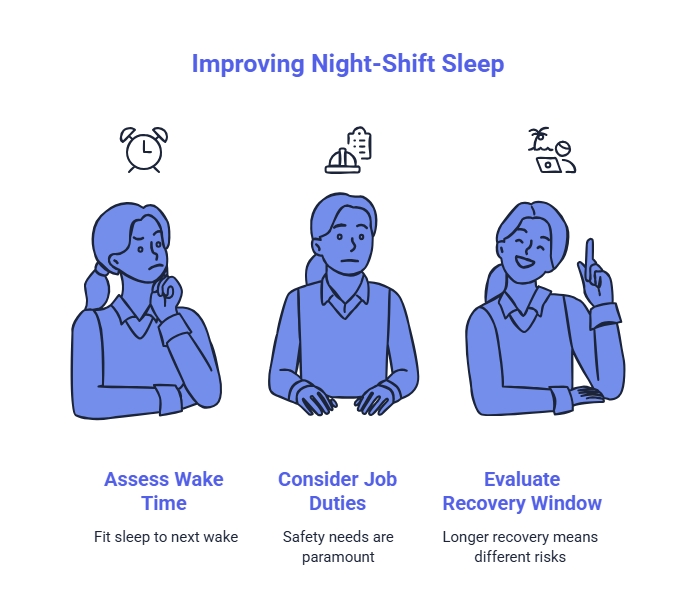
Night-shift sleep is not simply regular bedtime moved to a different hour.
After overnight work, the body may be tired while the environment keeps signaling wakefulness: daylight, errands, family noise, phone notifications, and the mental residue of the shift. Rotating schedules can add another layer because the body may not get a stable pattern long enough to adjust.
CDC/NIOSH provides workplace fatigue resources for shift work and long work hours, including training materials for nurses and other workers managing fatigue-related risks. That context supports a widely accepted point: irregular or overnight work can make sleep timing and alertness planning more complicated.
For medication conversations, the practical issue is not only whether a medication can help sleep. It is whether the sleep plan fits the worker’s next required wake time, commute, job duties, and safety needs. A worker who must drive at 4:00 PM after sleeping from 8:00 AM to 3:00 PM has a different risk conversation than someone with a longer recovery window.
For broader schedule support, SleepScriptMD has a related guide on shift worker circadian realignment. The focus here stays narrower: how to describe the sleep pattern before discussing non-controlled prescription options.
The Pattern-Fit Table: What To Tell The Clinician
Use this table as conversation prep, not as a medication-matching quiz.
What happens after your shift? | What it may suggest discussing | Off-label options for clinical discussion | What the clinician still needs to check |
|---|---|---|---|
You cannot fall asleep because thoughts keep looping | Racing-thought or anxiety-like activation pattern | Hydroxyzine may be discussed | Medication list, sedation risk, alcohol use, timing, health history |
You fall asleep but wake too early or repeatedly | Sleep-maintenance pattern | Trazodone may be discussed | Morning grogginess risk, current medications, safety screen, sleep window |
Your body feels keyed up and will not downshift | Hyperarousal or “wired but tired” pattern | Clonidine may be discussed | Blood pressure history, cardiovascular history, medications, dizziness risk, alertness needs |
You sleep but wake foggy | Timing, dose, sleep-window, or schedule issue | Not necessarily a medication mismatch | Wake-time demands, driving, sleep length, rotating schedule, clinician follow-up |
You snore, gasp, act out dreams, have sudden sleep attacks, or strong leg urges | Possible condition needing screening or local care | Online prescription may not be the right first step | Sleep testing, primary care, or local specialist evaluation |
A few terms can make the intake conversation clearer.
Sleep onset means falling asleep. Sleep maintenance means staying asleep. Hyperarousal means the body or nervous system feels activated even when the person is tired. Non-controlled medication means the medication is not in the same controlled-substance category as benzodiazepines or Z-drugs.
That is why “the strongest sleep medication” is usually the wrong frame. A more useful question is whether the option fits the sleep pattern, health history, medication list, sleep window, and next-shift alertness needs.
To learn more about SleepScriptMD’s medication education model, see its overview of non-addictive sleep med options.
If Your Main Issue Is Racing Thoughts After Clock-Out
Some night shift workers can leave the building but not the shift.
A nurse may replay patient-care tasks. A dispatcher may keep hearing the last call. A warehouse worker may think through tomorrow’s family schedule while trying to sleep at 8:30 AM. The body is in bed, but the mind keeps looping.
That pattern often belongs in the sleep-onset conversation. It does not automatically mean the person has an anxiety disorder. It does mean the clinician should know that mental activation, rather than repeated waking, is the dominant barrier.
Hydroxyzine is often evaluated when anxiety-like activation or racing thoughts disrupt the transition into sleep. A clinician still needs to review current medications, alcohol use, sedation risk, health history, sleep timing, and what the worker must do after waking.
For medication-specific education, review SleepScriptMD’s hydroxyzine online prescription page and MedlinePlus’s general hydroxyzine drug information.
If You Fall Asleep But Wake Too Early Or Keep Waking Up
For other workers, the first hour of sleep is not the problem. The problem is staying asleep long enough to recover.
A warehouse worker may fall asleep at 8:30 AM and wake at noon again and again. A security worker may drift off quickly, then wake every time a delivery truck passes or sunlight leaks into the room. Early waking can feel especially frustrating because the worker did technically fall asleep, but not long enough to feel restored.
That pattern is closer to a sleep-maintenance conversation.
For patients struggling primarily with frequent awakenings or abbreviated sleep cycles, trazodone frequently enters the clinical conversation. That should not be interpreted as a personal recommendation. A clinician still needs to know how often waking happens, how long the person stays awake, what time clear-headedness is required, and whether other medications or health factors change the safety picture.
Repeated waking also does not automatically mean a higher dose is needed. Timing, daylight, caffeine, sleep debt, household noise, medication fit, and a separate sleep concern can all affect the pattern. Medication-specific details should be reviewed with a licensed clinician, and general trazodone information is available from MedlinePlus.
If Your Body Feels Wired Even When You Are Exhausted
“Wired but tired” is not always the same as racing thoughts.
Racing thoughts feel mental: replaying conversations, worrying about tasks, or running through the next day’s obligations. Wired-but-tired sleep is often a physical sensation. The body remains in a state of sympathetic nervous system hyperarousal—feeling alert, braced, or physically unable to downshift despite exhaustion. An EMT or emergency worker after an intense shift may experience this as a residual physiological surge, where the body remains physiologically activated despite the mental intent to sleep.
When physical hyperarousal—feeling physically braced despite exhaustion—is the primary barrier, clonidine may be considered. That conversation requires careful medical review. Blood pressure history, cardiovascular history, dizziness risk, current medications, and next-shift alertness may all matter.
For more background, see SleepScriptMD’s clonidine prescription online education page and MedlinePlus’s general clonidine drug information.
Morning Grogginess Is Part Of The Medication-Fit Question
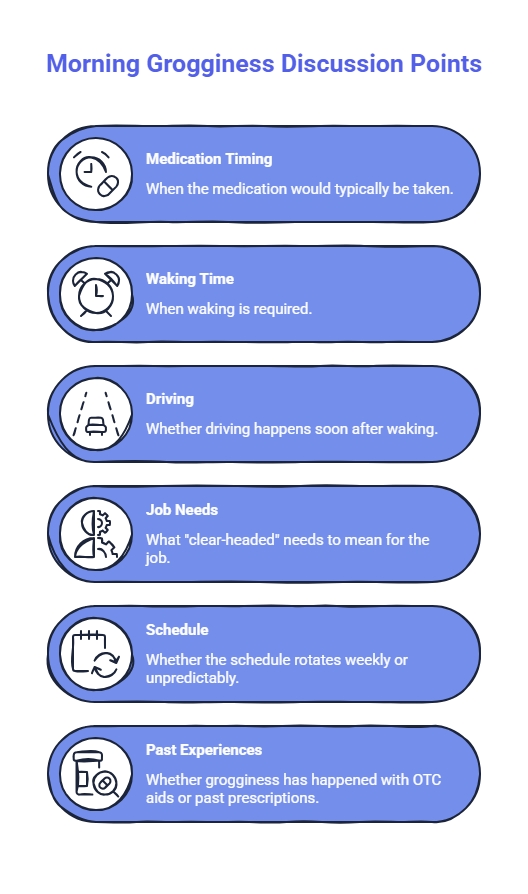
For night shift workers, sleep is only half the concern. The other half is waking up clear enough to function.
Morning grogginess may stem from the medication, but it may also be caused by a short sleep window, dose timing, accumulated sleep debt, or late caffeine intake. Clinicians distinguish between simple fatigue and ‘residual sedative effects’ (often called a ‘hangover’ effect), where the medication’s half-life outlasts the planned sleep window. Because the cause varies by person and schedule, this should be explicitly discussed with your clinician.
A practical way to prepare is to tell the clinician:
- When the medication would typically be taken
- When waking is required
- Whether driving happens soon after waking
- What “clear-headed” needs to mean for the job
- Whether the schedule rotates weekly or unpredictably
- Whether grogginess has happened with OTC aids or past prescriptions
Grogginess does not always mean the medication failed. It may mean the plan needs adjustment, the sleep window is too short, or another factor is interfering with recovery.
SleepScriptMD has related resources on how to time sleep medication on rotating shifts, medication timing windows, and morning grogginess on sleep medication.
What SleepScriptMD needs to know before a prescription decision
SleepScriptMD describes its care model as asynchronous sleep care: a secure digital intake, clinician review, and e-prescribing if treatment is approved. That model can reduce appointment friction where available and appropriate, but it is still medical care, not automatic prescribing.
Before starting intake, gather the details a clinician needs to evaluate fit.
What to tell your clinician
- Work schedule, including rotating shifts
- Usual post-shift bedtime and wake time
- Whether the main issue is falling asleep, staying asleep, racing thoughts, or physical activation
- Caffeine timing, alcohol use, and OTC sleep aid use
- Current prescription medications, OTC medications, and supplements
- Medical history, pregnancy status, and mental health or substance-use concerns
- Snoring, gasping, stopping breathing during sleep, sudden sleep attacks, leg urges, or acting out dreams
- Driving, caregiving, or job duties that require clear alertness after waking
That information helps the clinician decide whether online medication review is appropriate, whether a non-controlled medication may fit the pattern, and whether another evaluation should come first.
To understand the care model, review SleepScriptMD’s page on asynchronous sleep care. When ready for clinician review, Start Your Sleep Treatment.
When Online Sleep Medication May Not Be The Right First Step
Online sleep medication is not appropriate for every sleep concern.
SleepScriptMD care is intended for qualified, low-risk adults. Some symptoms may point to a need for sleep testing, primary care, or local specialist evaluation before prescription sleep medication is considered.
Practical safety check before intake
Online medication review may not be the right first step when any of the following apply:
- Pregnancy or plans to become pregnant
- Major medical, mental health, or substance-use concerns that may affect medication safety
- Snoring, gasping, or stopping breathing during sleep
- Sudden daytime sleep attacks or symptoms that may suggest narcolepsy
- Acting out dreams, yelling, kicking, or punching during sleep
- Strong urges to move the legs at rest or during the night
- Need for controlled substances such as benzodiazepines or Z-drugs
SleepScriptMD states that it does not prescribe controlled substances, including benzodiazepines and Z-drugs. That boundary is part of a non-controlled medication model. However, this boundary does not imply that non-controlled medications are universally appropriate or free from contraindications.
FAQs
What if falling asleep is easy, but waking too early is the problem?
That may be a sleep-maintenance pattern to discuss with a clinician. It does not automatically mean a different dose or stronger medication is needed.
What if the mind races after work?
Racing thoughts are important to disclose because they may point to a different medication discussion than repeated waking or physical hyperarousal. They should not be treated as a self-diagnosis.
What does “wired but tired” mean after a night shift?
It often describes physical activation despite exhaustion. It is a pattern to describe to a clinician, not a diagnosis.
Can sleep medication make someone groggy before the next shift?
Grogginess can happen with sleep medications, and timing, sleep window, individual response, schedule rotation, and other factors may matter. Next-shift alertness should be part of the medical review.
When should a night shift worker seek local care instead?
Local care or screening may be needed when symptoms suggest sleep apnea, narcolepsy, REM sleep behavior disorder, active restless legs concerns, pregnancy, or major medical, mental health, or substance-use complexity.
Next Step: Prepare For A Safe Medication Review
A better medication conversation starts with a better description of the problem.
Instead of starting with “Which sleep pill is strongest?” start with the pattern: racing thoughts, early waking, repeated waking, wired-but-tired activation, or grogginess risk. Add the schedule details that shape safety: clock-out time, bedtime, required wake time, driving needs, rotating shifts, caffeine timing, and current medications.
That preparation makes the clinician review more useful. It also helps identify when online sleep care may fit and when another evaluation should come first.
To review SleepScriptMD’s medication education, see its page on non-controlled prescription sleep aids. For transparent cost details regarding the intake and prescription process, review the current pricing options.
Disclaimer:
This article is for general informational purposes only and does not constitute medical advice, diagnosis, or treatment. Readers should consult a licensed healthcare professional for guidance specific to their health, symptoms, medications, or treatment options.
Our Editorial Process:
Our expert team uses AI tools to help organize and structure our initial drafts. Every piece is then extensively rewritten, fact-checked, and enriched with first-hand insights and experiences by expert humans on our Insights Team to ensure accuracy and clarity.
By: SleepScriptMD Insights Team
Reviewed by: David Danish, MD, Chief Psychiatric Officer, and Peter Kelly, DO, Chief Medical Officer. Dr. Danish is double board-certified in adult and child/adolescent psychiatry, and Dr. Kelly is a board-certified family medicine physician with over 10 years of clinical practice.