
📌 Key Takeaways
Shift-work insomnia often needs a sleep plan that matches your real schedule, not just a darker room.
- Timing Drives Sleep: Night-shift sleep can fail when your body still reads morning as wake-up time.
- Darkness Is Not Enough: Blackout curtains help, but light, noise, meals, and routine still affect sleep.
- Plans Beat Guessing: A clinician-reviewed plan may match sleep support to your actual sleep problem.
- Safety Comes First: SleepScriptMD focuses on non-controlled options and screens for risks before treatment.
- Wake-Up Clarity Matters: Shift workers need sleep support that also protects alertness for work, driving, and caregiving.
Better shift-worker sleep starts with matching care to the clock your life actually uses.
Shift workers with persistent insomnia will gain a clearer path to safer sleep support, preparing them for the detailed overview that follows.
~ ~ ~ ~ ~ ~ ~ ~ ~ ~ ~ ~ ~ ~ ~ ~ ~ ~
The sun is up.
You get home after a night shift, pull the blackout curtains tight, silence your phone, and crawl into bed while the rest of the neighborhood starts moving. The room is dark. The fan is running. Your body is exhausted.
Still, sleep does not come.
That is the frustrating part of shift-work insomnia. You can do the “right” sleep-hygiene things and still feel wide awake at the exact time you need recovery. The problem is not weakness. It is timing. Your work schedule is asking your body to sleep when your internal clock is still receiving signals for daytime alertness.
For many qualified adults, that is where circadian realignment and safe, non-controlled prescription care can work together. Blackout curtains help with the room. A medically reviewed sleep plan helps with the bigger issue: getting your body to rest during the sleep window your life actually gives you.
What You’ll Learn
This guide explains why blackout curtains often are not enough for shift workers, how circadian realignment works in plain English, and where non-controlled prescription sleep support may fit.
You will also learn how SleepScriptMD approaches safe online sleep care for eligible adults ages 18–64, why controlled substances are not part of the model, and what practical next step to take if your schedule keeps wrecking your sleep.
Why Shift Workers Can Feel Exhausted but Still Unable to Sleep
Shift-work sleep problems often start with a mismatch between two clocks.
One clock is your work clock. It says your shift ended at 7:12 AM, so now it is time to sleep.
The other clock is your body clock. It responds to light, activity, meals, temperature, and routine. When morning light hits your eyes after a night shift, your brain may read that as a wake-up cue, even if you are desperate for sleep.
The National Heart, Lung, and Blood Institute explains that circadian rhythm disorders can happen when the body’s internal clock is out of sync with the environment. That is the core shift-worker problem. Your environment and schedule are asking for two different things at once.
Blackout curtains reduce light. They do not automatically erase every daytime alerting signal.
That is why a night-shift nurse, warehouse worker, dispatcher, first responder, or rotating-shift employee may lie in a dark room and still feel wired. The room says “night.” The body says “day.”
Circadian Realignment, in Plain English
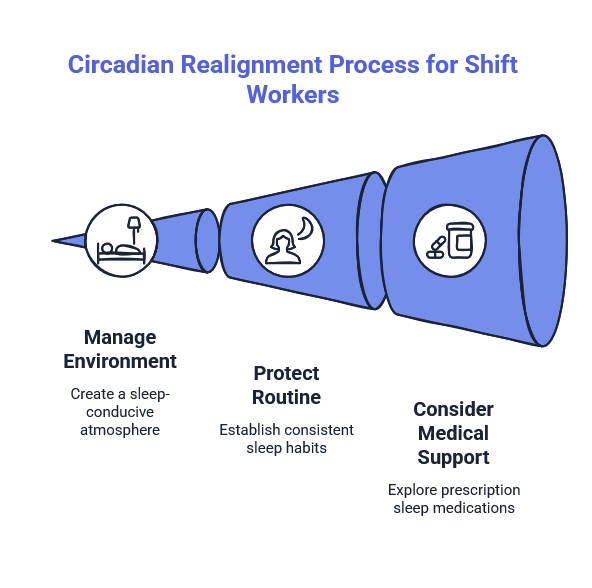
Circadian realignment means helping your sleep-wake rhythm match the schedule you actually live on.
It does not mean forcing your body into perfect sleep every day. It also does not mean relying only on willpower, melatonin, or a darker bedroom. It means building a practical plan around your real sleep window.
For shift workers, that plan usually has three parts.
First, manage the environment. This includes blackout curtains, a cool room, white noise, sunglasses after work, and limiting bright light before sleep.
Second, protect the routine. A short wind-down routine, caffeine cutoff, phone boundary, and household communication can make daytime sleep less fragile.
Third, consider medical support when appropriate. For eligible adults, non-controlled prescription sleep medications may help create a more reliable sleep window without using habit-forming controlled substances.
That third piece matters because shift workers are not only trying to fall asleep. They are trying to wake up clear enough to drive, chart, lift, monitor, calculate, respond, or make safe decisions.
Where Non-Controlled Sleep Medication Fits
A safe shift-worker sleep plan should not be “take something strong and hope for the best.” It should match the medication option to the sleep pattern.
SleepScriptMD focuses on non-controlled prescription options such as trazodone, hydroxyzine, and clonidine. These medications are commonly used in clinical care for insomnia-related patterns and are not benzodiazepines or Z-drugs.
For the right patient, a non-addictive sleep med may help support sleep without the dependency concerns associated with controlled sedatives. The right choice depends on the person’s symptoms, health history, current medications, work schedule, and clinical review.
For example, one person may struggle to fall asleep after a shift because their nervous system still feels activated. Another may fall asleep but wake after 3 hours. A third may sleep, but wake with heavy grogginess that makes the next shift harder.
These distinct sleep architecture disruptions may benefit from targeted pharmacological interventions rather than a universal sedative approach.
SleepScriptMD’s role is to help eligible adults move from guessing to a physician-reviewed plan. The goal is practical: better sleep, fewer next-day problems, and a safer path back to alertness.
Why OTC Sleep Aids Can Be a Poor Fit for Rotating Schedules
Over-the-counter sleep aids are easy to reach for after another failed sleep day. That does not make them the best fit for every shift worker.
Some OTC sleep aids use sedating antihistamines, including diphenhydramine. MedlinePlus notes that diphenhydramine may cause drowsiness, and people should understand how it affects them before driving or operating machinery.
For a shift worker, the issue is not only whether a product makes you sleepy. The issue is whether the drowsiness overlaps with your next commute, patient handoff, production line, dispatch shift, or childcare responsibilities.
That is the “zombie hangover” problem many shift workers describe. The medication may create sedation, but the wake-up may feel heavy and unreliable.
This does not mean every OTC option is wrong. It means rotating schedules need more precision. When your sleep window moves, your sleep aid has to be judged by both sides of the result: sleep quality and wake-up clarity.
A clinician-reviewed safe sleeping pill option may be a better fit for some eligible adults because the decision starts with your pattern, not a pharmacy shelf guess.
The Shift Worker Sleep Solution: Medical Support When Habits Aren’t Enough
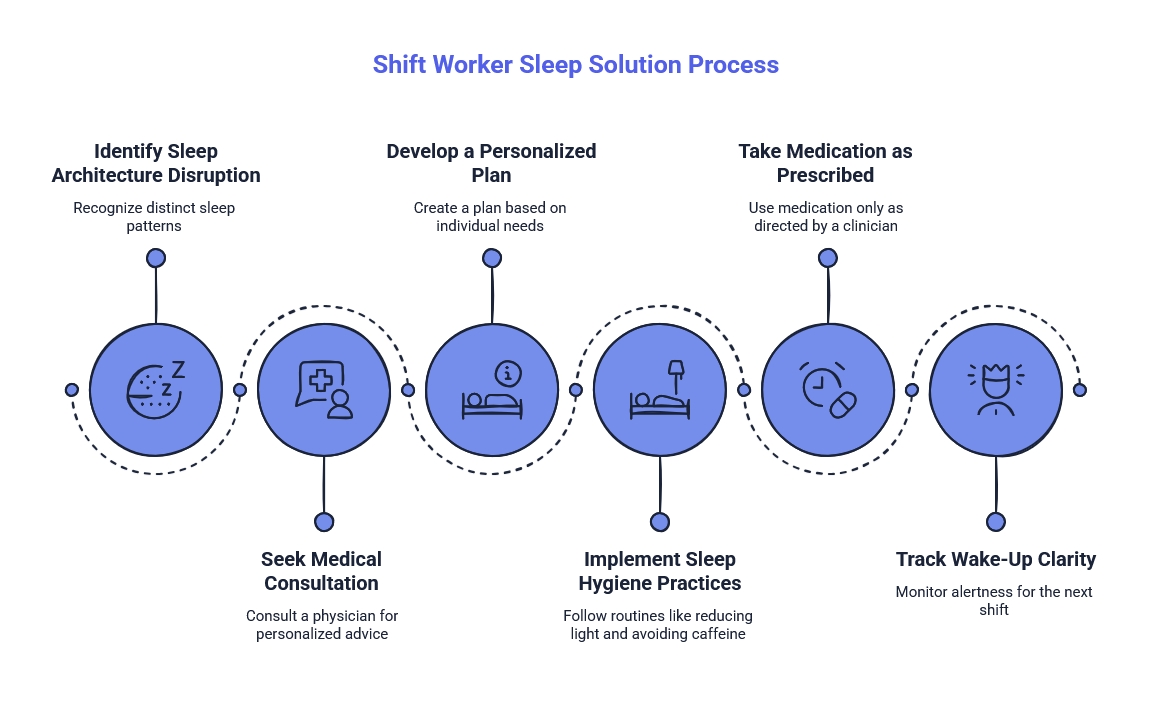
Habits still matter, but they may not always be the whole solution when insomnia is persistent and schedule-driven.
A medication-supported plan does not replace common-sense routines. It makes those routines more useful. Think of the prescription as one part of the plan, and the wind-down routine as the runway that helps it work better.
A practical post-shift plan may look like this:
- Reduce bright light on the way home.
- Keep the room cool, dark, and quiet.
- Avoid alcohol with sleep medication.
- Keep caffeine away from the planned sleep window.
- Take medication only as directed by the prescribing clinician.
- Track whether you wake clear enough for your next shift.
This is a comprehensive approach: combining sleep hygiene with medical support when appropriate. The habits are there to support the prescription plan, not to replace medical care when medical care is appropriate.
A shift worker does not need another lecture about discipline. They need a plan that respects the job.
How SleepScriptMD Handles Safety Without Making Care Feel Complicated
SleepScriptMD is built for time-pressed adults who want safe, non-controlled sleep medication care with minimal appointment friction.
The model is straightforward: you complete a secure online intake, a licensed medical professional reviews your information, and if treatment is appropriate, a prescription can be sent to a pharmacy. In states where asynchronous care is permitted, this can often happen without a live appointment. Some states may require a brief virtual visit before prescribing.
That state-law nuance matters. No online sleep clinic should promise the same process everywhere.
SleepScriptMD treats low-risk adults ages 18–64. The clinical review looks for factors that could make online treatment inappropriate, including pregnancy, certain medical risks, active substance use concerns, severe mental health concerns, or symptoms that suggest a different sleep disorder.
This is safety as a filter, not a scare tactic.
Practical Safety Box
SleepScriptMD may be a fit if you are an adult ages 18–64, low risk, and looking for non-controlled prescription help for persistent insomnia.
Local or in-person care may be safer if you have symptoms such as sudden daytime sleep attacks, dream enactment, active restless legs evaluation, untreated sleep apnea concerns, pregnancy, or complex medical/mental health needs.
Before taking any sleep medication, tell your provider about current prescriptions, supplements, alcohol use, medical conditions, and your required wake-up time. Common side effects can include next-day drowsiness, dry mouth, dizziness, or feeling less alert than expected. Your provider can help you adjust the plan when needed.
What SleepScriptMD Does Not Prescribe
SleepScriptMD does not prescribe controlled substances such as Ambien, Xanax, benzodiazepines, or Z-drugs.
That is a key part of the brand’s care model. The focus is on non-controlled, non-habit-forming options that can be used as part of a physician-reviewed sleep plan.
This matters for shift workers who are worried about dependency, morning fog, or needing to perform safely after sleep. You should not have to choose between untreated insomnia and a treatment path that does not match your risk comfort level.
A safe, routine prescription option can be the middle path.
How to Know Whether Medication Support Is the Right Next Step
A non-controlled prescription may make sense when insomnia is persistent, affects work or daily function, and does not improve with basic schedule adjustments.
It may also make sense when the pattern is clear. For example, you can identify that you consistently cannot fall asleep after night shifts, wake too early during daytime sleep, or feel trapped between exhaustion and alertness.
A quick self-check can help:
You may be ready for medical review if poor sleep is affecting focus, mood, safety, or recovery, and you want a non-controlled option reviewed by a clinician.
You may need a different path if your symptoms suggest sleep apnea, narcolepsy, REM Sleep Behavior Disorder, active Restless Legs Syndrome evaluation, pregnancy, or another complex issue that needs local care.
That distinction protects both access and safety. The right patients should be able to get help quickly. The wrong clinical situations should be routed to the right level of care.
How Asynchronous Sleep Care Works
For many shift workers, traditional appointments are part of the problem. You may be sleeping when the clinic is open. You may be working when calls are returned. You may simply not have another hour to spend explaining the same sleep problem again.
SleepScriptMD’s online model is designed to reduce that friction.
The usual process is:
- Start with a secure online intake.
- Share your sleep pattern, medical history, and current medications.
- A licensed clinician reviews your information.
- If appropriate, treatment is prescribed and sent to your pharmacy.
- You follow the plan and use support channels when needed.
Where permitted, this model can save time because it does not require a traditional office visit. Clinical timing can also vary based on state rules, medical complexity, provider availability, and whether more information is needed.
That is why the next step should be simple, not exaggerated: Start Your Sleep Treatment and let the clinical review determine what is appropriate.
What About Cost?
Pricing can change, so the most accurate place to review current fees is the official Pricing page.
The important point is that SleepScriptMD is designed around transparent access to physician-reviewed sleep medication care. Medication costs may be separate from the clinical review, and pharmacy costs can vary by medication, insurance status, and pharmacy.
That is normal. What matters is knowing the cost structure before you move forward.
A Comprehensive Plan for Your Next Sleep Window
The most useful sleep plan starts with your next real sleep opportunity.
Not the perfect schedule. Not the schedule a day worker would use. Your actual window.
Ask three questions before your next post-shift sleep block:
What time do you need to be alert again?
What is the main problem: falling asleep, staying asleep, or waking groggy?
Have you been guessing with OTC products instead of getting a clinical review?
If the answer to that last question is yes, a non-controlled prescription pathway may be worth considering. You can see which meds SleepScriptMD offers before starting care, then decide whether the intake is the right next step.
The best shift-worker plan does not treat sleep as an afterthought. It treats sleep as part of work readiness.
Frequently Asked Questions
What is circadian realignment for shift workers?
Circadian realignment means helping your sleep-wake rhythm match your real work schedule. For shift workers, that often means combining light control, routine changes, and, when appropriate, non-controlled prescription sleep support.
Are blackout curtains enough for night-shift sleep?
Blackout curtains help reduce light, but they may not fully solve shift-work insomnia. Your body can still receive daytime alerting signals from sunlight, noise, activity, meals, and schedule changes.
What medications does SleepScriptMD offer?
SleepScriptMD focuses on non-controlled options such as trazodone, hydroxyzine, and clonidine. These are prescription medications, so a clinician must review your history before determining what is appropriate.
Does SleepScriptMD prescribe Ambien or Xanax?
No. SleepScriptMD does not prescribe controlled substances such as Ambien, Xanax, benzodiazepines, or Z-drugs.
Can shift workers get care without a traditional appointment?
Often, yes, where state law permits asynchronous care. Some states may require a brief virtual visit before prescribing. The intake process will help determine what applies.
Who is SleepScriptMD designed for?
SleepScriptMD is designed for low-risk adults ages 18–64 with persistent insomnia who want a safe, non-controlled prescription option and minimal appointment friction.
When should someone seek local care instead?
Local care may be safer for suspected narcolepsy, REM Sleep Behavior Disorder, active Restless Legs Syndrome workups, untreated sleep apnea concerns, pregnancy, severe mental health concerns, active substance use concerns, or complex medical conditions.
What to Do Next
If shift work keeps breaking your sleep, the next step is not another random product from the pharmacy aisle. The next step is a safer decision process.
Start by reviewing SleepScriptMD’s prescription sleep aids to understand the non-controlled options available. Then, when you are ready, Start Your Sleep Treatment through the secure intake process.
Blackout curtains can help your room look like night.
A medication-supported sleep plan can help your body treat the sleep window like it matters.
Disclaimer: This article is for educational purposes only and does not replace medical advice, diagnosis, or treatment from a licensed clinician. Treatment availability, prescription decisions, care format, and timing may vary by state law, eligibility, clinical appropriateness, and provider review.
Our Editorial Process:
Our expert team uses AI tools to help organize and structure our initial drafts. Every piece is then extensively rewritten, fact-checked, and enriched with first-hand insights and experiences by expert humans on our Insights Team to ensure accuracy and clarity.
By: SleepScriptMD Insights Team
Reviewed by: David Danish, MD, Chief Psychiatric Officer, and Peter Kelly, DO, Chief Medical Officer. Dr. Danish is double board-certified in adult and child/adolescent psychiatry, and Dr. Kelly is a board-certified family medicine physician with over 10 years of clinical practice.