
📌 Key Takeaways
The author recommends matching prescription timing to a protected sleep window and tracking alertness before driving or safety-sensitive work.
- Plan From Wake Time: Required wake time sets the safe sleep window, including commuting, responsibilities, wind-down, and predictable interruptions.
- Time Caffeine Around Sleep: Late-shift caffeine can disrupt post-shift sleep, so timing matters more than a fixed clock cutoff.
- Keep Wind-Down Simple: A brief, prepared routine reduces decisions and stimulation without becoming a rigid hour-long program.
- Protect Daytime Sleep: Darkness, quiet, and household planning can limit interruptions, but they cannot replace enough clinician-recommended sleep time.
- Track Waking Clarity: A first-week record helps prescribers spot patterns in sleep, caffeine, interruptions, and alertness without unsafe self-adjustments.
Protect the sleep window, then protect alertness.
Night shift workers starting a sleep prescription will plan safer daytime rest using the practical first-week steps that follow below.
~ ~ ~ ~ ~ ~ ~ ~ ~ ~ ~ ~ ~ ~ ~ ~ ~ ~
Your night shift ends, the sun is rising, and the rest of the household may be starting its day. You may feel physically exhausted while caffeine, bright light, unfinished responsibilities, and the pressure of your next required wake time keep your mind alert.
A sleep prescription does not operate separately from those conditions. During the first week, the practical goal is to coordinate the prescription instructions with a realistic planned sleep period, reduce avoidable interruptions, and observe how clearly you function after waking.
Follow the prescription label and use the medication as directed by your prescriber. Protect the sleep opportunity your clinician recommends, reduce late-shift stimulation where practical, and track post-sleep alertness. These steps support clinician-supervised care; they do not determine the correct dose or timing for you. Readers comparing care approaches can review SleepScriptMD’s non-controlled prescription sleep options.
Start With the Time You Must Be Awake and Alert
Clock-out time does not automatically equal medication time. Start with the next point when you must be fully awake for driving, childcare, an appointment, caregiving, or another safety-sensitive shift.
Your available sleep opportunity is the usable period between completing essential responsibilities and the required wake time. It includes more than the hours you hope to spend asleep. Account for the commute home, necessary tasks, a short wind-down, the time it may take to fall asleep, and predictable interruptions.
A practical planning order is:
Required alertness → commute and responsibilities → available sleep opportunity → prescription and prescriber instructions
Consider a hypothetical example. A worker finishes at 7:00 a.m. but must attend an appointment at noon. That person has a very different sleep opportunity from someone who can remain in bed until late afternoon. The example does not establish when medication should be taken. It shows why a shortened or uncertain window belongs in a prescriber conversation. Non-controlled sleep medications generally have an active duration of several hours, which is why calculating this window accurately is so critical.
Do not take a potentially sedating medication before driving home unless your prescriber has specifically addressed that situation and confirmed it is safe. The U.S. Food and Drug Administration advises that some medicines can affect attention, coordination, and driving for hours or into the next day.
If the available sleep period is shorter than your clinician recommended, contact the prescriber rather than improvising. Do not move, split, skip, increase, or decrease a dose independently.
Treat Caffeine Timing as Relative to Sleep, Not the Clock
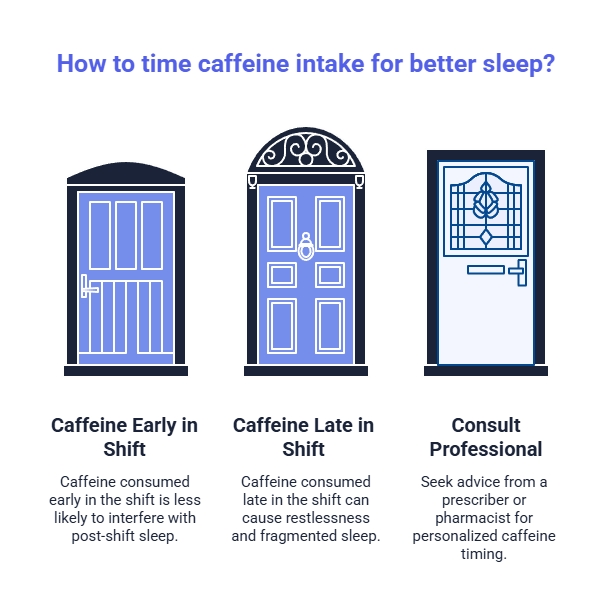
A rule such as “no caffeine after 2 p.m.” does not fit someone who may be asleep at 2 p.m. For night shift workers, caffeine timing should be considered relative to the planned sleep period.
First, inventory every source used during the shift:
- Coffee, tea, or energy drinks
- Soda, chocolate, or pre-workout products
- Caffeine-containing nonprescription medicines
Record the final serving and its approximate size. This gives the prescriber more useful information than simply saying, “Caffeine does not affect me.”
CDC/NIOSH notes that caffeine used near the end of a night shift may remain active during post-shift sleep and may contribute to restlessness or waking. The National Heart, Lung, and Blood Institute recommends that shift workers limit caffeine to the first part of the shift.
Those sources support a general principle, not one universal cutoff. The practical effect can vary with serving size, repeated doses, individual sensitivity, pregnancy, health conditions, and other medications. A worker who has one small coffee near the start of the shift has a different pattern from someone who uses an energy drink during the final hour.
During the first week, note when caffeine was used and whether the planned sleep period was delayed or fragmented. Ask the prescriber or pharmacist how to think about a shift-relative cutoff for your schedule. If caffeine intake is heavy or daily, do not turn the week into an abrupt withdrawal experiment without professional guidance.
Build a Short Wind-Down Before Reaching the Bedroom
A useful post-shift wind-down should be brief enough to repeat when you are exhausted. It is not a therapy program, and it does not need to become a rigid 60-minute routine.
Where practical, reduce optional bright light and stimulating tasks as the shift ends. Prepare food, water, shower items, prescription instructions, and bedroom controls before work. This lowers the number of decisions waiting when you return home.
A low-friction sequence may look like this: finish the drive, complete essential responsibilities, keep food and hygiene simple, follow the prescription instructions, and enter the prepared sleep space. The sequence is an illustrative planning example, not a dosing rule.
Nonessential errands can shrink the sleep window quickly. Delaying them may protect the planned sleep period, but real obligations still matter. Childcare, transportation, medical appointments, pet care, and a second job cannot always be moved.
NHLBI’s general sleep guidance supports a quiet period before sleep and reducing bright artificial light. These environmental steps may support the prescribed plan, but they cannot guarantee sleep or compensate for an unsuitable medication schedule. When post-shift duties regularly leave too little time for the clinician-recommended sleep opportunity, bring that pattern to the prescriber.
Protect Daytime Sleep From Light, Noise, and Household Interruptions
Daytime sleep often needs active protection because the surrounding environment is operating on a daytime schedule. Medication cannot stop a delivery, silence a pet, or darken a sunlit room.
Darken the bedroom as much as practical. Reduce sound with affordable options such as earplugs, a fan, or white noise when they can be used safely. Silence optional alerts while preserving emergency contacts and the alarm required for your wake time. NHLBI and CDC/NIOSH guidance support reducing bedroom light and sound for shift workers.
Before the first dose, identify predictable interruptions:
- Deliveries, doorbells, and phone notifications
- Children, pets, household chores, or shared-space noise
- Appointments or responsibilities that shorten the sleep block
A household plan can be more effective than requesting quiet after you are already in bed. For example, household members might agree on protected sleep hours, place a note near the doorbell, use a shared calendar, or assign someone else to handle a delivery. This is a general planning example, not a promise that every home can eliminate interruptions.
A safe backup sleep location may help in some homes, but it should be realistic and preserve access to necessary alarms or emergency communication. Environmental control supports daytime sleep; it does not replace an adequate sleep opportunity or an appropriate medication plan.
Track Sleep and Post-Sleep Clarity, Not Only Sleep Onset
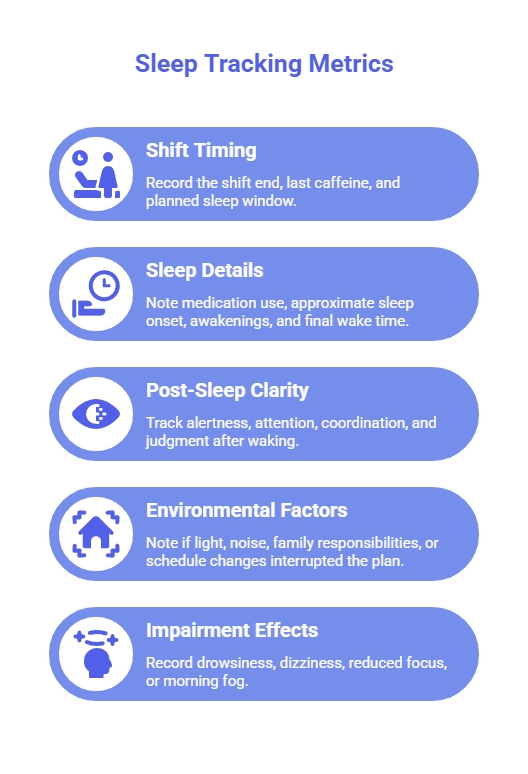
“It worked” or “it did not work” usually gives the prescriber too little information. During the first week, record the circumstances around each planned sleep period.
Track the shift end, last caffeine, planned sleep window, medication use exactly as prescribed, approximate sleep onset, awakenings, final wake time, and alertness after waking. Note whether light, noise, family responsibilities, or schedule changes interrupted the plan.
Post-sleep impairment means reduced attention, coordination, judgment, or alertness after waking. Depending on the medication and the individual, effects such as drowsiness, dizziness, reduced focus, or morning fog may matter for driving, caregiving, or safety-sensitive work. Record what happened in plain language rather than assigning yourself a diagnosis.
One difficult sleep period does not show why the problem occurred. A short record may reveal late caffeine, a shortened sleep opportunity, repeated interruptions, or a persistent medication concern. It can make the clinician conversation more specific without turning the week into self-experimentation.
First-Week Daytime Sleep Check-In
Day/date | Shift ended | Last caffeine | Planned sleep period | Taken exactly as prescribed? | Sleep onset and awakenings | Alertness after waking and clinician notes | Light, noise, family, or schedule interruption |
|---|---|---|---|---|---|---|---|
Day 1 | Yes / No | ||||||
Day 2 | Yes / No | ||||||
Day 3 | Yes / No | ||||||
Day 4 | Yes / No | ||||||
Day 5 | Yes / No | ||||||
Day 6 | Yes / No | ||||||
Day 7 | Yes / No |
Use the tracker to report patterns, not to change the dose or timing. Current SleepScriptMD patients can request a medication review when persistent effects, schedule changes, or safety concerns need clinician attention.
Rotating Shifts Need a Prescriber Conversation
A rotating shift changes between work periods rather than following one stable overnight schedule. The available sleep opportunity and required wake time may change after only one or two shifts.
Switching between daytime and nighttime sleep can complicate medication timing and post-sleep alertness. Ask how the prescription should be handled during nights off, quick turnarounds, shortened sleep periods, and transitions back to daytime obligations. A plan designed for permanent nights may not transfer safely to every rotation.
Do not assume medication should be taken after every night shift. Do not skip it, move it, or change the dose because an online schedule appears to match your calendar. Those decisions depend on the medication, the prescription instructions, and your health history.
For broader schedule preparation, review guidance on timing medication around a rotating shift, then bring the actual rotation to your prescriber. The useful questions are practical: When must full alertness return? How predictable is the sleep opportunity? What should happen when the schedule changes unexpectedly?
First-Week Safety Check
- Use the medication exactly as prescribed, and read the prescription label and pharmacy instructions.
- Give the prescriber and pharmacist a complete list of prescriptions, nonprescription products, and supplements.
- Follow medication-specific instructions about alcohol.
- Do not drive, operate machinery, provide safety-sensitive care alone, or begin hazardous work until you know how the medication affects alertness and have followed professional guidance.
- Contact the prescriber about persistent drowsiness, dizziness, reduced focus, unexpected effects, schedule changes, or an inadequate sleep opportunity.
- Do not change or stop the prescription without guidance.
- Pregnancy or pregnancy planning requires a clinician discussion.
- Possible sleep apnea, narcolepsy, dream enactment, or active restless legs symptoms may require different testing or local evaluation.
- Severe, rapidly worsening, or emergency symptoms require urgent local medical care.
What to Do Next
Before starting, write down the planned sleep periods, required wake times, caffeine pattern, current medications and supplements, and predictable household interruptions. Those details help the clinician review the prescription in the context of your real schedule.
SleepScriptMD focuses on clinician-reviewed, non-controlled prescription options for eligible adults and does not prescribe benzodiazepines or Z-drugs. Non-controlled status does not mean a medication is side-effect-free or appropriate for everyone.
Frequently Asked Questions
Should a sleep prescription be taken as soon as a night shift ends?
Not necessarily. Follow the prescription label and your prescriber’s instructions. Consider the drive home, planned sleep period, and the time when full alertness will be required. Ask the prescriber what to do when the available sleep opportunity is shorter or less predictable than expected.
When should a night shift worker stop drinking caffeine?
There is no single clock time that fits every worker. CDC/NIOSH notes that caffeine near the end of a shift may interfere with post-shift sleep, while NHLBI recommends limiting it to the first part of the shift. A clinician can help relate the cutoff to your planned sleep period and sensitivity.
What should happen if grogginess continues after waking?
Do not drive or begin safety-sensitive work until it is safe. Record medication use as prescribed, actual sleep duration, caffeine, awakenings, interruptions, and the effect on alertness. Contact the prescriber or pharmacist rather than changing the dose or timing independently.
How should a sleep prescription be handled when shifts rotate?
Rotating schedules can change both the sleep opportunity and required alertness time. Ask the prescriber about nights off, quick turnarounds, partial sleep periods, and transitions. Do not apply one timing plan to every schedule without clinician guidance.
Disclaimer: This article is for general informational purposes only and does not constitute medical advice, diagnosis, or treatment. Readers should consult a licensed healthcare professional for guidance specific to their health, symptoms, medications, or treatment options.
Our Editorial Process:
Our expert team uses AI tools to help organize and structure our initial drafts. Every piece is then extensively rewritten, fact-checked, and enriched with first-hand insights and experiences by expert humans on our Insights Team to ensure accuracy and clarity.
By: SleepScriptMD Insights Team
Reviewed by: David Danish, MD, Chief Psychiatric Officer, and Peter Kelly, DO, Chief Medical Officer. Dr. Danish is double board-certified in adult and child/adolescent psychiatry, and Dr. Kelly is a board-certified family medicine physician with over 10 years of clinical practice.