
📌 Key Takeaways
Clinicians choose safer sleep options by first mapping the sleep problem, available rest time, and required alertness after waking.
- Define the Sleep Pattern: Clinicians separate trouble falling asleep from repeated waking because each pattern raises different questions.
- Map Wake-Time Risks: A short sleep window can make lingering drowsiness unsafe for driving, childcare, patient care, or machinery.
- Check What Keeps You Alert: Morning light, late caffeine, work replay, body tension, and schedule pressure can delay daytime sleep.
- Non-Controlled Is Not Risk-Free: Trazodone, hydroxyzine, and clonidine can still cause drowsiness, interactions, dizziness, or blood-pressure effects.
- Bring a Clear Timeline: The author recommends tracking shifts, caffeine, light, sleep timing, awakenings, past sleep-aid effects, and safety duties.
The right sleep aid starts with the right timeline.
Night-shift workers will prepare safer clinical details, setting up the schedule and medication comparison that follows.
~ ~ ~ ~ ~ ~ ~ ~ ~ ~ ~ ~ ~ ~ ~ ~ ~ ~
You finish an overnight shift exhausted, drive home after sunrise, and expect to fall asleep quickly. Instead, your body feels drained while your mind remains alert. Every minute awake makes the daytime sleep window shorter.
Night work conflicts with the body’s normal light-dark rhythm. Bright morning light, late-shift caffeine, a stimulating commute, work-related thoughts, and limited time before the next responsibility can make daytime sleep difficult even when physical fatigue is strong.
A useful clinical evaluation starts with the sleep pattern, not a preferred medication. The clinician needs to understand what happens after clock-out, how much uninterrupted sleep is possible, and how alert the person must be after waking.
Define the Sleep Problem First
“Cannot sleep after a night shift” describes a real problem, but it does not yet show what kind of sleep difficulty is occurring.
The main issue may be:
- Taking a long time to fall asleep
- Waking repeatedly
- Waking earlier than intended
- Racing or repetitive thoughts
- Feeling physically tense or keyed up
- Having too little protected time available for sleep
- Feeling groggy after a previous sleep aid
A helpful description covers the entire period between the end of the shift and the required wake time. Include when work ends, when you arrive home, when you try to sleep, what keeps you awake, and when you must function again.
Sleep-onset difficulty means having trouble moving from wakefulness into sleep.
Sleep-maintenance difficulty means falling asleep but waking repeatedly or earlier than planned.
Two workers may both call their problem “night-shift insomnia” while experiencing different patterns. One may lie awake for two hours. Another may fall asleep quickly but wake after three or four hours. Those histories lead to different clinical questions.
Identify What May Be Keeping Sleep From Starting
Post-shift wakefulness often has several causes working together.
Morning light
Sunlight during the commute home tells the brain that daytime has begun. Therefore, the amount and timing of light exposure matter when a clinician reviews a daytime sleep schedule.
Caffeine and other stimulants
Caffeine used near the end of a shift may still be active when the person reaches bed. Energy drinks, pre-workout products, nicotine, prescription stimulants, and some cold medications may also affect alertness.
Mental activation
Some workers replay difficult conversations, review mistakes, anticipate the next shift, or mentally run through unfinished tasks. Others describe a general inability to “switch off” even when they are not worried about anything specific.
A keyed-up body
A person may feel physically tired but still notice muscle tension, restlessness, a pounding heartbeat, or a fight-or-flight feeling. These details are useful to report, but they do not automatically identify the right medication.
A short sleep opportunity
Childcare, appointments, household noise, school pickups, or an evening responsibility may leave only a narrow period for rest. Medication cannot create time that the schedule does not provide. A drug that remains active near the required wake time makes a short sleep window less safe.
Consider a worker who finishes at 7 a.m., uses caffeine near the end of the shift, drives home in bright daylight, and must wake at 1 p.m. to pick up children. That history raises different concerns from someone who can sleep uninterrupted until 4 p.m.
Readers looking for broader schedule-based guidance can review SleepScriptMD’s guide to the best sleep aid for night-shift workers.
Why Medication Duration and Wake Time Matter
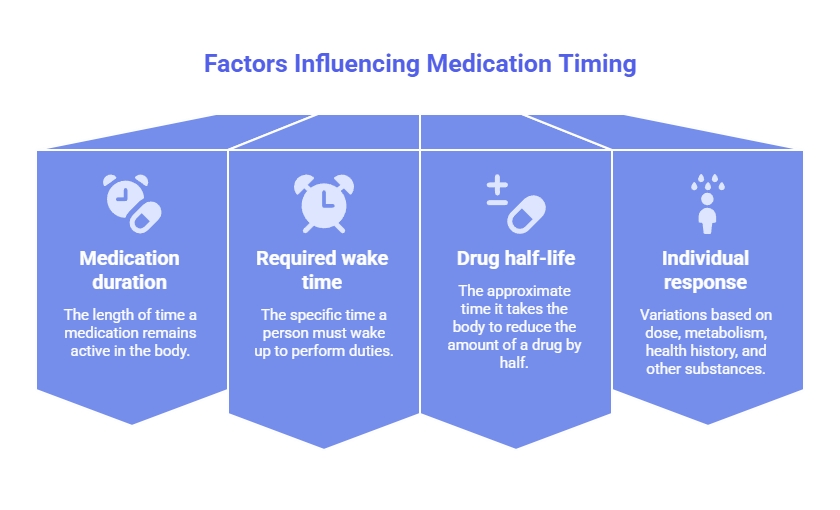
A clinician does not consider only when a medication is taken. The required wake time and the medication’s duration also matter.
One term that may appear in medication information is half-life. In plain language, half-life is the approximate time it takes the body to reduce the amount of a drug by half.
Here is a simplified example:
A worker takes a medication at 9 a.m. that has an approximate six-hour half-life. At 3 p.m., a substantial amount of the medication may still be in the body. That does not predict exactly how sleepy the person will feel, because response varies by medication, dose, metabolism, health history, and other substances being used. It does show why waking at 1 p.m. to drive or supervise children may present a different concern than waking at 4 p.m. with no immediate safety-sensitive duties.
This example is not a dosing instruction. Medication timing should follow the prescriber’s directions and should be discussed before making changes.
How Trazodone, Hydroxyzine, and Clonidine May Enter the Discussion
Trazodone, hydroxyzine, and clonidine belong to different medication classes and have different approved uses, effects, and safety concerns.
They may be prescribed off-label for sleep. Off-label means the medication is FDA-approved for one purpose but is being prescribed for another purpose based on the clinician’s judgment. It does not mean the medication is unregulated or being used without medical oversight.
These medications are also generally described as non-controlled. This means they are not scheduled as controlled substances under federal drug law. It does not mean they are free of side effects, interactions, or safety risks.
Medication | Original approved-use context | Why it may enter a sleep discussion | Important shift-worker question | Evidence consideration |
|---|---|---|---|---|
Trazodone | Antidepressant | Sometimes considered when a clinician is evaluating insomnia symptoms, including interrupted sleep | Could lingering drowsiness interfere with the required wake time? | Clinical guidelines do not treat it as a universal first-line insomnia treatment, and the evidence has limitations |
Hydroxyzine | Sedating antihistamine with anxiety-related uses | May be discussed when racing thoughts, worry, or mental alertness are part of the history | Have antihistamines caused grogginess, dry mouth, or reduced alertness before? | Research specifically supporting long-term insomnia treatment is limited and mixed |
Clonidine | Medication with blood-pressure and other approved uses | May be considered when a person describes a persistent keyed-up or fight-or-flight feeling and other clinical factors support its use | Could dizziness, drowsiness, or blood-pressure effects interfere with safe functioning? | Evidence for routine insomnia treatment is limited and depends heavily on the clinical context |
This comparison is educational and does not identify a “best” medication or match a symptom directly to a drug. A licensed clinician must review the complete sleep pattern, medical history, medication list, possible interactions, available sleep time, and required wake-time alertness before deciding whether any prescription is appropriate.
For a more focused comparison, see Trazodone, Hydroxyzine, or Clonidine After Night Shifts.
SleepScriptMD also provides information about its non-controlled prescription sleep-aid options. Educational service pages should not replace an individualized medical review.
What a Clinician Checks Before Recommending Medication
Choosing a sedating medication is only one part of a sleep evaluation.
A clinician may review:
- The exact sleep complaint
- Fixed, rotating, or irregular shift schedules
- Intended sleep and wake times
- The amount of uninterrupted sleep realistically available
- Caffeine, nicotine, stimulant, and energy-drink timing
- Current prescriptions and over-the-counter products
- Vitamins, herbal products, and supplements
- Alcohol or other substances that cause drowsiness
- Previous experiences with sleep aids
- Driving, childcare, or safety-sensitive duties after waking
Prior treatment experience can be particularly useful. A product that caused mild grogginess when eight hours of sleep were available may become unacceptable when the worker has only five hours before driving.
The clinician may also ask about heavy snoring, gasping, breathing pauses, severe daytime sleepiness, unexpected sleep attacks, acting out dreams, or an uncontrollable urge to move the legs. These symptoms can point to conditions that require a different type of evaluation.
Pregnancy, breastfeeding, or plans to become pregnant also require individualized medical guidance.
Practical Safety and Eligibility Questions
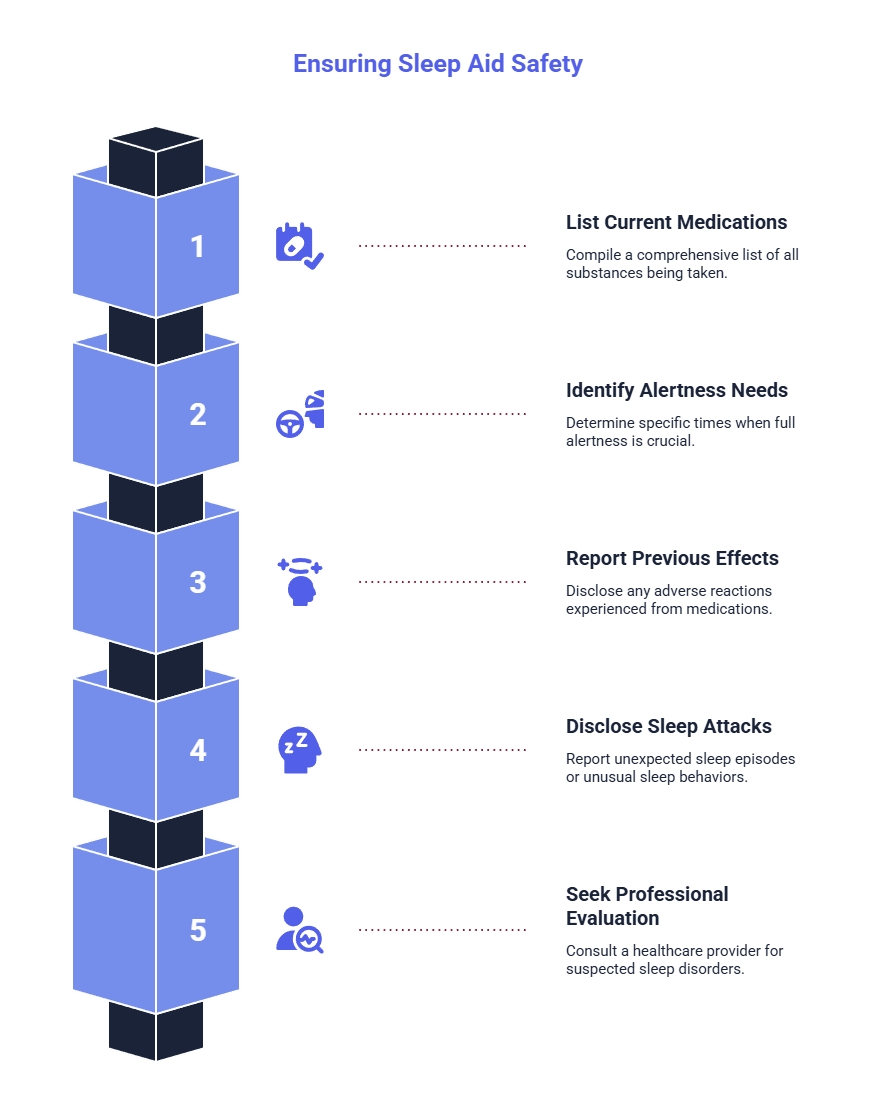
Before discussing a prescription, prepare a complete list of everything currently being taken. Include prescriptions, over-the-counter products, supplements, alcohol, and any other substances used near the planned sleep period.
Be specific about when full alertness is required. Relevant responsibilities may include:
- Driving
- Supervising children
- Operating machinery
- Providing patient care
- Returning to another job
- Making safety-sensitive decisions
Report previous effects such as prolonged drowsiness, dizziness, faintness, dry mouth, confusion, or impaired coordination.
Unexpected daytime sleep attacks, physically acting out dreams, and a strong urge to move the legs should also be disclosed. SleepScriptMD directs suspected narcolepsy, REM sleep behavior disorder, and active restless legs syndrome concerns to local, in-person evaluation rather than routine online insomnia treatment.
What to Track Before an Appointment or Online Intake
A short record from several representative shifts can turn a vague complaint into a useful timeline. It is not a diagnostic test and does not determine medication choice or eligibility.
Post-Shift Sleep Pattern Brief
What to track | What to record |
|---|---|
Shift schedule | Shift start and end times, plus whether the schedule rotates |
Arrival home | Approximate time you reach home |
Last caffeine or stimulant use | Product, amount if known, and time used, including nicotine |
Morning light exposure | Time spent in bright daylight after the shift, including the commute home |
Intended sleep time | When you planned to get into bed |
Estimated sleep-onset time | Approximately how long it took to fall asleep |
Mental or physical alertness | Racing thoughts, work replay, worry, tension, restlessness, or neither |
Awakenings | Number and approximate timing of awakenings |
Required wake time | The latest time you could safely remain asleep |
Responsibilities after waking | Driving, childcare, work, appointments, or other safety-sensitive duties |
Previous sleep-aid use | Product used, timing, benefit, and lingering effects |
Current medications and supplements | Prescriptions, OTC products, vitamins, herbs, and supplements |
Alcohol or other sedating substances | Type and timing |
Possible warning symptoms | Sleep attacks, dream enactment, breathing pauses, or an urge to move the legs |
Bring this record to the clinical review and consider asking:
- What sleep pattern does this timeline suggest?
- Which schedule or environmental factors may be contributing?
- How long might the medication affect alertness?
- Could it still be active at the required wake time?
- Which common side effects should be monitored?
- When should the treatment plan be reassessed?
How Physician-Reviewed Online Care May Fit
SleepScriptMD uses a secure online intake followed by review from a licensed medical professional. The intake allows the patient to provide details about sleep symptoms, health history, current medications, and relevant safety concerns without scheduling a live appointment.
A prescription is issued only when the reviewing clinician considers treatment medically appropriate and the patient meets the service’s current eligibility requirements.
SleepScriptMD focuses on non-controlled options and does not prescribe benzodiazepines or Z-drugs. Availability depends on current state telemedicine rules and clinician licensing. Completing an intake does not guarantee approval or a prescription.
Learn more about how asynchronous sleep care works before deciding whether the model is appropriate.
Frequently Asked Questions
How does a clinician compare trazodone, hydroxyzine, and clonidine after a night shift?
The clinician first looks at the drug class—such as an antidepressant, antihistamine, or alpha-agonist—and reviews the type of sleep difficulty, previous medication responses, health history, current medications, available sleep time, and required alertness after waking. The comparison involves more than matching one symptom—such as racing thoughts—to one medication.
Does medication timing affect grogginess before the next shift?
Yes. The time a medication is taken, how long it remains active, the prescribed dose, the available sleep window, and the person’s individual response can all affect next-day alertness.
Follow the prescriber’s directions. Do not move a dose earlier or later based only on general online guidance.
What should be shared if racing thoughts keep sleep from starting?
Describe when the thoughts begin, what they are about, how long they continue, and whether they occur only after demanding shifts. Also report caffeine timing, morning light exposure, the available sleep window, and previous reactions to sedating products.
What if falling asleep is easy but waking too soon is the problem?
Tell the clinician when the awakenings occur, how often they repeat, whether environmental interruptions are present, and how much total sleep is possible. This is usually described as a sleep-maintenance problem rather than a sleep-onset problem.
Are trazodone, hydroxyzine, and clonidine controlled substances?
They are generally classified as non-controlled prescription medications. Each still has its own approved uses, side effects, interactions, and safety requirements. Non-controlled does not mean risk-free or appropriate for unsupervised use.
Prepare the Pattern Before Choosing the Next Step
Before deciding on any prescription, the first step is capturing an accurate picture of your post-shift routine. By completing our secure, 10-minute digital intake, our board-certified physicians can review your specific sleep patterns and medical history to design a personalized, non-habit-forming treatment plan.
Track when you leave work, how much morning light you encounter, when caffeine was last used, when you try to sleep, what keeps you awake, and when full alertness is required again. That timeline helps the clinician assess whether medication fits the situation and whether its effects could extend into important daytime responsibilities.
Eligible adults can start SleepScriptMD’s clinician-reviewed intake. Treatment and prescription decisions remain subject to medical review, current eligibility requirements, and state availability.
Disclaimer: This article is for general informational purposes only. It does not provide medical advice, diagnosis, dosing instructions, or treatment recommendations. Consult a licensed healthcare professional for guidance specific to your symptoms, health history, medications, and work schedule.
Our Editorial Process:
Our expert team uses AI tools to help organize and structure our initial drafts. Every piece is then extensively rewritten, fact-checked, and enriched with first-hand insights and experiences by expert humans on our Insights Team to ensure accuracy and clarity.
About the SleepScriptMD Insights Team:
The SleepScriptMD Insights Team is our dedicated engine for synthesizing complex topics into clear, helpful guides. While our content is thoroughly reviewed for clarity and accuracy, it is for informational purposes and should not replace professional advice.