
📌 Key Takeaways
Shift-worker sleep care starts by naming the sleep pattern, not guessing at pharmacy-shelf fixes.
- Name The Pattern: Falling asleep, staying asleep, and waking clear are different problems that need different clinical conversations.
- Safety Comes First: Snoring, sleep attacks, violent sleep movements, pregnancy, or major health concerns need local evaluation first.
- Morning Clarity Matters: Any sleep aid may be a poor fit if it leaves you foggy before driving or work.
- Online Care Has Limits: SleepScriptMD may help eligible low-risk adults, but some symptoms need in-person testing or care.
- Non-Controlled Options Exist: Licensed clinicians may consider non-controlled prescriptions based on symptoms, risks, and work demands.
Clear pattern = safer sleep care and fewer guesses before the next shift.
Night, swing, rotating, and 7-on/7-off shift workers will get clearer language for safer next steps, guiding them into the sleep-care details that follow.
~ ~ ~ ~ ~ ~ ~ ~ ~ ~ ~ ~ ~ ~ ~ ~ ~ ~
Your shift is over.
Daylight is slipping around the blackout curtains, your phone is buzzing on the dresser, and your body still feels like it is on duty.
You need sleep soon. Not after the neighborhood quiets down. Not after three more hours of tossing and turning. And not after guessing between bottles in the pharmacy aisle.
If you work nights, swing shifts, rotating schedules, or 7-on/7-off blocks, your sleep problem may not be a lack of discipline. Your sleep window may simply be fighting your biology. The right shift worker sleep solution starts by naming the pattern.
This 2-minute quiz can help you sort your sleep issue into a practical category. It is not a diagnosis. It does not choose a medication. It gives you clearer language for a physician-reviewed conversation about safe, non-controlled sleep care.
Why Shift-Worker Sleep Needs a Pattern Match
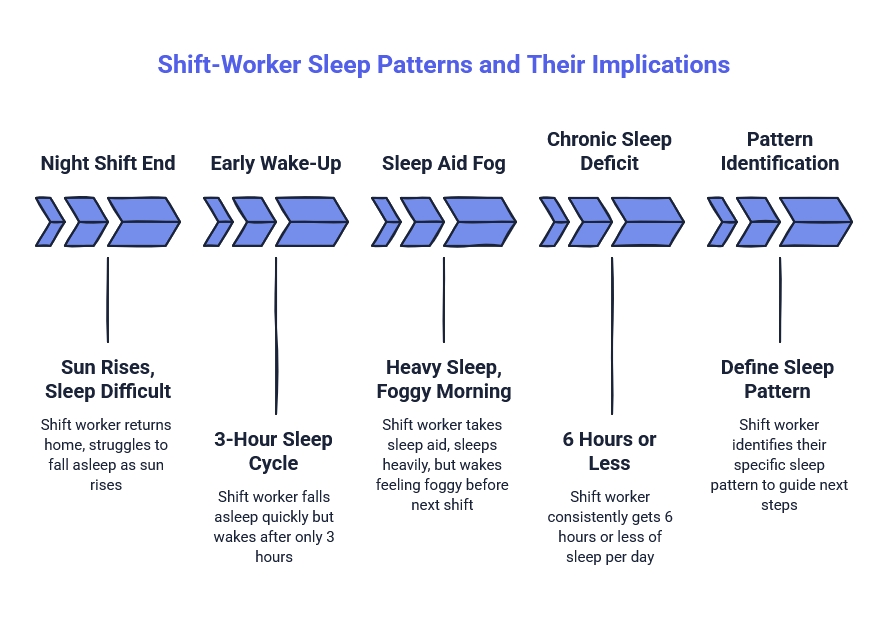
Shift-work sleep problems do not all look the same.
One person gets home after a night shift and cannot fall asleep once the sun is up. Another falls asleep fast but wakes after 3 hours. Someone else takes an over-the-counter sleep aid, sleeps heavily, and wakes up foggy before the next shift.
Those patterns need different next steps.
The CDC and NIOSH recognize that most adults require 7 to 8 hours of sleep for optimal health. Shift work often disrupts this recovery, and research frequently indicates that a large segment of U.S. healthcare workers—often estimated at one-third or more—consistently achieve 6 hours or less of sleep per day. This chronic sleep deficit is a significant factor in professional alertness, judgment, and overall recovery. For shift workers, that matters because short or poor sleep can affect alertness, judgment, and recovery.
The goal is not to force sleep with guesswork. Instead, define the pattern to determine the appropriate next step.
What This Quiz Can and Cannot Tell You
Think of this quiz as a map, not a prescription pad.
It can help you identify whether your sleep pattern looks more like:
- Daytime sleep failure
- Feeling wired after work
- Waking too early
- OTC-related morning fog
- A safety concern that needs local evaluation
It cannot diagnose insomnia, sleep apnea, narcolepsy, REM Sleep Behavior Disorder, Restless Legs Syndrome, anxiety, depression, or any other condition. It also cannot tell you which medication to take.
A licensed clinician needs to review your symptoms, medical history, current medications, and risk factors before any treatment decision is made.
The 2-Minute Sleep Clarity Quiz
Choose the answer that best matches your current sleep pattern. Keep a simple tally of A, B, C, D, and E answers.
- What is your main sleep problem after a shift?
A. You cannot fall asleep when the sun is up.
B. You feel exhausted but wired after work.
C. You fall asleep but wake up too soon.
D. OTC sleep aids make you feel foggy or hungover.
E. Your sleep problem includes unusual or concerning symptoms. - What kind of schedule are you working right now?
A. Fixed night shift.
B. 3-day rotating shift.
C. 7-on/7-off schedule.
D. Swing shift.
E. Your schedule changes unpredictably. - How soon after waking do you need to be sharp?
A. Within about an hour.
B. Within 1–2 hours.
C. You have a flexible wake-up window.
D. It changes depending on the rotation.
E. You are not sure because your symptoms feel hard to predict. - What happened when you tried OTC sleep aids?
A. They did not work.
B. They worked inconsistently.
C. You slept, but woke too soon.
D. They made you feel like a zombie.
E. You avoided them because your symptoms or risks felt complicated. - Which safety statement applies to you?
A. You are 18–64 and have no major medical, psychiatric, pregnancy, or substance-use concerns.
B. You snore, gasp, or have been told you stop breathing during sleep.
C. You fall asleep unexpectedly, have muscle weakness with emotion, or feel paralyzed around sleep.
D. You act out dreams, kick, punch, yell, or move violently during sleep.
E. You have uncomfortable leg urges at night, are pregnant or planning pregnancy, are outside the standard eligibility range, or have major medical, mental health, or substance-use concerns. - What is the biggest barrier to getting help?
A. You cannot schedule appointments around your shifts.
B. You do not want waiting rooms or unnecessary appointment friction.
C. You are worried a prescription will be addictive.
D. You are worried you will be groggy at work.
E. You do not know whether online care is safe for your situation.
How to Score Your Result
Use the simplest rule first.
Mostly A answers mean Pattern A: The Daytime Sleep Wall.
Mostly B answers mean Pattern B: Wired After Work.
Mostly C answers mean Pattern C: The Wake-Up Loop.
Mostly D answers mean Pattern D: The OTC Zombie Hangover.
Any safety answer in Question 5 other than A means Pattern E: Safety Detour.
If your answers are mixed, choose the result that affects your next shift the most.
The safety rule comes first. If Question 5 points to Pattern E, treat that as your result even if the rest of your answers point somewhere else.
Pattern A: The Daytime Sleep Wall
This pattern shows up when you are exhausted but cannot fall asleep during the day. The room is dark, the fan is running, and the world outside is already awake.
Generic sleep advice may help around the edges. It may not be enough when your body is receiving daytime wake-up signals at the exact moment you need recovery.
A clinician may want to understand your schedule, wake-up deadline, caffeine timing, current medications, and whether your symptoms suggest a condition that needs testing. If you appear eligible, a non-controlled prescription option may be discussed as part of a physician-reviewed plan.
For more context, read SleepScriptMD’s guide to the best sleep aid for night shift workers.
Pattern B: Wired After Work
This pattern feels like physical exhaustion with a brain that will not power down. The shift ends, but your nervous system keeps replaying alarms, conversations, patient rooms, machines, or the drive home.
The practical fix often starts before bed. A short wind-down routine, lower light, hydration, and consistent medication timing may help support a prescription plan if a clinician decides treatment is appropriate.
This is where medication-forward care can be useful for eligible adults. Non-controlled options such as trazodone, hydroxyzine, or clonidine may be considered by a licensed clinician depending on the person’s sleep pattern and medical history. Learn more about SleepScriptMD’s prescription sleep aids.
Pattern C: The Wake-Up Loop
This pattern means you can fall asleep, but you do not stay asleep long enough. You may wake too early or keep waking through the sleep block.
Sleep onset and sleep maintenance are different problems. That distinction matters because a person who wakes after 3 hours may need a different clinical conversation than someone who cannot fall asleep at all.
If this sounds familiar, bring your sleep timing, work schedule, wake-up deadline, and morning clarity concerns into your assessment. For rotating schedules, timing often matters as much as the medication itself.
A helpful next read is How to Time Your Sleep Medication on a 3-Day Rotating Shift.
Pattern D: The OTC Zombie Hangover
This pattern is common among shift workers who have tried over-the-counter sleep aids and woke up foggy, heavy, or slow.
The problem is not only whether something helps you sleep. The problem is whether you can wake up clear enough to drive, work, chart, operate equipment, or care for other people.
MedlinePlus notes that hydroxyzine may cause drowsiness and advises people not to drive or operate machinery until they know how it affects them. That same practical principle applies broadly to sedating sleep products: understand how the medication affects you before doing anything that requires full alertness.
For a deeper shift-worker angle, read Why OTC Sleep Aids Make Shift Workers Feel Like “Zombies”.
Pattern E: Safety Detour
This result does not mean you are out of options. It means the safest next step may not be standard online insomnia treatment.
Seek local evaluation or appropriate testing if your sleep problem includes:
- Snoring, gasping, or possible breathing pauses
- Sudden sleep attacks
- Muscle weakness with emotion
- Sleep paralysis around falling asleep or waking
- Acting out dreams, kicking, punching, or yelling during sleep
- Uncomfortable leg urges at night
- Pregnancy or planned pregnancy
- Major medical, mental health, or substance-use concerns
Some symptoms need an in-person clinician, sleep specialist, or sleep test. That is especially true when the issue may be sleep apnea, narcolepsy, REM Sleep Behavior Disorder, or active Restless Legs Syndrome.
Practical Safety Check Before Starting Sleep Treatment
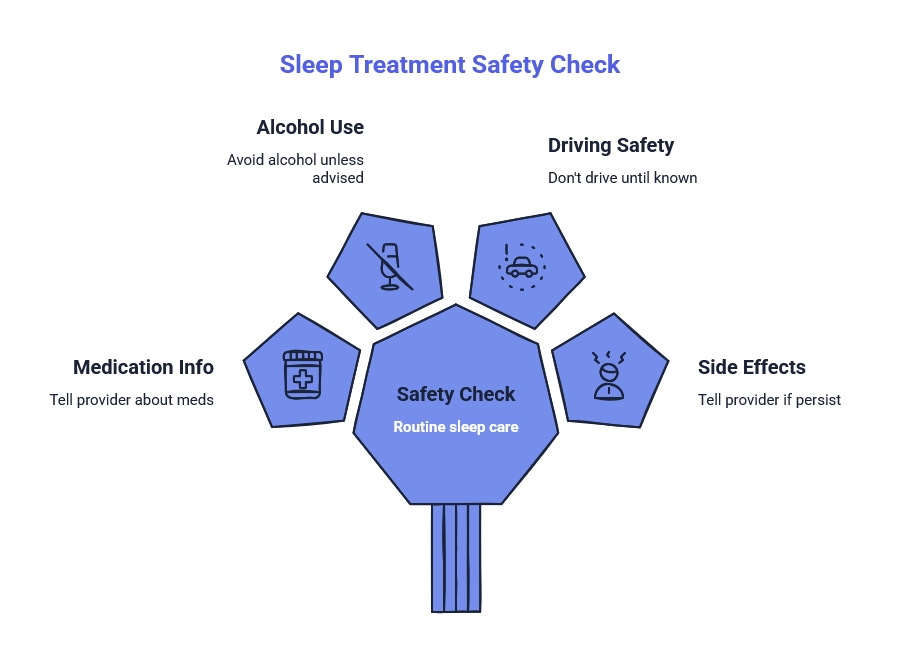
Safe sleep care should feel routine, not alarming. The key is to match the treatment to the right patient.
SleepScriptMD focuses on low-risk adults ages 18–64 where online care is appropriate. Some states may require a brief virtual visit before prescribing, and care availability can vary by state.
Before starting any sleep prescription, tell your provider about:
- Current medications and supplements
- Alcohol use
- Pregnancy or plans for pregnancy
- Breathing issues during sleep
- Mood symptoms or substance-use concerns
- Any morning grogginess that affects work or driving
Avoid alcohol while taking sleep medication unless your clinician tells you otherwise. Do not drive or operate machinery until you know how a medication affects you. MedlinePlus gives similar practical cautions for clonidine, including possible drowsiness, dizziness, and alcohol-related side effect concerns.
Simple guidance is often the most useful guidance. Take the medication only as directed. Track your morning clarity. Tell your provider if side effects persist or interfere with your day.
What SleepScriptMD Does Not Prescribe
SleepScriptMD does not prescribe controlled substances such as benzodiazepines or Z-drugs.
That does not mean every prescription sleep medication is the same. It means SleepScriptMD focuses on non-controlled options for eligible adults who want physician-reviewed care without habit-forming sedatives.
The FDA has added a Boxed Warning for certain Z-drugs, including zolpidem, eszopiclone, and zaleplon, because rare complex sleep behaviors have occurred with these medications. The FDA also reminds patients that insomnia medicines can affect next-morning alertness.
This context explains the preference for non-controlled care pathways. The main point is straightforward: a clinician should help match the treatment to your sleep pattern, risks, and work demands.
How SleepScriptMD Care Works
SleepScriptMD is designed for adults who want sleep care without unnecessary appointment friction.
The process is simple:
- Complete a secure online intake.
- A licensed clinician reviews your symptoms, medical history, and eligibility.
- If approved, your prescription is sent electronically to your chosen local pharmacy.
Where legally permitted, care may be asynchronous. Some states may require a brief virtual visit before prescribing, so the experience can vary by state.
To understand the process in more detail, read how asynchronous sleep care works. For current cost details, visit SleepScriptMD Pricing.
What to Do Next
Use your quiz result as a starting point.
If your results align with Patterns A through D and you meet basic eligibility, SleepScriptMD may be a fit for physician-reviewed, non-controlled sleep medication care. If you scored Pattern E, local evaluation or testing is the safer next step.
You do not need to guess alone. You need a clear pattern, a safe review, and a plan that respects your schedule.
To compare medication options first, see which non-addictive sleep med options SleepScriptMD offers.
Frequently Asked Questions
Is this quiz a diagnosis?
No. It is an educational self-sorting tool. It can help you describe your pattern, but a licensed clinician must evaluate diagnosis, eligibility, and treatment.
Will the quiz tell you which medication to take?
No. It helps organize the conversation. A licensed clinician decides whether medication is appropriate.
What if OTC sleep aids make you groggy?
That is worth discussing. Shift workers often need to wake up sharp, so next-day clarity matters. A physician-reviewed plan may help eligible adults choose a better-fitting option.
Does SleepScriptMD prescribe Ambien or Xanax?
No. SleepScriptMD does not prescribe controlled substances such as benzodiazepines or Z-drugs.
What if your state requires a video visit?
Some states may require a brief virtual visit before prescribing. SleepScriptMD follows state requirements where care is available.
Where do you pick up medication if approved?
If approved, your prescription is sent electronically to the local pharmacy you choose.
Our Editorial Process:
Our expert team uses AI tools to help organize and structure our initial drafts. Every piece is then extensively rewritten, fact-checked, and enriched with first-hand insights and experiences by expert humans on our Insights Team to ensure accuracy and clarity.
By: SleepScriptMD Insights Team
Reviewed by: David Danish, MD, Chief Psychiatric Officer, and Peter Kelly, DO, Chief Medical Officer. Dr. Danish is double board-certified in adult and child/adolescent psychiatry, and Dr. Kelly is a board-certified family medicine physician with over 10 years of clinical practice.