
📌 Key Takeaways
Daytime sleep trouble after night shifts works best when reviewed by pattern, schedule, safety, and medical history.
- Pattern Comes First: Sleep medication conversations start with what goes wrong: falling asleep, staying asleep, early waking, or hyperarousal.
- Timing Changes Safety: A short daytime sleep window can affect whether medication fits, especially before driving or work.
- Bring Full Details: Caffeine, alcohol, cannabis, sleep aids, prescriptions, and supplements all matter during clinician review.
- Online Care Has Limits: Sudden sleep attacks, dream acting, leg urges, or muscle weakness may need local evaluation.
- Medication Is Not Guesswork: Non-controlled options may fit some adults, but only after a licensed clinician reviews the full picture.
Better sleep decisions start with better details.
Night shift workers considering sleep medication will gain clearer preparation steps here, guiding them into the schedule-specific details that follow.
~ ~ ~ ~ ~ ~ ~ ~ ~ ~ ~ ~ ~ ~ ~ ~ ~ ~
You finish a night shift, get home after sunrise, lie down, and expect sleep to come quickly. Your body feels drained. Your mind does not.
Instead of drifting off, thoughts start replaying the shift. A stressful handoff. A difficult customer. A mistake that may not even matter tomorrow. For some night shift workers, this can feel like anxiety. For others, it feels like insomnia, caffeine overload, or simply being too activated to sleep.
This pattern does not automatically mean an anxiety disorder. It may reflect schedule strain, hyperarousal, an insomnia-like pattern, or a mix of factors that a licensed clinician should review.
Before starting sleep medication, the most useful step is not choosing a medication name. It is preparing the right questions. A clinician will want to understand when the problem happens, what the daytime sleep window looks like, what has already been tried, and whether any symptoms point to a need for local or in-person care.
Why Daytime Bedtime Can Feel Anxious After A Night Shift
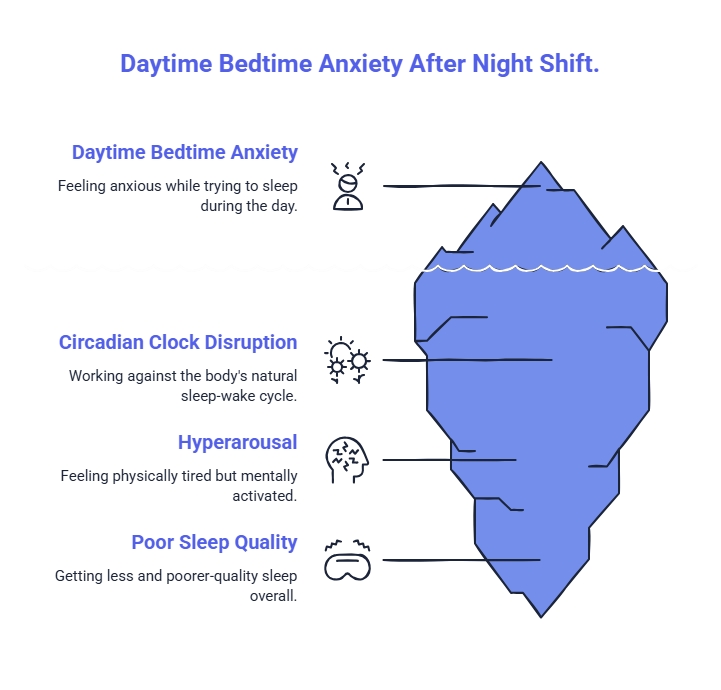
Night work asks the body to stay awake when it is usually preparing for sleep, then sleep when daylight and daily life are pushing it toward alertness. CDC/NIOSH guidance on night and evening shifts explains that night shift workers are working against the circadian clock, which is strongly influenced by the sun’s light-dark cycle.
A circadian rhythm is the body’s internal timing system. It helps regulate sleepiness and alertness across a 24-hour period. For a person on a typical daytime schedule, morning light helps reinforce wakefulness. For a night shift worker trying to sleep at 8 AM, that same light can become part of the problem.
Hyperarousal is a practical term for feeling physically tired but mentally or physiologically activated. After a night shift, hyperarousal may come from job stress, bright light during the commute, late-shift caffeine, household noise, or the pressure of knowing there are only a few hours available before the next obligation.
That is why the question is rarely just, “Can medication make someone sleep?” A better question is, “What is keeping the body alert when it is supposed to be sleeping?”
CDC/NIOSH sleep guidance for night shift workers also notes that night shift workers usually get less sleep overall and poorer-quality sleep than day shift workers. This does not diagnose any individual worker.
Medication may be one part of a clinician-reviewed plan for some eligible adults. But the review should begin with the pattern.
Clarify The Sleep Pattern Before Asking About Medication
Before asking which sleep medication may fit, describe what is actually happening.
Sleep-onset trouble means the main difficulty is falling asleep. Sleep-maintenance trouble means sleep starts, but repeated wake-ups interrupt recovery. Early waking means sleep ends too soon, often before the planned wake time. Shift-related hyperarousal means the body feels tired, but the mind or nervous system still feels switched on.
These patterns can overlap. For example, a warehouse worker may use caffeine at 4 AM to finish the shift, try to sleep at 8 AM, and then feel both mentally alert and frustrated by every sound in the house. That scenario does not prove one diagnosis. It does show why timing, environment, caffeine, and stress all matter in a medication review.
A clinician may want to know:
- What time the shift ends
- What time the worker tries to sleep
- How long it usually takes to fall asleep
- Whether wake-ups happen during the sleep window
- Whether the problem happens only after night shifts or also on days off
- When caffeine, alcohol, cannabis, OTC sleep aids, or other sedating products are used
- Whether morning grogginess affects driving, childcare, or the next shift
The goal is not to create a perfect sleep diary. The goal is to bring enough detail that medication, if considered, can be matched to the pattern rather than chosen by guesswork.
Post-Night-Shift Sleep Medication Question Checklist
Use this checklist before a clinician review or online intake.
Question to Ask | Why It Matters | What to Bring Up |
|---|---|---|
Does this look more like trouble falling asleep, staying asleep, waking too early, or shift-related hyperarousal? | Medication fit can vary by sleep pattern. | Bedtime after the shift, time to fall asleep, wake-ups, and racing thoughts. |
How should daytime sleep timing affect medication decisions? | Night shift workers often have nontraditional sleep windows. | Planned sleep time, required wake time, next shift start time, and commute needs. |
What should be expected during the first few nights if medication is prescribed? | Realistic expectations reduce confusion and unsafe self-adjustment. | Concerns about grogginess, dry mouth, dizziness, or feeling too sedated. |
What should be avoided while taking a sleep medication? | Alcohol, other sedating substances, and certain medications can affect safety. | Alcohol, cannabis, OTC sleep aids, sedating prescriptions, supplements, and pain medications. |
What if the available sleep window is shorter than usual? | A short sleep opportunity can change whether medication is appropriate. | Childcare pickup, overtime, rotating shifts, split sleep, or early appointments. |
How could the medication affect the next wake-up time? | Alertness matters for driving, clinical work, machinery, caregiving, and safety-sensitive jobs. | Driving time, job duties, and how quickly full alertness is needed after waking. |
How do current medications or health history affect the choice? | A licensed clinician needs to screen for interactions and risk factors. | Full medication and supplement list, medical conditions, mental health history, and substance use concerns. |
Which symptoms mean online sleep treatment is not the right path? | Some symptoms need local evaluation rather than routine online insomnia care. | Sudden sleep attacks, muscle weakness with emotions, dream enactment, or uncomfortable leg urges at rest. |
This checklist keeps the conversation focused. Instead of asking for the strongest sleep aid, the reader can ask which option, if any, fits the sleep pattern, schedule, and safety needs.
How Non-Controlled Sleep Medication May Fit Racing Thoughts Or Wired-But-Tired Sleep
Non-controlled medication is medication that is not classified as a controlled substance. Controlled substances include medication categories with higher misuse, dependence, or regulatory concerns. SleepScriptMD does not prescribe benzodiazepines or Z-drugs such as Ambien or Xanax.
For eligible adults, SleepScriptMD focuses on clinician-reviewed, non-controlled options. Examples listed by SleepScriptMD include medications such as trazodone, hydroxyzine, clonidine, doxepin, and mirtazapine—many of which are commonly prescribed off-label for sleep—when approved after review. These are not interchangeable choices, and not everyone is a candidate.
A clinician may discuss different options based on the pattern:
Pattern to Discuss | Medication Conversation That May Come Up | Important Caveat |
|---|---|---|
Racing thoughts or anxiety-like activation at bedtime | Hydroxyzine may be discussed when clinically appropriate. | MedlinePlus identifies hydroxyzine as an antihistamine used for anxiety and tension and as a sedative in specific medical contexts, but medication decisions require clinician review. |
Wired-but-tired physical activation | Clonidine may be discussed when clinically appropriate. | DailyMed’s clonidine label identifies clonidine as a centrally acting alpha-agonist hypotensive agent. Safety depends on health history and medication review. |
Trouble staying asleep or repeated wake-ups | Trazodone may be discussed when clinically appropriate. | DailyMed’s trazodone label includes safety information that should be reviewed by a clinician. |
SleepScriptMD provides more information about non-addictive sleep medication, including non-controlled prescription options. Readers who want medication-specific education can also review SleepScriptMD’s pages on Hydroxyzine online prescription and Clonidine prescription online.
The key point is fit. Hydroxyzine, clonidine, trazodone, or another option should not be selected because a night shift worker recognizes one symptom phrase. A licensed clinician should evaluate the full pattern, sleep window, medical history, current medications, and safety responsibilities.
Safety Questions Shift Workers Should Not Skip
A daytime sleep plan has to account for what happens after waking. A medication that causes manageable sleepiness in one person may be a poor fit for someone who has to drive, care for children, return to a high-risk job, or operate equipment soon after a short sleep window.
Ask how medication could affect the next wake-up time. Ask what to do if the available sleep window changes. Ask whether a medication should be skipped or reconsidered when the next day requires early alertness.
Also bring the full medication and supplement list. Include prescriptions, over-the-counter products, antihistamines, sleep aids, pain medication, cannabis, alcohol, and supplements. This is not about judgment. It is about giving the clinician enough information to screen for sedation, interaction, blood pressure concerns, and other safety issues.
Alcohol deserves a direct mention. If sleep medication is being considered, alcohol use after a shift should be disclosed. Combining alcohol with sedating medication can create safety concerns, and the clinician should give specific guidance.
For workers on rotating schedules, medication timing may be more complicated. SleepScriptMD’s related guide on how to time sleep medication on a rotating shift may be useful background, but personal timing decisions should still be reviewed by a clinician.
When Online Sleep Medication May Not Be The Right Next Step
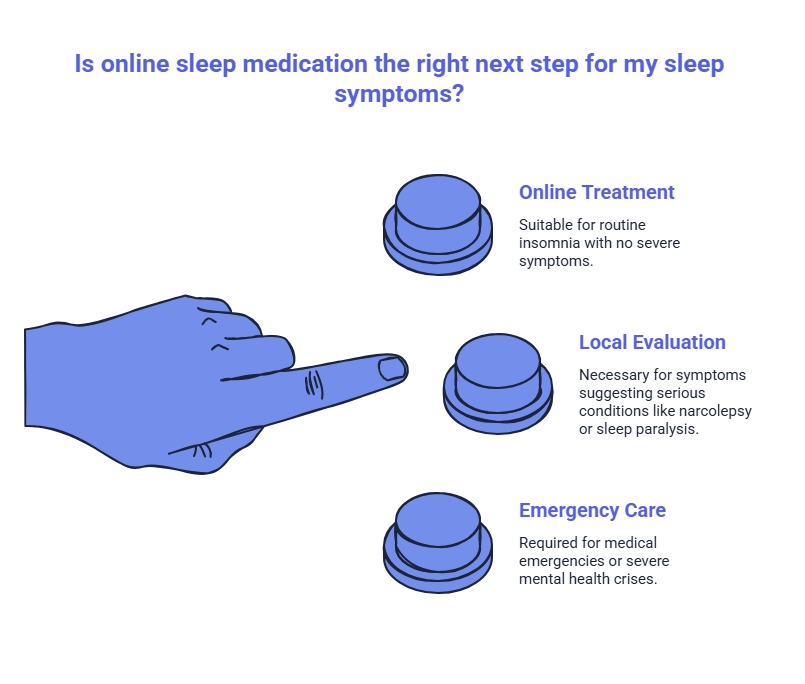
Online treatment is not the right path for every sleep symptom. Some symptoms may require a local clinician, primary care provider, sleep specialist, neurologist, sleep study, or lab work.
Seek local or in-person evaluation when symptoms suggest something beyond routine insomnia care, such as:
- Unexpected sleep attacks during the day, especially while talking, eating, working, or driving
- Muscle weakness triggered by strong emotions
- Sleep paralysis that is new, frequent, or concerning
- Acting out dreams, including yelling, kicking, punching, or leaving the bed during sleep
- An uncomfortable urge to move the legs at rest or at night
SleepScriptMD identifies possible narcolepsy, suspected REM Sleep Behavior Disorder, and Restless Legs Syndrome symptoms as concerns that require local or in-person evaluation rather than routine online treatment through SleepScriptMD.
Pregnancy, planned pregnancy, significant medical concerns, significant mental health concerns, substance use concerns, or severe symptoms may also change whether online care is appropriate.
If there is a medical emergency or severe mental health crisis, call 911 or seek emergency care.
What To Prepare Before Starting A Clinician-Reviewed Intake
A better intake starts with better details. Before seeking a clinician-reviewed medication option, gather:
- A recent work schedule
- Typical post-shift bedtime and wake time
- Time needed to fall asleep
- Number and timing of wake-ups
- Caffeine timing
- Alcohol, cannabis, OTC sleep aid, or sedating medication use
- Current prescriptions and supplements
- Morning grogginess or alertness concerns
- Any symptoms that may require local evaluation
SleepScriptMD uses a secure intake process so a licensed clinician can review symptoms, health history, and medication information before determining whether treatment is appropriate. Current availability, process details, and eligibility should be confirmed through the intake because requirements can vary by situation.
Readers who want to understand costs should review SleepScriptMD’s current pricing rather than relying on permanent article-body price claims. Readers who want to move from education to review can Start Your Sleep Treatment through the secure intake.
Starting an intake does not guarantee a prescription. It gives a clinician the information needed to decide whether online treatment is appropriate and, if so, which non-controlled option may fit safely.
FAQs
Is racing thoughts after a night shift the same as anxiety?
Not necessarily. Racing thoughts after a night shift may reflect schedule strain, stress activation, insomnia-like patterns, anxiety symptoms, or a combination. A licensed clinician can help interpret the pattern without assuming one diagnosis.
Can sleep medication help if someone feels wired but tired after work?
For some eligible adults, non-controlled medication may be considered after clinician review. Suitability depends on the sleep pattern, health history, current medications, sleep window, and safety responsibilities after waking.
What should be tracked before asking about medication?
Track shift end time, planned sleep time, time to fall asleep, wake-ups, caffeine timing, alcohol use, OTC sleep aid use, morning grogginess, and how alert the worker needs to be after waking.
Does SleepScriptMD prescribe Ambien or Xanax for night shift sleep?
No. SleepScriptMD does not prescribe benzodiazepines or Z-drugs. Its online care model focuses on non-controlled medication options when a licensed clinician determines they are appropriate.
Conclusion
Daytime bedtime anxiety after night shifts is not something a reader has to label alone. The more useful step is to describe the pattern clearly: when it happens, what the sleep window looks like, what substances or medications are involved, and what safety responsibilities exist after waking.
For eligible adults, a non-controlled medication may be considered after clinician review. The goal is not to guess the right medication. The goal is to bring the right details to a licensed clinician so the next step can be safer, more specific, and better matched to the worker’s real schedule.
Disclaimer: This article is for general informational purposes only and does not constitute medical advice, diagnosis, or treatment. Sleep symptoms, anxiety symptoms, shift-work sleep problems, and medication decisions should be reviewed with a licensed healthcare professional who can evaluate your health history, current medications, and personal risk factors. If you are experiencing a medical emergency or severe mental health crisis, call 911 or seek emergency care.
Our Editorial Process:
Our expert team uses AI tools to help organize and structure our initial drafts. Every piece is then extensively rewritten, fact-checked, and enriched with first-hand insights and experiences by expert humans on our Insights Team to ensure accuracy and clarity.
By: SleepScriptMD Insights Team
Reviewed by: David Danish, MD, Chief Psychiatric Officer, and Peter Kelly, DO, Chief Medical Officer. Dr. Danish is double board-certified in adult and child/adolescent psychiatry, and Dr. Kelly is a board-certified family medicine physician with over 10 years of clinical practice.