
📌 Key Takeaways
OTC sleep aids use old antihistamines that stay in your system too long, leaving shift workers groggy when they need to be alert.
- Drowsiness Outlasts Sleep: The pills that knock you out can keep affecting you for eight hours or more—way past when your alarm goes off.
- Shift Work Fights Biology: Your brain sends “stay awake” signals during daylight, so daytime sleep is already harder without adding a slow-clearing sedative.
- Stacking Makes It Worse: Doubling up on PM pills or mixing them with alcohol doesn’t help you sleep better—it just stretches out the zombie feeling.
- Prescription Options Exist: Medications like trazodone and clonidine work differently and can be timed to fit your schedule without the long hangover.
- Environment Matters Too: Blackout curtains, cool rooms, and a consistent wind-down routine help your brain accept that it’s “night” even when the sun is up.
Better sleep for shift workers means matching the medication to your schedule, not fighting your body twice.
Night-shift nurses, factory workers, and anyone on rotating schedules will find practical alternatives to the OTC loop here, preparing them for the treatment options that follow.
~ ~ ~ ~ ~ ~ ~ ~ ~ ~ ~ ~ ~ ~ ~ ~ ~ ~ ~ ~ ~ ~ ~ ~ ~ ~ ~ ~ ~ ~ ~ ~ ~ ~ ~ ~ ~ ~ ~ ~ ~ ~ ~ ~ ~ ~ ~ ~ ~ ~ ~ ~ ~
It’s 8:13 a.m. after a night shift. Sunlight is blasting through the blinds while you’re trying to fall asleep. You took something—maybe a “PM” pill, maybe two—and you did eventually pass out. But five hours later, you wake up with a thick, cottony head and you’re due back on the floor in 43 minutes.
This isn’t rest. This is trading one problem for another.
You’re not imagining it. That zombie hangover is real, and it’s not because you’re “bad at sleeping.” It’s because many OTC sleep aids weren’t designed for the way you live. When your bedtime shifts from 10 p.m. one day to 8 a.m. the next, and you need to be sharp within an hour of waking, those products can actually make things worse.
Many OTC “PM” sleep aids work by using older antihistamines that make you drowsy. The catch is that drowsy can outlast your actual sleep window—especially when you’re sleeping during the day or on a rotating schedule. That’s why you can fall asleep and still wake up feeling like a zombie.
The good news: non-controlled prescription options exist that work differently—helping you sleep without the extended grogginess. This article explains why OTC antihistamines cause that hangover, why shift workers get hit harder, and how physician-supervised alternatives like trazodone and clonidine offer a more predictable path to rest.
The Real Reason OTC Sleep Aids Create a “Zombie Hangover”
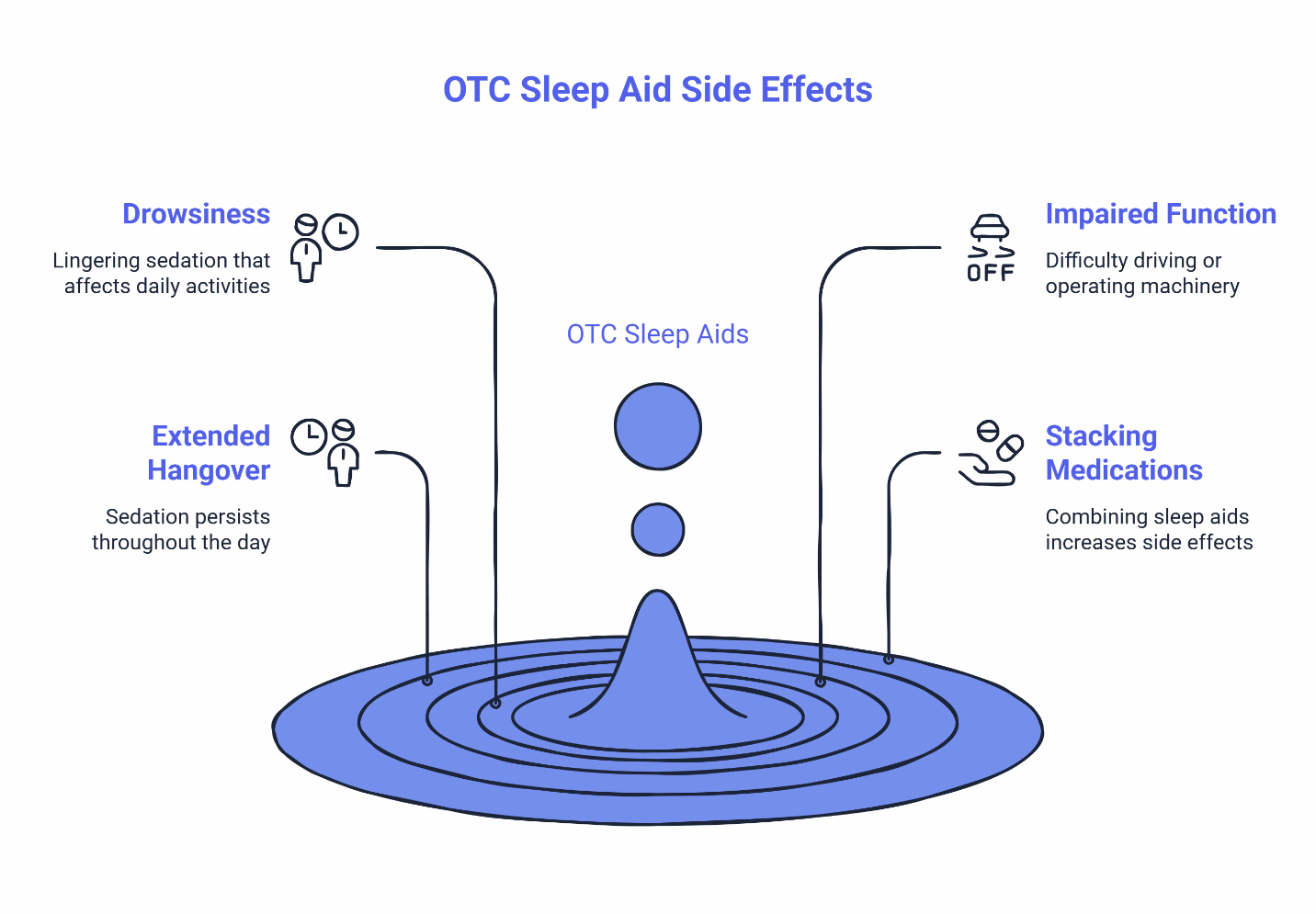
Most over-the-counter sleep aids don’t contain specialized “sleep medicine.” They contain sedating antihistamines—the same active ingredient found in allergy medications, just marketed for nighttime use. Diphenhydramine, the most common one, works by blocking histamine receptors in the brain, which makes you drowsy.
The problem? That drowsiness doesn’t stop when your alarm goes off.
Clinical insomnia guidelines from the American Academy of Sleep Medicine note that OTC antihistamine sleep aids aren’t recommended for chronic insomnia due to limited efficacy and safety data. The issue isn’t whether they make you drowsy—it’s whether that drowsiness fits your life.
Half-life, in plain English: “Half-life” means how long it takes your body to clear half the dose from your system. Diphenhydramine has a half-life of roughly 4–8 hours in most adults. So if you take a dose at midnight, half of it may still be circulating at 6 a.m.—and a quarter of it could still be affecting you at noon. That’s why you can sleep for six hours and still feel sedated when you wake up.
This lingering effect is exactly what OTC sleep-aid labels warn about: drowsiness may persist the next day, and you shouldn’t drive or operate machinery if you feel impaired.
When the standard dose doesn’t knock you out fast enough, the temptation is to double up or add another product. Taking a higher dose than directed, combining a “PM” product with a nighttime cold medicine, adding alcohol, or mixing with other drowsy-causing drugs—these are common patterns when you’re desperate for sleep. But stacking sedating medications doesn’t improve sleep quality. It just extends the hangover.
The “zombie” feeling isn’t a sign that the medication was too strong at bedtime. It’s a sign that sedation is still lingering in your body when you need to be awake.
Why Shift Workers Get Hit Harder Than 9-to-5 Sleepers
If you work rotating shifts, you’re not just dealing with a slow-clearing sedative. You’re fighting your own biology at the same time.
Your body has an internal clock—a circadian rhythm—that sends a powerful “stay awake” signal during daylight hours. For 9-to-5 workers, this isn’t a problem: they sleep at night, when that signal is quiet. But when you’re trying to sleep at 8 a.m. after a night shift, your brain is essentially working against you while the antihistamine adds lingering sedation on top.
The CDC’s research on shift work and fatigue documents the connection between nonstandard schedules and increased risk of errors and accidents. Fatigue from disrupted sleep slows reaction times, reduces attention, and impairs judgment. When you add a sedative that lingers past your wake-up time, you’re compounding a challenge that’s already elevated.
Three factors make the same OTC pill hit shift workers harder than everyone else.
Your sleep window is usually shorter. If you only have five or six hours before you need to be back at work, there’s less time for any sedating effect to wear off. A drug whose sedative effects actively linger for eight or more hours doesn’t fit that schedule.
Your bedtime isn’t consistent. OTC products don’t adapt to “8 a.m. bedtime today, 10 p.m. bedtime tomorrow.” Your body and the medication timing both get messy when your schedule flips every few days.
Daytime sleep is fragile sleep. Light, noise, texts, doorbells—daytime sleep has friction baked in. So even if the medication helps you fall asleep, it doesn’t guarantee you’ll stay asleep. The result is lighter, choppier rest and less time for the sedative to wear off.
Waking up unrefreshed after using these aids is a common experience. It is not a personal failure—it is a physiological mismatch between how these products work and what your schedule demands.
What to Do Instead: Non-Controlled Prescription Options That Fit Your Schedule
The goal isn’t just to “knock yourself out.” It’s to sleep and still be sharp when you wake up. For shift workers dealing with persistent insomnia, that often means moving beyond the OTC aisle to physician-supervised options designed for more predictable results.
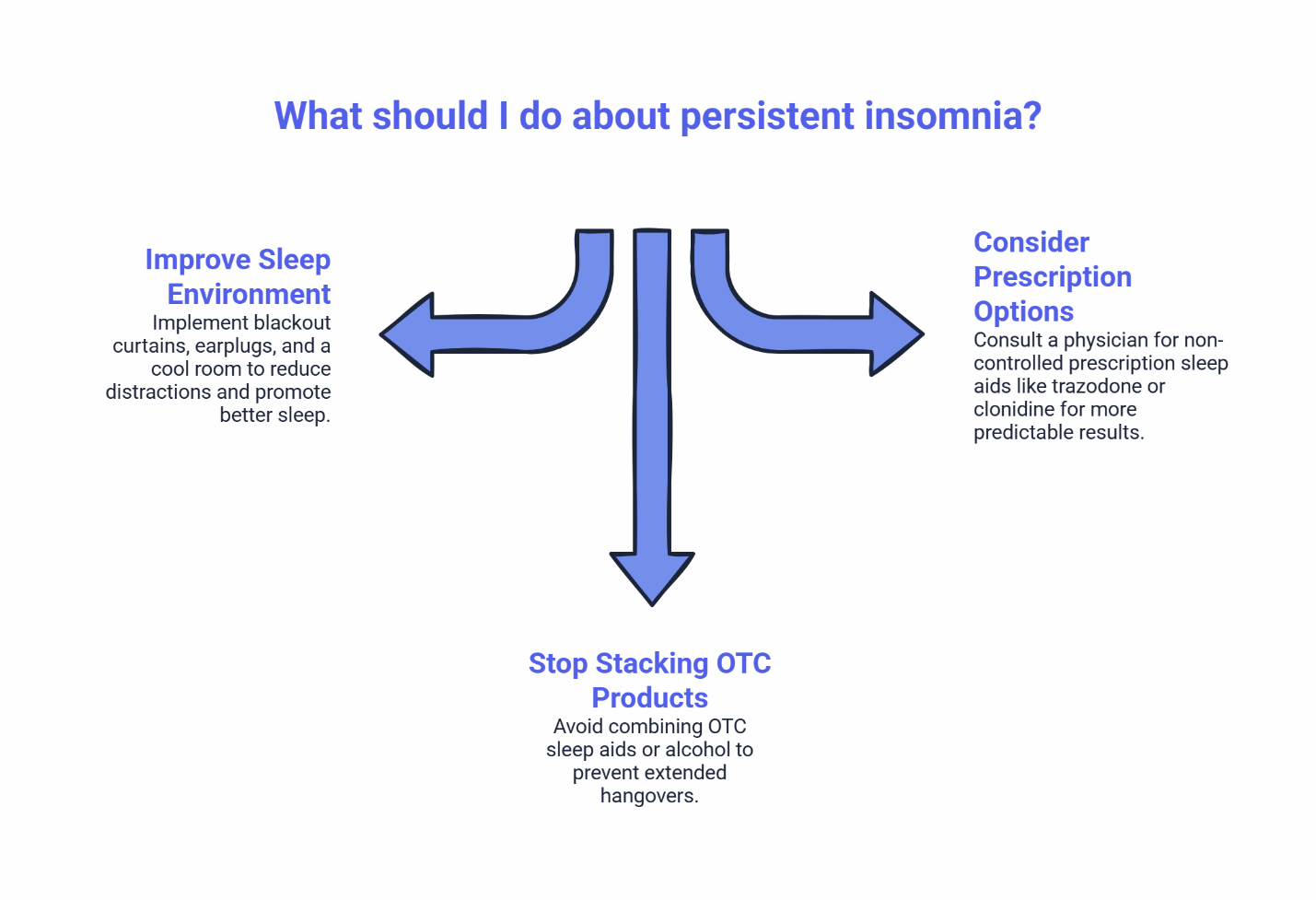
Start with your environment and timing.
Your body’s circadian system takes cues from light. When you’re trying to sleep during the day, those cues are working against you. Blackout curtains paired with a sleep mask can help block intrusive light. A cool room, earplugs or a white noise machine, and putting your phone on “Do Not Disturb” reduce the friction that fragments daytime sleep. A repeatable wind-down routine signals to your brain that it’s time to rest, even when the sun says otherwise.
Protect a realistic sleep window. If you only have six hours before your next shift, don’t plan on sleeping for eight. Consistency matters more than perfection.
If OTC products aren’t working, stop stacking them.
Taking more of a slow-clearing sedative doesn’t make it work better—it just extends the hangover. If you’ve been combining products or adding alcohol, that pattern is worth breaking before trying something new.
Consider non-controlled prescription options.
When sleep problems persist despite good habits, non-controlled prescription sleep aids offer a different approach. Medications trazodone and clonidine work through entirely different neurological pathways than standard OTC medications. While originally developed for other medical conditions and commonly prescribed off-label for sleep, they are often utilized by clinicians aiming to manage sleep architecture (Jaffer et al., Innovations in Clinical Neuroscience, 2017). Though any sleep medication carries a risk of next-day grogginess, a medical professional can typically help adjust these options to better suit your unique needs.
These aren’t DEA-scheduled controlled substances—they are off-label options that physicians frequently utilize when standard OTC treatments fail. While trazodone is one of the most routinely prescribed medications for general insomnia, clonidine is a more specialized, evidence-based option typically reserved for patients whose sleep issues are driven by severe hyperarousal or an overactive stress response (Jaffer et al., Innovations in Clinical Neuroscience, 2017; Yasaei & Saadabadi, StatPearls, 2023). Each works slightly differently:
Trazodone enhances deep, restorative sleep and is often a good fit for people who wake up multiple times per night.
Clonidine reduces the “wired but tired” feeling by quieting the stress response, making it useful for people who feel physically exhausted but mentally alert.
The key difference from standard one-size-fits-all OTC antihistamines: a clinician can personalize the dosing and timing of prescription options to better align with your specific sleep pattern and schedule (Neubauer, Psychiatric Clinics of North America, 2015). While no medication completely guarantees the absence of residual effects—especially if your sleep window is severely shortened—a clinician can help you find an optimized regimen designed to minimize next-day impairment.
SleepScriptMD provides physician-supervised care for low-risk adults (18–65) seeking non-controlled sleep medication. In most states, you can complete an online assessment and receive a prescription through asynchronous care, often within 24 hours. Some states require a brief virtual visit before prescribing—check pricing and state details here.
Ready to move past the OTC loop? Start your sleep treatment and get matched with a non-addictive option that fits your schedule.
When In-Person Evaluation Is Needed
SleepScriptMD treats straightforward insomnia in low-risk adults. Some situations require in-person evaluation with a local provider instead:
Sleep apnea symptoms: If you’ve been told you snore loudly, gasp, or stop breathing during sleep, a home sleep test is typically required before any sleep medication is prescribed.
Narcolepsy-like symptoms: Sudden daytime sleep attacks, muscle weakness with strong emotions, or sleep paralysis require specialized evaluation.
REM sleep behavior disorder: Physically acting out dreams (kicking, punching, yelling during sleep) needs in-person assessment.
Restless legs syndrome: An uncomfortable urge to move your legs at night may need lab workup before treatment.
If you’re pregnant, planning pregnancy, or have certain medical or psychiatric conditions, in-person care is also the appropriate path. These boundaries exist to ensure you get the right type of care for your situation.
Quick “Next Shift” Checklist
Avoid doubling up. Combining multiple sleep aids only compounds next-day fatigue.
Protect a realistic sleep window. Strictly control your physical environment to help your brain accept that it’s “night” even when the sun is up.
If you must use an OTC product, use it rarely. These aren’t designed for ongoing rotating-schedule use.
Track your results for a week. Monitor time-to-sleep and next-day clarity. If you’re consistently waking up groggy, that’s a sign the current approach isn’t working.
If insomnia is recurring, get physician guidance. Non-controlled prescription options exist that fit shift schedules better than OTC antihistamines.
Not sure what’s driving your sleep issues? Take the 6 Second Sleep Check or try the Choose Your Sleep Quiz to guide your next step.
Ready to start treatment? Get started here—most patients in eligible states receive a prescription within 24 hours.
This article is for informational purposes only and is not medical advice. Do not start, stop, or combine medications without talking to a licensed clinician.
Our Editorial Process
Our expert team uses AI tools to help organize and structure our initial drafts. Every piece is then extensively rewritten, fact-checked, and enriched with first-hand insights and experiences by expert humans on our Insights Team to ensure accuracy and clarity.
By: SleepScriptMD Insights Team
SleepScriptMD’s Insights Team translates complex sleep and mental health topics into clear, practical guides.