
📌 Key Takeaways
Racing thoughts after a night shift often come from mixed body signals, not personal failure.
- Tired Is Not Sleepy: Your body can feel drained while daylight, stress, and caffeine still push alertness.
- Protect The Transition: A calm post-shift routine may help your brain move out of work mode.
- Watch Repeated Patterns: Recurring sleep trouble, unsafe driving, or poor focus may need clinician review.
- Medication Needs Review: Non-controlled sleep prescriptions may fit some adults after a licensed clinician checks safety.
- Know Care Limits: Sudden sleep attacks, breathing pauses, pregnancy, or severe symptoms may need local care.
Wired does not mean broken; it means your sleep signals may need better support.
Night shift workers struggling with post-shift racing thoughts will gain clear next steps here, preparing them for the detailed overview that follows.
~ ~ ~ ~ ~ ~ ~ ~ ~ ~ ~ ~ ~ ~ ~ ~ ~ ~
You clock out, get home, lie down, and expect sleep to happen quickly. Your body feels drained. Your mind does not.
Instead of drifting off, your brain starts replaying the shift. A patient handoff. A hard conversation. A missed task. The drive home. The alarm that is already set for the next shift.
That wired-but-tired feeling can be especially frustrating for night shift workers. You may feel exhausted but mentally switched on. This can happen when your sleep drive and wake signals are out of sync.
Here is what to know: racing thoughts after a night shift do not automatically mean something is wrong. They can reflect a mix of circadian timing, daylight, caffeine, work stress, household noise, and anxiety about not sleeping. But when the pattern keeps happening, affects safety, or makes daytime sleep unreliable, medically supervised, non-controlled pharmacotherapy may be worth considering for eligible adults.
You’re Exhausted — So Why Is Your Brain Still Awake?
Fatigue and sleep readiness are related, but they are not identical.
After a night shift, your body may have real sleep pressure. You have worked through hours when most people are asleep. Your muscles may feel heavy. Your eyes may burn. But your internal clock may still be sending wake cues, especially once daylight, movement, noise, and post-work stimulation enter the picture.
The American Academy of Sleep Medicine explains that shift work disorder is tied to circadian rhythm disruption, and that circadian rhythms help signal when the body is supposed to feel sleepy or alert. Not every difficult morning after an overnight shift is shift work disorder. Still, the same basic concept helps explain why daytime bedtime can feel harder than expected.
Your body may be saying, “Rest.” Your environment and nervous system may be saying, “Stay alert.”
That mismatch is why “just lie down” often does not feel like enough.
The “Wired-but-Tired” Pattern: Hyperarousal After Overnight Work
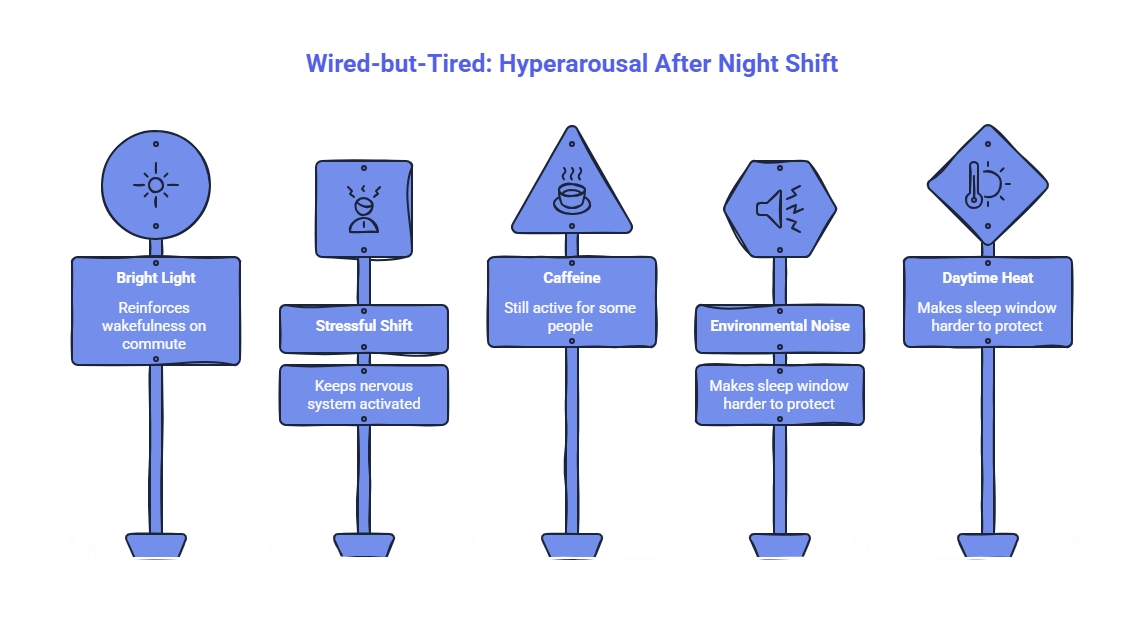
Hyperarousal is a plain-English way to describe a brain and nervous system that remain activated when the body needs rest. A PubMed-indexed review in the Journal of Sleep Research describes hyperarousal as a central concept in many models of insomnia, while also noting that the underlying mechanisms are complex and still studied.
For a night shift worker, hyperarousal may feel like mental acceleration at the worst possible time. The shift is over, but the body has not fully exited work mode.
This can show up as replaying conversations, reviewing mistakes, planning the next shift, worrying about sleep, or feeling tense even in a dark room. It may also be physical: a tight chest, restless energy, sensitivity to small noises, or a sense that the body is still “on.”
Several common post-shift factors can feed that pattern. Bright light on the commute home can reinforce wakefulness. A stressful shift can keep the nervous system activated. Caffeine used to get through the final hours may still be active for some people. Family noise, deliveries, traffic, and daytime heat can make the sleep window harder to protect.
This does not mean racing thoughts are a personal failure. It also does not prove anxiety or insomnia. It means the body may need a clearer transition from alertness to sleep.
A Quick Check: Is This a Rough Shift or a Recurring Sleep Problem?
One rough shift can disrupt sleep. A repeated pattern deserves more attention.
The difference is not whether the morning feels frustrating. The difference is whether the pattern keeps returning, affects functioning, or creates safety concerns.
Post-Shift Racing Thoughts Checkpoint
Common post-shift triggers
- caffeine late in the shift
- bright light during the commute home
- a stressful or high-stakes shift
- noise, sunlight, heat, or interruptions during daytime sleep
- checking messages, bills, work updates, or family logistics right before bed
Recurring problem signs
- lying awake after several shifts, not just one difficult morning
- growing anxiety about sleep before getting home
- feeling unsafe driving after work because sleep loss is building
- struggling to function, concentrate, or regulate mood between shifts
- relying on repeated short sleep windows that never feel restorative
Local-care flags
- sudden sleep attacks, especially during conversation, driving, or other active tasks
- acting out dreams, yelling, kicking, or punching during sleep
- uncomfortable urges to move the legs at rest or near bedtime
- loud snoring, gasping, choking, or witnessed pauses in breathing
- pregnancy or planning pregnancy
- severe mental health crisis, medical emergency, or symptoms that feel unsafe to manage online
This checkpoint is not a diagnosis. It is a practical sorting tool. Occasional activation after an intense shift may improve with better timing, a calmer wind-down, and a more protected sleep window. Repeated insomnia symptoms, unsafe sleepiness, or red-flag symptoms should be discussed with a licensed clinician or local provider.
Is This Anxiety, Insomnia, or Just Night Shift?
It can feel like anxiety, especially when the thoughts are fast, repetitive, or focused on what will happen if sleep does not come.
But racing thoughts after night shift can have more than one source. They may come from stress, schedule mismatch, caffeine timing, daytime sleep disruption, insomnia patterns, or a combination of those factors.
That distinction matters because the next step may vary. A person who has one overstimulating shift may need a better post-shift routine. A person who repeatedly lies awake after overnight work may benefit from a clinician review. A person with sudden sleep attacks, dream enactment, or breathing-related sleep symptoms may need local evaluation or sleep testing.
The goal is not to self-label the problem. The goal is to recognize when the pattern is persistent enough to deserve medical attention.
When a Non-Controlled Sleep Prescription May Fit
For some eligible adults, clinician-reviewed non-controlled prescription care may fit when racing thoughts after night shift become a recurring sleep-onset problem.
A non-controlled medication is a prescription medication that is not classified as a controlled substance. In sleep care, that distinction matters for people who want to avoid benzodiazepines or Z-drugs. SleepScriptMD does not prescribe controlled substances such as benzodiazepines or Z-drugs.
SleepScriptMD focuses on non-controlled prescription options that are often utilized off-label for sleep, such as trazodone, hydroxyzine, and clonidine, where appropriate after clinician review. A licensed clinician can help determine whether medication is appropriate based on the sleep pattern, medical history, current medications, safety profile, and state-specific care requirements.
This is not self-prescribing. It is neither automatic nor a guarantee that medication will ‘knock out’ racing thoughts. Medication fit can vary by person, schedule, symptoms, and risk factors.
For a rotating shift worker, the question may not be only, “Can this help me sleep?” It may also be, “Will this fit my next wake time, commute, work demands, and risk of morning grogginess?” Those are exactly the kinds of details that should be reviewed by a clinician rather than guessed.
For general medication safety information, MedlinePlus provides high-authority drug information pages for medications such as hydroxyzine, trazodone, and clonidine. Personal risks, side effects, interactions, and off-label use should be reviewed with a licensed healthcare professional.
To learn more about SleepScriptMD’s medication education, see non-addictive sleep medication. Do not use this information to choose a medication independently.
What to Try Before Bed After a Night Shift
Supportive habits can help reduce wake signals before daytime sleep. These habits are not a substitute for medical review when sleep problems are persistent, but they can make the sleep window less hostile.
Start the wind-down before getting into bed. After a hard shift, the brain often needs a transition period. That might mean keeping the commute calm, avoiding emotionally loaded calls, and delaying non-urgent tasks until after sleep.
Light matters too. CDC/NIOSH guidance for shift workers recommends keeping light levels low before bedtime and using a relaxing routine to help the body transition from wakefulness to sleep. The same guidance notes that caffeine should be avoided for several hours before bedtime depending on individual sensitivity, and that night shift workers who use caffeine may do better taking it near the beginning of the shift rather than close to the end.
A practical post-shift reset can stay simple:
- lower stimulation after clock-out
- reduce bright light exposure before bed when possible
- keep the bedroom cool, dark, and protected from interruption
- avoid solving new problems once the sleep window starts
- repeat the same short routine so the body learns the cue
A warehouse worker who uses caffeine at 4 AM and tries to sleep at 8 AM may not need a complicated plan. The first useful step may be shifting caffeine earlier when possible and protecting the hour before bed from bright light, scrolling, and household demands.
If those basics help, stay consistent. If they do not help and the pattern keeps repeating, the next step may be clinician review rather than more willpower.
Safety Box — When Online Sleep Care May Not Be the Right Fit
SleepScriptMD treats low-risk adults ages 18–65 according to its eligibility criteria. Online sleep medication care is not appropriate for every person or every sleep concern.
SleepScriptMD may not be the right fit if someone is pregnant, planning pregnancy, or has major medical, mental health, or substance-use conditions that could make sleep medication unsafe without more direct local care.
Some symptoms require local or in-person evaluation rather than online prescription care. These include possible narcolepsy symptoms, possible REM Sleep Behavior Disorder symptoms such as acting out dreams, and possible Restless Legs Syndrome symptoms such as an uncomfortable urge to move the legs at rest.
Snoring, gasping, choking, or witnessed pauses in breathing may require sleep testing before medication is considered. Severe symptoms, unsafe daytime sleepiness, medical emergencies, or severe mental health crisis symptoms should be handled through emergency services or local care as appropriate.
Care format and availability may vary by state. Some situations may require a different visit format before prescribing. Completing an intake does not guarantee approval or a prescription.
How SleepScriptMD’s Online Review Works
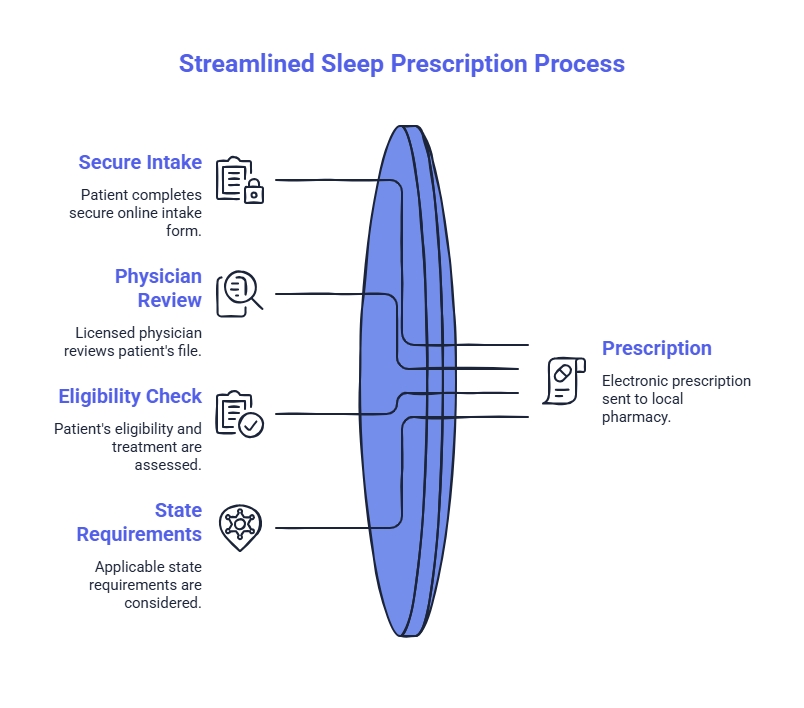
SleepScriptMD’s process is designed to reduce appointment friction where available while keeping clinician review central.
The general process is straightforward. A patient completes a secure intake. A licensed physician reviews the file. If the patient is eligible and treatment is approved, the prescription is sent electronically to a local pharmacy.
SleepScriptMD describes this model in more detail on its page about how asynchronous care works. Crucially, online care does not imply automatic prescribing. The review still depends on symptoms, health history, current medications, eligibility, and applicable state requirements.
That can matter for night shift workers because traditional appointment times often conflict with the same daytime hours needed for recovery sleep. An online intake may reduce scheduling friction where eligible, but the medical decision still belongs to the clinician.
Summary of Findings
Racing thoughts after a night shift often reflect conflicting signals. Your body may be tired, while your circadian rhythm, nervous system, caffeine timing, daylight exposure, stress, or sleep anxiety may still be pushing alertness.
A rough morning after a hard shift can happen. A recurring pattern that affects safety, functioning, or reliable recovery deserves more attention.
For some eligible adults, clinician-reviewed non-controlled prescription care may fit as part of a practical sleep plan. The right next step depends on medical history, symptoms, current medications, state requirements, and clinician review.
To begin an eligibility review, visit Start Your Sleep Treatment.
For educational medication information, see See which meds we offer.
Frequently Asked Questions
Why do thoughts race after a night shift even when the body is exhausted?
This can happen when sleep drive and wake signals are out of sync. The body may be tired, while the nervous system and circadian rhythm are still promoting alertness. Light, stress, caffeine, noise, and worry about not sleeping can all contribute.
Is this the same as anxiety?
It can feel like anxiety, but it is not possible to diagnose the cause from the symptom alone. Racing thoughts may come from stress, schedule mismatch, insomnia patterns, or another factor. If the pattern is recurring, clinician review can help clarify the next step.
Can sleep medication help night shift workers sleep during the day?
For some eligible adults, clinician-reviewed non-controlled medication may help support a sleep plan. Fit depends on sleep pattern, medical history, current medications, safety screening, and provider review. Medication should not be treated as a guaranteed fix.
What sleep medications does SleepScriptMD not prescribe?
SleepScriptMD does not prescribe controlled substances such as benzodiazepines or Z-drugs. Its care model focuses on non-controlled prescription sleep medication options when appropriate after clinician review.
When should local care be used instead of online sleep treatment?
Local care may be needed for sudden sleep attacks, dream enactment, restless legs symptoms, pregnancy or planning pregnancy, complex medical or mental health concerns, severe crisis symptoms, or snoring, gasping, or breathing pauses that may require sleep testing.
Is an appointment required?
SleepScriptMD uses online intake and physician review where eligible. Care format and availability may vary by state, and some circumstances may require a different visit format. No article or intake form can guarantee approval.
Disclaimer: This article is for general informational purposes only and does not constitute medical advice, diagnosis, or treatment. Readers should consult a licensed healthcare professional for guidance specific to their health, symptoms, medications, or treatment options.
Our Editorial Process:
Our expert team uses AI tools to help organize and structure our initial drafts. Every piece is then extensively rewritten, fact-checked, and enriched with first-hand insights and experiences by expert humans on our Insights Team to ensure accuracy and clarity.
About the SleepScriptMD Insights Team:
The SleepScriptMD Insights Team is our dedicated engine for synthesizing complex topics into clear, helpful guides. While our content is thoroughly reviewed for clarity and accuracy, it is for informational purposes and should not replace professional advice.