
📌 Key Takeaways
Melatonin may help with sleep timing, but it may not solve post-shift stress, noise, caffeine, or safety concerns.
- Track The Pattern: Clear notes help a clinician see what melatonin is not fixing after night shifts.
- Timing Is Not Everything: Racing thoughts, caffeine, light, and noise can keep daytime sleep from happening.
- Safety Comes First: Snoring, gasping, pregnancy, health issues, or substance-use risks may need local care first.
- Medication Needs Review: Non-controlled sleep medicine may help some adults, but only after clinician screening.
- Avoid Guessing Alone: Better sleep support starts with matching the treatment to the real sleep problem.
The strongest next step is not taking more—it is bringing better information to a licensed clinician.
Night shift workers struggling with daytime sleep will gain clearer next steps, preparing them for the detailed overview that follows.
~ ~ ~ ~ ~ ~ ~ ~ ~ ~ ~ ~ ~ ~ ~ ~ ~ ~
You clock out after a night shift, take melatonin, pull the curtains closed, and still lie there with your mind racing.
Your body is exhausted. Your brain is not.
That “wired but tired” feeling can be frustrating, especially when melatonin seemed like the obvious next step. Melatonin can be useful for some sleep-timing issues, but it may not address every reason daytime sleep becomes hard after overnight work. Post-shift stress, bright morning light, caffeine timing, household noise, inconsistent sleep windows, and medical safety factors can all change what the right next step looks like.
This article is not meant to diagnose shift-work disorder, anxiety, insomnia, or any other sleep condition. It is a practical guide to help night shift workers understand why melatonin may not be enough, what to track, and what to discuss with a licensed sleep clinician.
Why Daytime Sleep Can Feel Hard After a Night Shift
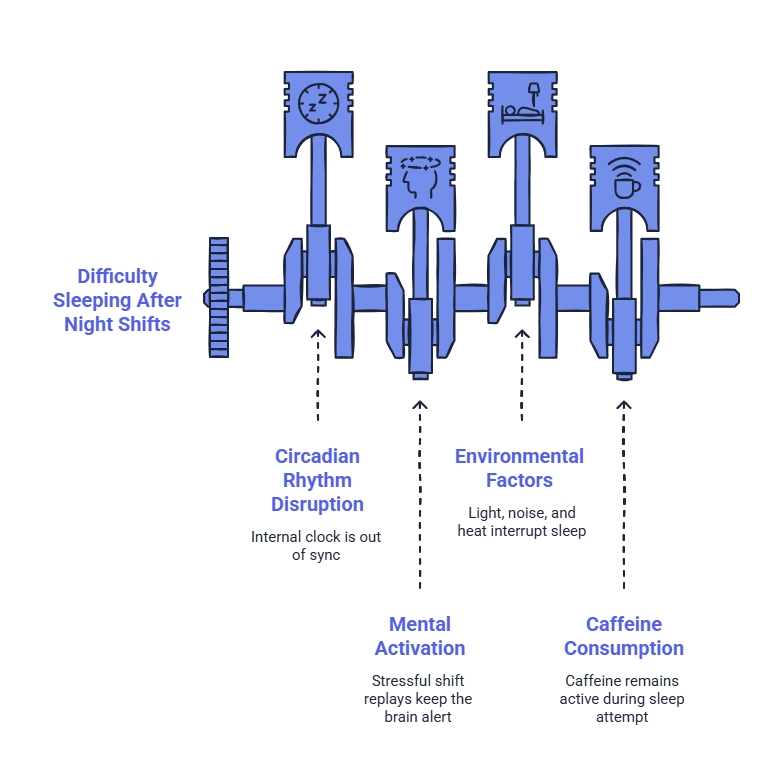
Daytime sleep after night work is difficult because it asks the body to rest at a time when the outside world is signaling wakefulness.
The CDC’s NIOSH training materials note that night shift workers usually get less sleep overall and poorer-quality sleep than day shift workers. The American Academy of Sleep Medicine’s Sleep Education resource also describes shift work disorder as a circadian rhythm disorder, which means sleep timing is out of alignment with the body’s internal clock. Not every night shift worker has shift work disorder, but the concept helps explain why a daytime bedtime can feel so unnatural.
For many people, the issue is not one single mistake. A nurse finishing at 7:00 AM may still be replaying difficult moments from the shift at 9:00 AM. A warehouse worker may be trying to sleep while caffeine is still active. A rotating-shift worker may have no stable bedtime from one week to the next.
Several factors can overlap:
Bright morning light can tell the brain it is time to be alert. A stressful commute can keep the nervous system activated. Family noise, deliveries, neighborhood activity, and daytime heat can interrupt sleep. Caffeine can still be doing its job when the worker is trying to shut down.
That is why “just take melatonin” can feel too simple. The real question is whether the problem is mainly timing, environment, mental activation, sleep maintenance, or a safety issue that needs clinician review.
Why Melatonin May Help Timing but Still Miss the “Wired but Tired” Problem
Melatonin is tied to the body’s darkness and timing signals. The National Center for Complementary and Integrative Health explains that short-term melatonin use appears safe for most people, but long-term safety information is limited. NCCIH also notes that while a review found melatonin may slightly increase daytime sleep duration for shift workers, the evidence quality was low, and it remains unclear if it helps them fall asleep faster (National Center for Complementary and Integrative Health, ‘Melatonin: What You Need To Know’).
That does not mean melatonin is useless. It means melatonin should not be treated as a complete solution for every post-shift sleep problem.
Melatonin may help signal that it is time for sleep, but it may not fully address racing thoughts, stress activation, pain, caffeine overlap, alcohol use, medication interactions, snoring or gasping symptoms, or a noisy daytime sleep environment.
If melatonin does not help, the answer is not automatically to take more or to jump to the strongest possible medication. A safer and more useful approach is to ask: what part of the sleep problem is melatonin failing to reach?
A clinician will want to understand the pattern, not just which supplement was tried.
The Post-Shift Sleep Clinician Checklist
Use this checklist before a clinician conversation. It turns “melatonin did not work” into information that can guide safer, more specific review.
What to Track | Why It Matters | Example Note |
|---|---|---|
Shift end time and attempted bedtime | Shows the real sleep window | “Home at 8:15 AM, bed at 9:30 AM” |
Melatonin timing | Helps assess whether timing may be part of the issue | “Took it at 8:45 AM” |
Racing thoughts or body tension | Describes hyperarousal without self-diagnosis | “Replay calls from shift; body feels tense” |
Caffeine cutoff | Identifies stimulant overlap | “Last coffee at 3:00 AM” |
Light and noise exposure | Shows environmental sleep disruption | “Bright commute; kids home at noon” |
Actual sleep duration and awakenings | Clarifies severity and sleep maintenance | “Slept 3 hours, woke twice” |
Snoring, gasping, or breathing pauses | Flags possible need for sleep testing | “Partner says breathing pauses happen” |
Medications, alcohol, and supplements | Supports safety and interaction review | “Uses antihistamine sometimes” |
Next-shift alertness needs | Helps balance sleep support with clear waking | “Need to drive at 5:00 PM” |
The checklist is not a diagnostic tool. It is a preparation tool. A clinician may use these details to decide whether the main issue looks like schedule mismatch, post-shift activation, persistent insomnia, medication or supplement mismatch, environmental disruption, or a condition that requires local evaluation first.
Factors a Clinician May Review Before Recommending Medication
A sleep clinician may look at the full pattern before discussing medication. That review often includes how sleep starts, how long it lasts, what wakes the person up, and how alert the person needs to be after waking.
The clinician may ask whether the main problem is falling asleep after the shift, waking too soon, waking repeatedly, or sleeping but feeling unrefreshed. They may also ask whether the person feels mentally keyed up, physically tense, emotionally stressed, or overstimulated by light, caffeine, or work demands.
Safety screening matters as much as symptom matching. Age, pregnancy status, current medications, alcohol use, medical history, mental health history, substance-use history, and possible sleep apnea symptoms can all affect whether online sleep care is appropriate.
SleepScriptMD’s eligibility criteria limit online care to low-risk adults ages 18–65 who are not pregnant or planning pregnancy and who do not have major medical, mental health, or substance-use conditions that could make sleep medications unsafe. SleepScriptMD also states that people who snore, gasp, or stop breathing during sleep may need an at-home sleep test before treatment begins.
That screening is not a barrier for its own sake. It is part of responsible prescribing. Sleep support should match the person’s sleep pattern and safety profile.
When a Non-Controlled Prescription May Be Worth Discussing
If melatonin and reasonable timing strategies are not enough, a clinician may consider whether a non-controlled prescription sleep aid fits the pattern. This is not the same as saying prescription medication is better for everyone. It means supervised care may be appropriate for some eligible adults when OTC options are not addressing the main problem.
For example, a clinician may review whether the person mainly has trouble falling asleep after a shift, wakes too early, feels mentally activated, or needs to avoid next-shift grogginess. Those details help guide whether medication is worth discussing and what safety issues need attention first.
SleepScriptMD focuses on physician-reviewed, non-controlled sleep medication care for eligible adults. Its materials state that prescriptions are reviewed by medical practitioners, not algorithm-only approval, and that controlled substances such as benzodiazepines and Z-drugs are not prescribed.
For readers who want to avoid habit-forming sedatives, that distinction is important. SleepScriptMD provides more information about non-controlled prescription sleep aids and how clinician review fits into treatment decisions.
Medication should be framed as “better matched and safely reviewed,” not simply “stronger.”
Safety Detours: When Online Sleep Care May Not Be the Right First Step
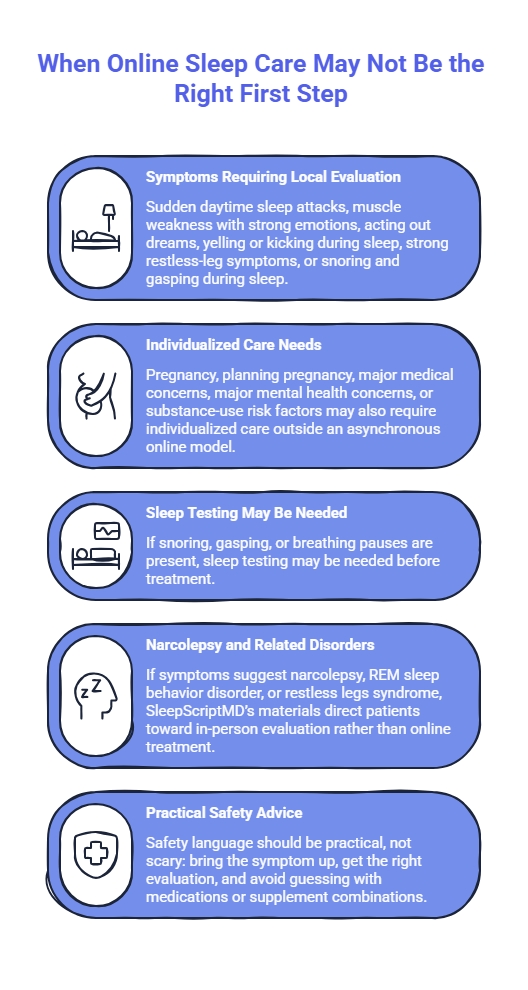
Online sleep care is not the right first step for every sleep concern. Some symptoms need local, in-person, or specialist evaluation before medication is considered.
Symptoms that may require local evaluation include sudden daytime sleep attacks, muscle weakness with strong emotions, acting out dreams, yelling or kicking during sleep, strong restless-leg symptoms, or snoring and gasping during sleep. Pregnancy, planning pregnancy, major medical concerns, major mental health concerns, or substance-use risk factors may also require individualized care outside an asynchronous online model.
This does not mean something is automatically wrong. It means the symptom pattern needs the right level of evaluation.
If snoring, gasping, or breathing pauses are present, sleep testing may be needed before treatment. If symptoms suggest narcolepsy, REM sleep behavior disorder, or restless legs syndrome, SleepScriptMD’s materials direct patients toward in-person evaluation rather than online treatment.
Safety language should be practical, not scary: bring the symptom up, get the right evaluation, and avoid guessing with medications or supplement combinations.
What to Do Next
Start with the checklist. Track sleep timing, melatonin timing, caffeine, racing thoughts, awakenings, light exposure, noise exposure, current medications, alcohol, supplements, and any snoring or gasping symptoms.
Then discuss the pattern with a licensed clinician. The goal is not to prove that melatonin “failed.” The goal is to understand what is keeping sleep from happening after the shift.
Eligible adults who want physician-reviewed, non-controlled sleep care can begin SleepScriptMD’s secure intake where care is available and clinically appropriate. State requirements may vary, so asynchronous care depends on location and eligibility.
Cost questions can be reviewed on the SleepScriptMD Pricing page.
FAQs
Why does melatonin not help sleep after night shifts?
Melatonin may help with some sleep-timing issues, but it may not address the full “wired but tired” pattern. Racing thoughts, stress activation, caffeine timing, light exposure, daytime noise, and persistent insomnia can all interfere with sleep after a night shift.
Are racing thoughts after a night shift the same as anxiety?
Not necessarily. Racing thoughts can come from post-shift activation, stress, schedule mismatch, anxiety, insomnia, or another sleep-related pattern. A clinician can help sort out what is most likely based on symptoms, timing, health history, and safety factors.
What should a night shift worker tell a sleep clinician?
Useful details include shift schedule, attempted bedtime, actual sleep duration, melatonin timing, caffeine cutoff, racing thoughts, body tension, awakenings, current medications, alcohol use, supplements, and any snoring or gasping symptoms.
Can SleepScriptMD prescribe Ambien or Xanax for night-shift sleep?
No. SleepScriptMD does not prescribe controlled substances, including benzodiazepines or Z-drugs such as Ambien or Lunesta. Its care model focuses on non-controlled sleep medication options for eligible adults after clinician review.
When is online sleep care not enough?
Online sleep care may not be enough when symptoms suggest possible narcolepsy, REM sleep behavior disorder, restless legs syndrome, sleep apnea, pregnancy-related concerns, major medical concerns, major mental health concerns, or substance-use risk factors. In those cases, local evaluation or testing may be the safer first step.
Conclusion
Melatonin not being enough after night shifts does not mean there are no options. It means the sleep problem may involve more than timing.
The next step is to look at the full pattern: when sleep is attempted, what keeps the body activated, what disrupts daytime rest, and what safety factors need review. For some eligible adults, a non-controlled prescription option may be part of that clinician-guided conversation. For others, testing or local evaluation may be the safer first move.
The strongest next step is not guessing. It is bringing clear information to a licensed clinician.
Disclaimer: This article is for general informational purposes only and does not constitute medical advice, diagnosis, or treatment. Readers should consult a licensed healthcare professional for guidance specific to their health, symptoms, medications, or treatment options.
Our Editorial Process:
Our expert team uses AI tools to help organize and structure our initial drafts. Every piece is then extensively rewritten, fact-checked, and enriched with first-hand insights and experiences by expert humans on our Insights Team to ensure accuracy and clarity.
About the SleepScriptMD Insights Team:
The SleepScriptMD Insights Team is our dedicated engine for synthesizing complex topics into clear, helpful guides. While our content is thoroughly reviewed for clarity and accuracy, it is for informational purposes and should not replace professional advice.