
📌 Key Takeaways
The author recommends planning each dose backward from the next alertness deadline, using the prescription instructions and your sleep window.
- Plan Backward From Alertness: The author recommends finding your next duty first, then checking whether the prescribed sleep window still fits.
- Never Judge By Feeling: Feeling awake cannot prove that alcohol, medication, fatigue, or caffeine-related impairment has cleared.
- Impairment Rules Out Driving: The author recommends arranging other transportation when drowsiness, dizziness, slow thinking, or poor coordination affects you.
- Check Every Sedating Product: The author recommends reviewing alcohol, medicines, antihistamines, nighttime products, cannabis, and other substances before changing the routine.
- Changed Days Need Guidance: When the schedule no longer fits, the author recommends contacting the prescriber or pharmacist before changing dose timing.
Protect sleep now and full alertness later.
Night-shift workers using sleep prescriptions will spot unsafe schedule changes, preparing them for the detailed planning guide below.
~ ~ ~ ~ ~ ~ ~ ~ ~ ~ ~ ~ ~ ~ ~ ~ ~ ~
A non-addictive sleep medication —such as Trazodone, Hydroxyzine, or Clonidine—may be part of the plan for resting after a night shift, but the decision cannot be separated from the rest of the day. A noon appointment, school pickup, overtime callback, drink after work, or earlier return shift can shorten the time available before you must be alert again.
Before following the usual routine, identify the next time you must function clearly and confirm that the established medication plan still leaves enough uninterrupted time for sleep and waking recovery. Avoid alcohol when instructed, do not drive while impaired, and never change the prescribed dose or timing simply because the day’s schedule changed.
The central question is whether the established plan still fits today’s responsibilities.
What You Will Learn
This guide explains how to account for:
- The next time you must be fully alert
- Medication-specific sleep-window requirements
- Alcohol and other products that may increase drowsiness
- Driving and safety-sensitive work
- Overtime, rotating shifts, and unexpected responsibilities
- Environmental factors that reduce actual sleep time
It also includes a reverse-planning framework, a quick-reference table, and a readiness checklist.
Find the Next Alertness Deadline Before Taking a Sleep Prescription
The time you must next function clearly matters as much as the time you clock out. That moment is your alertness deadline.
Your alertness deadline might be:
- A commute
- An appointment
- A childcare responsibility
- An on-call obligation
- A return to work
- Any task involving driving, machinery, patient care, or public safety
A protected sleep window is the uninterrupted period available for sleep before that deadline. It is not a universal number of hours. The appropriate opportunity depends on the medication instructions, established treatment plan, and individual response.
FDA-approved instructions illustrate how widely these requirements can differ. For instance, the non-controlled bedtime insomnia medications prescribed by SleepScriptMD typically direct patients to allow seven to eight hours before their planned waking time. Other bedtime insomnia medications direct patients to allow seven to eight hours before the planned waking time. These are examples from specific medication labels—not general instructions for every sleep prescription.
Work backward rather than starting automatically from clock-out:
Next alertness deadline → protected waking period → planned sleep window → prescribed medication timing
The protected waking period is the transition between waking and the next responsibility. It gives you time to assess your thinking, balance, coordination, and focus before driving or beginning demanding work.
For example, a 7 a.m. clock-out followed by an open afternoon provides a different sleep opportunity than a 7 a.m. clock-out followed by a noon appointment. The second schedule may not leave enough time for the established plan.
One Medication-Specific Rule
Use the prescription label and medication guide as the controlling instructions for alcohol, minimum sleep time, missed doses, driving, and other sedating products. When those instructions do not clearly address a changed schedule or unusual situation, contact the prescriber or pharmacist before changing the dose or timing.
Avoid Alcohol When Directed
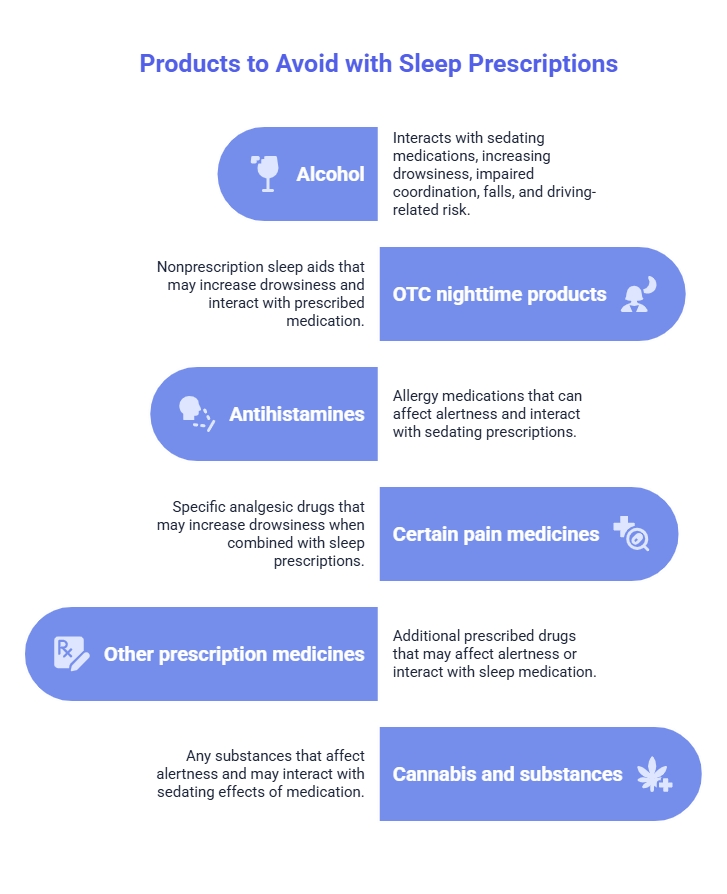
Alcohol can interact with medications, especially those with sedating effects. Combining alcohol with certain medicines may increase drowsiness, impaired coordination, falls, and driving-related risk. The exact interaction depends on the medication.
For example, if a worker finishes the final night shift of the week and has a social drink before going home. The statement “it was only one drink” does not determine whether taking, delaying, or omitting the prescription would be appropriate. How alert the person feels also cannot rule out an interaction.
If alcohol has already been consumed, use the medication-specific rule above. Do not estimate safety solely from the number of drinks, the time since the last drink, or your subjective sense of alertness.
The same principle applies to other products that may increase drowsiness. These can include:
- OTC nighttime products
- Antihistamines
- Certain pain medicines
- Other prescription medicines
- Cannabis or other substances that affect alertness
Check active ingredients rather than assuming that a nonprescription product is automatically compatible with a prescription.
Do Not Drive or Perform Safety-Sensitive Work While Impaired
Medication-related impairment involves more than feeling ready to fall asleep. It may include:
- Dizziness
- Slowed reaction time
- Reduced focus
- Unsteadiness
- Poor coordination
- Difficulty thinking clearly
The FDA advises that some prescription and nonprescription medicines can interfere with driving and that the effects of some sleep medicines may continue into the next day. No single waiting period makes every medication safe for every person. Furthermore, individual factors like age, metabolism, and kidney function can extend how long a medication remains active in your system, which is why following individualized prescriber guidance is safer than relying on a generalized timeline.
Residual drowsiness means sleepiness, slowed thinking, dizziness, poor coordination, or reduced concentration that remains after waking.
Safety-sensitive work includes any task requiring full alertness, quick reflexes, or continuous focus, such as operating machinery, driving professionally, providing clinical care, working at heights, or responding to emergencies.
Do not drive or perform safety-sensitive work while drowsy, dizzy, slowed, unfocused, unsteady, or otherwise impaired.
Night-work fatigue can compound the problem. NIOSH notes that nonstandard schedules can disrupt or shorten sleep and that fatigue can slow reaction time, reduce attention, limit short-term memory, and impair judgment. These effects do not prove that a medication caused the impairment; they show why both the work schedule and the medication plan matter.
For example, a worker starting a new prescription may have a long commute after the first daytime sleep period. Because they do not yet know how alert they will feel after waking, they should arrange alternative transportation in advance. Simply feeling “not asleep” does not establish driving fitness.
Shift Changes Can Make the Established Plan Stop Fitting
A changed shift does not guarantee that the same medication timing will remain appropriate. Rotating schedules, overtime, callbacks, early appointments, and family responsibilities can move the next alertness deadline closer to the planned sleep period.
For example, a worker who normally sleeps after a 7 a.m. clock-out may suddenly have a noon appointment. That appointment substantially shortens the protected sleep window. The worker should not redesign the prescription schedule independently to make the day fit.
Similarly, a worker who finishes several night shifts and then rotates to evening work may find that the usual medication time now falls too close to the next commute or shift. Map the new alertness deadline and compare it with the established plan before taking the medication.
Overtime, callbacks, and split sleep can create the same problem by reducing uninterrupted rest. Treat every non-negotiable responsibility—including childcare, driving, appointments, equipment operation, and returning to work—as an alertness deadline.
Alcohol, Driving, and Timing at a Glance
Situation | What It Changes | Appropriate Next Step |
|---|---|---|
Alcohol was consumed | Medication-specific alcohol precautions may apply | Use the alcohol and missed-dose instructions provided with the medication |
A drive or safety-sensitive task is approaching | The task requires full functional alertness | Do not perform the task while impaired |
Overtime or an appointment shortened sleep | The established sleep window may no longer exist | Compare the remaining time with the medication’s required sleep window |
Another product may cause drowsiness | Sedating effects may add together | Review its active ingredients and include it in your medication history |
The prescription is new or feels different | Waking effects may be unfamiliar | Arrange transportation and avoid safety-sensitive duties until the response is understood |
The schedule changed substantially | The original timing plan may no longer fit | Obtain medication-specific guidance before altering the plan |
Other Factors Can Reduce the Real Sleep Opportunity
A schedule may appear adequate on paper while providing fragmented sleep in practice. Bright morning light, household noise, heat, deliveries, phone calls, pets, and family demands can reduce the sleep you actually obtain.
Caffeine taken too close to the intended sleep period may make daytime sleep harder. Caffeine after waking may increase the feeling of alertness, but it cannot prove that medication-related or fatigue-related impairment has cleared.
Protect the planned sleep period by:
- Darkening the room
- Reducing noise and interruptions
- Silencing nonessential notifications
- Maintaining a comfortable temperature
- Setting clear household expectations
- Completing necessary errands before the planned dose
These measures support the sleep opportunity but do not change the medication’s prescribed instructions.
Before You Take the Dose: Readiness Checklist
Use this checklist to identify whether anything important has changed. It is not an automated take-or-skip tool.
- Medication instructions: What sleep window, alcohol precautions, driving restrictions, and missed-dose directions apply?
- Alcohol: Has alcohol been consumed during or after the shift?
- Other products: Have you used another prescription, OTC medicine, antihistamine, nighttime product, or substance that may cause drowsiness?
- Alertness deadline: When is the next drive, work period, childcare duty, appointment, or safety-sensitive task?
- Protected sleep window: How much uninterrupted time is realistically available before that deadline?
- Waking buffer: Is there time after waking to assess concentration, balance, coordination, and reaction speed?
- Medication familiarity: Is the prescription new, or has its effect on waking alertness changed?
- Schedule change: Has overtime, a callback, rotation, or unexpected responsibility altered the day?
- Transportation: Is a safe alternative available if you wake feeling impaired?
- Independent adjustment: Are you considering changing the dose or timing without medication-specific guidance?
A shortened sleep window, alcohol use, an additional sedating product, or an unfamiliar response signals that the routine plan may not fit. It does not generate the same medication decision for every person.
When to Contact the Prescriber or Pharmacist
Seek medication-specific guidance when:
- The available sleep window no longer meets the instructions
- Alcohol was consumed and the directions do not clearly address the situation
- You added another product that may cause drowsiness
- The prescription is new
- Medication effects have changed
- Residual drowsiness, dizziness, slowed thinking, or poor coordination interferes with waking responsibilities
- You are considering changing the dose or timing
Medication-management questions are a routine part of individualized care. Asking one does not mean that the prescription is inherently unsafe.
Existing SleepScriptMD patients can use the secure returning-patient pathway to report side effects or request a refill, dose review, or medication change. A request remains subject to clinical review.
When Local Evaluation Is More Appropriate
Symptoms that suggest narcolepsy, REM sleep behavior disorder, or restless legs syndrome requiring an active medical evaluation fall outside routine online insomnia treatment.
Seek local assessment when symptoms include:
- Unexpected daytime sleep episodes
- Muscle weakness triggered by strong emotions
- Sleep paralysis accompanied by other narcolepsy symptoms
- Yelling, kicking, punching, or physically acting out dreams
- A persistent urge to move the legs while resting
- Leg symptoms that may require iron, kidney, blood sugar, or vitamin testing
These concerns may require an in-person clinician, laboratory testing, or an overnight sleep study.
How SleepScriptMD Approaches Medication-Supported Sleep
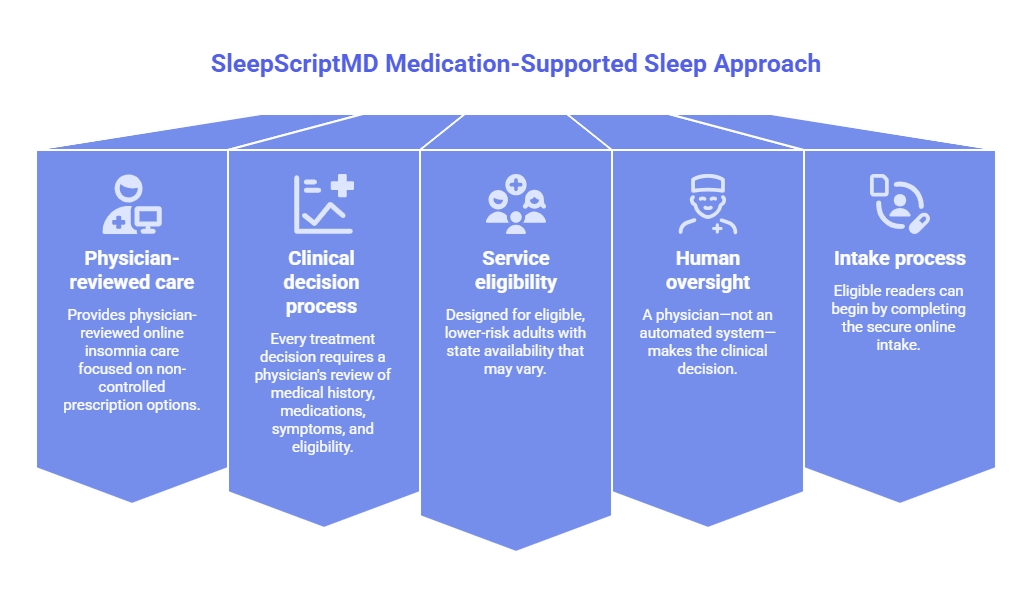
SleepScriptMD provides physician-reviewed online insomnia care focused on non-controlled prescription options. Every treatment decision requires a physician’s review of the patient’s medical history, current medications, symptoms, and eligibility.
The service is designed for eligible, lower-risk adults. A physician—not an automated system—makes the clinical decision, and state availability may vary.
Eligible readers can begin by completing the secure online intake. Starting an intake does not guarantee that a particular medication will be prescribed.
Frequently Asked Questions
Can alcohol be used after a night shift when taking sleep medication?
Some medications carry alcohol precautions because combining them with alcohol may increase drowsiness or impairment. Use the alcohol and missed-dose instructions supplied with your specific prescription rather than estimating safety from how alert you feel.
What if the shift changes and there is less time to sleep?
Identify the next alertness deadline and compare the remaining uninterrupted sleep opportunity with the established instructions. Do not compress the sleep window or redesign the medication timing independently.
Can caffeine make it safe to drive after sleep medication?
No. Caffeine may make you feel more awake, but it cannot confirm that medication-related or fatigue-related impairment has cleared. Driving requires actual functional alertness.
Should a prescription automatically be skipped when the sleep window changes?
Not necessarily. Taking, delaying, or omitting a dose is medication-specific. Use the applicable instructions rather than adopting a universal rule.
Protect Both the Sleep Period and the Next Alertness Period
Do not follow a sleep-prescription routine on autopilot when the day has changed.
Start with the next alertness deadline. Work backward to determine the realistic sleep window and waking buffer. Account for alcohol, other sedating products, transportation, and any changes to the work or family schedule.
Avoid driving while impaired, and do not change the prescribed dose or timing simply to force the medication plan into a shortened day.
A workable plan must protect both the sleep period and the next time full alertness is required.
Eligible readers can start a physician-reviewed intake through SleepScriptMD.
Sources
- U.S. Food and Drug Administration: Some Medicines and Driving Don’t Mix
- CDC/NIOSH: Fatigue and Work
- National Institute on Alcohol Abuse and Alcoholism: Alcohol-Medication Interactions
Disclaimer: This article is for general informational purposes only and does not constitute medical advice, diagnosis, or treatment. Consult a licensed health care professional for guidance specific to your health, symptoms, medications, work responsibilities, or treatment options.
Our Editorial Process:
Our expert team uses AI tools to help organize and structure our initial drafts. Every piece is then extensively rewritten, fact-checked, and enriched with first-hand insights and experiences by expert humans on our Insights Team to ensure accuracy and clarity.
By: SleepScriptMD Insights Team
Reviewed by: David Danish, MD, Chief Psychiatric Officer, and Peter Kelly, DO, Chief Medical Officer. Dr. Danish is double board-certified in adult and child/adolescent psychiatry, and Dr. Kelly is a board-certified family medicine physician with over 10 years of clinical practice.