
📌 Key Takeaways
The author recommends linking medication timing to your alertness deadline, not just your planned sleep time.
- Track the Full Timeline: Record medication, sleep, waking, commute, and work times so your clinician can see the real pattern.
- Do Not Self-Adjust: The author advises against changing dose or timing without a licensed clinician, because several factors may cause grogginess.
- Treat Impairment Seriously: If alertness, balance, or judgment remain impaired, the author recommends avoiding driving and safety-sensitive work.
- Non-Controlled Still Sedates: Trazodone, hydroxyzine, and clonidine can still cause drowsiness, dizziness, or slower thinking after waking.
- Off-Label Needs Context: Off-label sleep use does not mean the FDA confirmed safety or effectiveness for insomnia.
Safe sleep plans protect wakefulness, not just sleep.
Night-shift workers with pre-shift grogginess will use these takeaways to prepare for the clinician discussion that follows below.
~ ~ ~ ~ ~ ~ ~ ~ ~ ~ ~ ~ ~ ~ ~ ~ ~ ~
Your alarm sounds at 5:00 p.m. for a 7:00 p.m. shift, but your thinking still feels slow and your commute begins in less than an hour. For a night-shift worker, “morning” grogginess may occur in the late afternoon or evening.
Sleep inertia is the temporary period of reduced alertness, slower thinking, and impaired performance that can occur immediately after waking. It usually improves as wakefulness builds. However, grogginess that persists into commute or work-preparation time may require a closer look at medication effects, sleep duration, schedule changes, or other contributing factors.
Feeling foggy after waking does not identify a single cause. Medication effects, limited sleep opportunity, delayed sleep onset, interruptions, rotating schedules, and other sedating substances may all matter. This guide explains how to build a sleep-to-shift timeline, document functional effects, and prepare focused questions for a prescribing clinician.
Important safety guidance: Continue taking prescription medication exactly as directed unless a licensed clinician advises otherwise. Do not independently change the dose or timing or add another sedating product. If grogginess affects attention, coordination, or judgment, arrange alternative transportation and avoid driving or safety-sensitive work until normal functioning returns.
Sleep Medication Timing for Night-Shift Workers Who Need to Be Alert
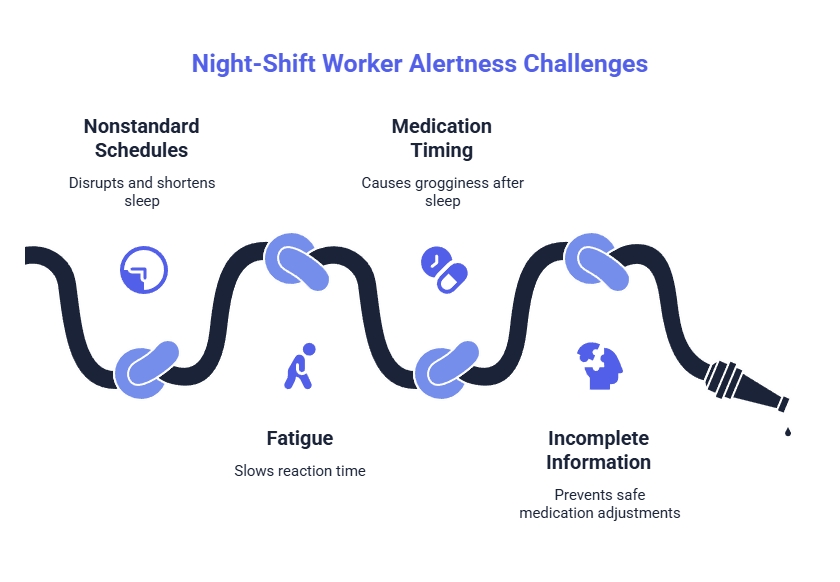
Wake time is not always the same as work-readiness. The more useful endpoint is the earliest time you must be safely alert enough to commute, make decisions, operate equipment, provide care, or perform other demanding tasks.
The CDC’s National Institute for Occupational Safety and Health notes that nonstandard schedules can disrupt or shorten sleep. Fatigue may slow reaction time, reduce attention, limit short-term memory, and impair judgment.
Work backward from the required alertness point:
Required alertness → commute and responsibilities → final wake time → actual sleep → sleep attempt → medication taken as prescribed
Consider a worker with a stable overnight schedule. They end their shift at 7:00 a.m., take their prescribed medication after arriving home, fall asleep later than intended, and wake up to a late-afternoon alarm. The commute starts soon afterward.
That sequence does not prove that the medication caused the grogginess. It does show why a suggestion such as “take it earlier” cannot be applied safely without considering the exact prescription, the available sleep period, the person’s health history, and the next required alert time.
A clinician needs the full sequence before deciding whether medication timing, dose, medication fit, sleep duration, or another sleep concern should be reassessed.
Build a Sleep-to-Shift Timeline From What Actually Happened
Record actual events rather than the schedule you intended to follow. Include:
- When the medication was taken
- When you tried to sleep
- When sleep probably began
- Any awakenings
- Your final wake time
- The time you needed to leave home
- The time you needed to be fully alert
Sleep opportunity is the total amount of time available for sleep. Actual sleep may be shorter because of delayed sleep onset, daylight, noise, caregiving responsibilities, temperature, or repeated awakenings.
Residual drowsiness means sleepiness, mental slowing, dizziness, or reduced coordination that continues after waking and interferes with normal functioning. It is different from simply wishing you had slept longer.
Record information in real time when possible. Notes entered shortly after waking or before leaving for work are usually more reliable than details reconstructed several days later.
Also document variables that may change the picture, including:
- Stable versus rotating schedules
- Late-shift caffeine
- Alcohol or cannabis
- OTC sleep products or antihistamines
- Supplements
- Other prescription medications
- Daytime interruptions
- Recent medication additions
A rotating schedule should be documented with separate timelines. A worker completing two overnight shifts followed by an evening shift has different sleep opportunities and alertness deadlines on each day. Combining those days into a single average can hide the pattern a clinician needs to see.
Shift-to-Sleep Timing Review Worksheet
Item to record | Example format | Why the clinician may ask |
|---|---|---|
Shift ended | 7:00 a.m. | Establishes the transition from work to sleep |
Medication taken | Actual time | Places medication use within the real timeline |
Tried to sleep | Actual time | Separates medication time from sleep attempt |
Estimated sleep onset | Approximate time | Shows how much sleep opportunity remained |
Awakenings | Number and duration | Adds sleep-continuity context |
Final wake time | Actual time | Marks the end of the sleep period |
Must leave home | Actual time | Identifies the commute deadline |
Shift starts | Actual time | Identifies the work-readiness deadline |
Grogginess | Mild, moderate, or strong; duration | Describes intensity and persistence |
Other substances | Caffeine, alcohol, cannabis, OTC products, prescriptions | Provides medication and interaction context |
Schedule type | Stable or rotating | Shows how much the timing varies |
Safety impact | Balance, concentration, driving, routine tasks | Describes the functional significance |
The worksheet organizes a clinical discussion. It does not diagnose the cause of grogginess or calculate a new medication schedule.
How Non-Controlled Options May Enter the Discussion
“Non-controlled” refers to a medication’s classification under controlled-substance laws. Many telehealth platforms prioritize these options to minimize dependence risks and adhere to remote prescribing regulations. However, this classification does not mean a medication is side-effect-free, appropriate for everyone, or incapable of affecting driving or work performance.
Current DailyMed records list the cited trazodone, hydroxyzine, and clonidine tablets as DEA Schedule “None.” When these medications are used for sleep, the discussion may involve off-label prescribing.
Off-label use means that an approved medication is prescribed for a purpose that does not appear in its FDA-approved labeling. The cited trazodone label lists major depressive disorder, hydroxyzine lists uses including anxiety and pruritus, and clonidine lists hypertension rather than insomnia.
Clinicians may prescribe an approved medication for an unapproved use when they determine that it is medically appropriate. However, off-label use should not be interpreted as FDA confirmation that the medication is safe and effective for that specific purpose.
Medication | What current labeling supports | Timing-review focus | Claims to avoid |
|---|---|---|---|
Trazodone | May cause somnolence or sedation and impair abilities needed for hazardous tasks | Residual drowsiness, actual sleep window, other central nervous system depressants, and work-readiness | “Best for staying asleep,” guaranteed clear mornings, or universally first-line |
Hydroxyzine | Drowsiness may occur; alcohol and other central nervous system depressants may increase its effects | Functional drowsiness, other sedating substances, and the commute deadline | “Best for racing thoughts,” always worn off before work, or appropriate for everyone |
Clonidine | Sedation and dizziness may affect driving or machinery; alcohol and other sedating drugs may increase the effect | Dizziness, sedation, blood-pressure history, other medications, and required alertness | “Best for hyperarousal,” no morning grogginess, or universally safe for shift workers |
This table is not a medication ranking. A report of racing thoughts, repeated waking, or feeling “wired” may help describe the sleep pattern, but it does not determine which prescription is appropriate.
A clinician considers the full sleep pattern, medical history, other medications, available sleep time, and required alertness before discussing possible options.
Questions to Bring to the Prescribing Clinician
A clear, clock-based record helps a clinician understand a reversed schedule without forcing it into a conventional nighttime routine. Bring several recent timelines and a complete list of prescriptions, OTC products, supplements, alcohol use, and cannabis use.
- Could the current prescription or its timing contribute to pre-shift grogginess?
- Is the actual sleep opportunity compatible with the current medication plan?
- Does a rotating or inconsistent schedule change how the plan should be evaluated?
- What features distinguish ordinary sleep inertia from persistent impairment that needs reassessment?
- Could another prescription, OTC product, supplement, alcohol, or cannabis be adding to the drowsiness?
- How should mild sleepiness be distinguished from clinically significant functional impairment?
- What safety plan should be followed when alertness has not returned before the commute or shift?
- When should the medication plan or overall treatment approach be reconsidered?
- What benefits, limitations, and alternatives should be discussed when a medication is used off-label for sleep?
- Which details should be tracked before the next follow-up?
The answer may involve medication timing, dose, medication choice, sleep duration, another substance, or an unrelated sleep concern. The timeline helps the clinician identify which part of the sequence deserves attention.
Reporting a side effect is a normal part of medication management. It does not automatically mean that treatment has failed or that care will be withdrawn. Persistent grogginess should be described accurately rather than silently accepted or managed through unsupervised experimentation.
Request a Prompt Review When Grogginess Affects Work-Readiness
Contact the prescribing clinician when grogginess:
- Repeatedly extends into commute or shift-preparation time
- Interferes with concentration, balance, coordination, or routine tasks
- Becomes stronger or lasts longer over time
- Appears after another medication or sedating product is added
- Occurs when the available sleep period has become shorter
- Changes unpredictably across a rotating schedule
Consider a worker who uses a prescribed medication and an OTC antihistamine before daytime sleep, then wakes with stronger-than-usual fogginess. The combination does not prove the cause, but both products should be included in the medication review.
Severe, rapidly worsening, or otherwise concerning symptoms require urgent medical evaluation.
Practical Pre-Shift Check
Before leaving for work, ask:
- Have alertness, balance, and routine task performance returned to normal?
- Was alcohol, cannabis, an antihistamine, or another potentially sedating product used?
- Was the sleep opportunity originally discussed with the clinician actually available?
- Is the grogginess improving, unchanged, or becoming stronger?
- Has a new prescription, OTC product, or supplement recently been added?
- Does the current schedule differ from the schedule used when the treatment plan was created?
The purpose of this check is to identify useful information for the clinician and recognize when normal work-readiness has not returned.
How Telehealth Eligibility Criteria Affect the Next Step
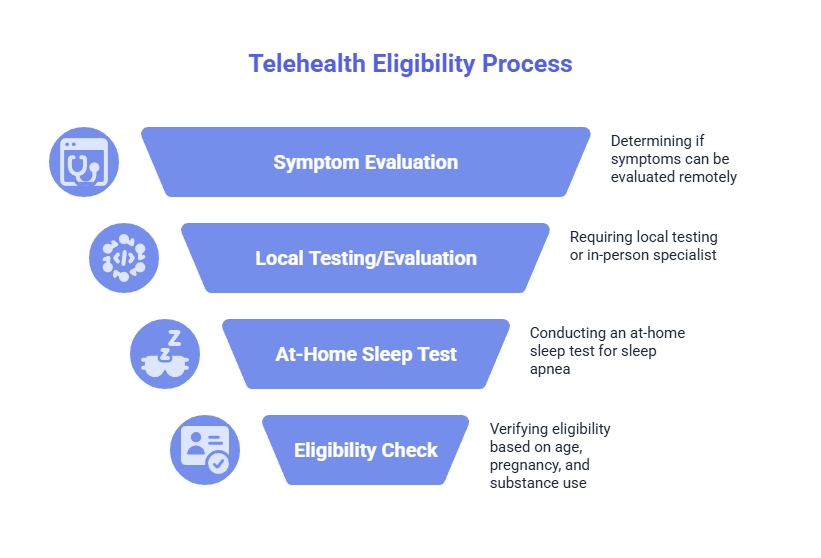
General telehealth safety principles are followed by each platform’s specific treatment criteria. Before beginning care, patients should understand which symptoms can be evaluated remotely and which require local testing or an in-person specialist.
Under SleepScriptMD’s supplied criteria, suspected narcolepsy, acting out dreams during sleep, and active restless-legs concerns require appropriate local evaluation. Potential untreated sleep apnea requires an at-home sleep test before treatment can begin.
SleepScriptMD’s virtual treatment pathway is also not intended for minors, people who are pregnant or breastfeeding, or patients seeking controlled substances. Eligibility and prescribing decisions remain subject to an individual clinical review.
These criteria are service-specific safeguards. They should not be interpreted as universal diagnostic rules for every healthcare platform.
Frequently Asked Questions
Should sleep medication be taken earlier before daytime sleep?
The appropriate timing depends on the prescription instructions, actual sleep opportunity, other substances, health history, and required alertness time. A sleep-to-shift timeline gives the prescriber the information needed to evaluate the current plan.
Can a non-controlled sleep medication still cause grogginess?
Yes. Non-controlled status does not eliminate the possibility of drowsiness, sedation, dizziness, or cognitive and motor impairment. Current labels for trazodone, hydroxyzine, and clonidine contain cautions relevant to alertness and hazardous activities.
Is all post-waking grogginess considered sleep inertia?
No. Sleep inertia is the temporary reduction in alertness that occurs during the transition from sleep to wakefulness. Grogginess that is unusually strong, persists for an extended period, or repeatedly interferes with normal functioning deserves clinical review.
What should be tracked before talking to a clinician?
Record medication time, sleep attempt, estimated sleep onset, awakenings, final wake time, commute deadline, shift start, grogginess intensity and duration, schedule type, functional effects, and other substances. Real-time notes are generally more useful than estimates made several days later.
When should grogginess be reported?
Report it when it repeatedly affects work-readiness, persists longer than expected, worsens, creates functional impairment, or begins after a medication, supplement, or schedule change.
What to Do Next
Bring the worksheet, clinician questions, and complete medication list to a licensed healthcare professional. A detailed timeline is more informative than a general statement such as “the medication makes me groggy.”
Eligible, low-risk adults may explore clinician-supervised telehealth care, but a prescription is not guaranteed. Suitability depends on health history, current medications, symptoms, available sleep time, and the clinician’s assessment.
Existing SleepScriptMD patients can use the returning-patient pathway to report side effects or request a medication review. New patients can review the non-controlled sleep medication options offered by the service. SleepScriptMD states that it does not prescribe benzodiazepines or Z-drugs; this describes the platform’s treatment scope rather than providing independent evidence about a particular medication.
A useful sleep plan must account for more than the ability to fall asleep. It must also preserve enough time for alertness, coordination, and judgment to return before commuting or beginning work. A precise sleep-to-shift timeline gives the prescribing clinician the information needed to evaluate that balance.
Treatment and prescription decisions remain subject to clinical review and eligibility.
Disclaimer: This article is for general informational purposes only and does not constitute medical advice, diagnosis, or treatment. Consult a licensed healthcare professional for guidance specific to your symptoms, medications, health history, and treatment options.
Our Editorial Process:
Our expert team uses AI tools to help organize and structure our initial drafts. Every piece is then extensively rewritten, fact-checked, and enriched with first-hand insights and experiences by expert humans on our Insights Team to ensure accuracy and clarity.
About the SleepScriptMD Insights Team:
The SleepScriptMD Insights Team is our dedicated engine for synthesizing complex topics into clear, helpful guides. While our content is thoroughly reviewed for clarity and accuracy, it is for informational purposes and should not replace professional advice.